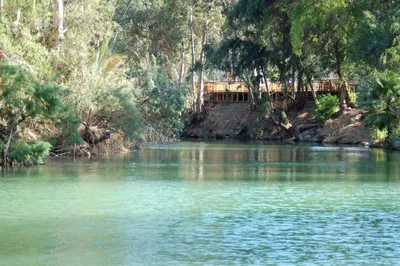
When Jesus travelled from Galilee to Judea, it is likely He traveled the Jordan Rift Valley. This was the easiest route (without going through Samaria) to get from Galilee to Judea.
The Jordan River flows through the valley and gives it its name, and runs from north of Lake Huleh to the Dead Sea. The valley itself is part of a larger geologic feature called the Great Rift Valley that runs 3,700 miles, from northern Syria to northeastern Africa. At the Dead Sea, the valley is the lowest place on land at more than 1,200 feet below sea level.
The climate of the Jordan Valley changes dramatically as it moves from north to south. In the north, near Lake Huleh, the valley is fertile, and plentiful rainfall allows substantial agriculture. South of the Sea of Galilee, the valley rapidly dries out and increases in temperature. Agriculture here is only possible by using the Jordan River for irrigation. Near the Dead Sea, the temperature is too high for most agricultural activity, although some palm crops are grown, like dates and bananas.
Humans have occupied the valley for thousands of years. Jericho, at the southern end of the valley, is considered by some to be the oldest inhabited city in the world. Other cities include Bethany Beyond the Jordan, Scythopolis (Beth Shean), Bethsaida, and Caesarea Philippi. John the Baptist ministered in the valley as well. As mentioned, it is also a major thoroughfare, allowing relatively easy travel from north to south. In the New Testament, Jesus traveled the valley several times, going from Galilee to Jerusalem and back, and was baptized in the Jordan River.
The Jordan River
Site Study
| Hershel Wayne House
The Jordan River is the only major waterway between the Mediterranean and the Euphrates River. It runs north to south 223 miles through the Jordan Rift Valley, from its headwaters in the foothills of Mt. Hermon, through Lake Huleh, through the Sea of Galilee, and on to where it empties into the Dead Sea. Over its course it falls 2885 feet in elevation, from 1500 ft. above sea level at its headwaters to 1385 feet below sea level at its mouth.
Due to the geography and climate of the area, the Jordan was subject to rapid fluctuations in flow during ancient times. From the Sea of Galilee south, the climate of the Jordan River Valley dries dramatically. With very little vegetation to hold excess water, heavy rains resulted in flash flooding in the canyons prevalent along the slopes of the valley. These flash floods swelled the amount of water flowing into the Jordan, and in turn the Jordan’s water level rapidly rose. Because of this, crossing the River ranged from fairly easy to very dangerous.
Although there are no major cities at the Jordan river, several important towns were located in the valley near the river, including Jericho in the south and Scythopolis (Beth Shean) further north, Bethsaida north of the Sea of Galilee, and Caesarea Philippi near one of the streams that form the headwaters of the Jordan.
Although there are few cities in the region of the Jordan River, it has been the scene of countless historical events. In the New Testament, it is the region where John the Baptist ministered, and the site of Jesus’ Baptism. Jesus undoubtedly traveled the route along the Jordan River valley between Galilee and Jerusalem.
1He entered again into the synagogue, and there was a man there whose hand was withered. 2They watched him, whether he would heal him on the Sabbath day, that they might accuse him. 3He said to the man whose hand was withered, “Stand up.”4He said to them, “Is it lawful on the Sabbath day to do good or to do harm? To save a life or to kill?” But they were silent. 5When he had looked around at them with anger, being grieved at the hardening of their hearts, he said to the man, “Stretch out your hand.” He stretched it out, and his hand was restored as healthy as the other. 6The Pharisees went out, and immediately conspired with the Herodians against him, how they might destroy him.
7Jesus withdrew to the sea with his disciples; and a great multitude followed him from Galilee, from Judea, 8from Jerusalem, from Idumaea, beyond the Jordan, and those from around Tyre and Sidon. A great multitude, hearing what great things he did, came to him. 9He spoke to his disciples that a little boat should stay near him because of the crowd, so that they wouldn’t press on him. 10For he had healed many, so that as many as had diseases pressed on him that they might touch him. 11The unclean spirits, whenever they saw him, fell down before him and cried, “You are the Son of God!” 12He sternly warned them that they should not make him known.
13He went up into the mountain and called to himself those whom he wanted, and they went to him. 14He appointed twelve, that they might be with him, and that he might send them out to preach 15and to have authority to heal sicknesses and to cast out demons: 16Simon (to whom he gave the name Peter); 17James the son of Zebedee; and John, the brother of James, (whom he called Boanerges, which means, Sons of Thunder); 18Andrew; Philip; Bartholomew; Matthew; Thomas; James, the son of Alphaeus; Thaddaeus; Simon the Zealot; 19and Judas Iscariot, who also betrayed him.
Then he came into a house. 20The multitude came together again, so that they could not so much as eat bread. 21When his friends heard it, they went out to seize him; for they said, “He is insane.” 22The scribes who came down from Jerusalem said, “He has Beelzebul,” and, “By the prince of the demons he casts out the demons.”
23He summoned them and said to them in parables, “How can Satan cast out Satan? 24If a kingdom is divided against itself, that kingdom cannot stand. 25If a house is divided against itself, that house cannot stand. 26If Satan has risen up against himself, and is divided, he can’t stand, but has an end. 27But no one can enter into the house of the strong man to plunder unless he first binds the strong man; then he will plunder his house.
28“Most certainly I tell you, all sins of the descendants of man will be forgiven, including their blasphemies with which they may blaspheme; 29but whoever may blaspheme against the Holy Spirit never has forgiveness, but is subject to eternal condemnation.”30—because they said, “He has an unclean spirit.”
31His mother and his brothers came, and standing outside, they sent to him, calling him. 32A multitude was sitting around him, and they told him, “Behold, your mother, your brothers, and your sisters are outside looking for you.”
33He answered them, “Who are my mother and my brothers?”34Looking around at those who sat around him, he said, “Behold, my mother and my brothers! 35For whoever does the will of God is my brother, my sister, and mother.”