2 Chronicles 4 (WEB)

Jordan·Water

Type
Water — River
Map
View on Google Maps
Appears in

Farther Side of Jordan

Site Study | Hershel Wayne House

When Jesus travelled from Galilee to Judea, it is likely He traveled the Jordan Rift Valley. This was the easiest route (without going through Samaria) to get from Galilee to Judea. 

The Jordan River flows through the valley and gives it its name, and runs from north of Lake Huleh to the Dead Sea. The valley itself is part of a larger geologic feature called the Great Rift Valley that runs 3,700 miles, from northern Syria to northeastern Africa. At the Dead Sea, the valley is the lowest place on land at more than 1,200 feet below sea level. 

The climate of the Jordan Valley changes dramatically as it moves from north to south. In the north, near Lake Huleh, the valley is fertile, and plentiful rainfall allows substantial agriculture. South of the Sea of Galilee, the valley rapidly dries out and increases in temperature. Agriculture here is only possible by using the Jordan River for irrigation. Near the Dead Sea, the temperature is too high for most agricultural activity, although some palm crops are grown, like dates and bananas. 

Humans have occupied the valley for thousands of years. Jericho, at the southern end of the valley, is considered by some to be the oldest inhabited city in the world. Other cities include Bethany Beyond the Jordan, Scythopolis (Beth Shean), Bethsaida, and Caesarea Philippi. John the Baptist ministered in the valley as well. As mentioned, it is also a major thoroughfare, allowing relatively easy travel from north to south. In the New Testament, Jesus traveled the valley several times, going from Galilee to Jerusalem and back, and was baptized in the Jordan River.
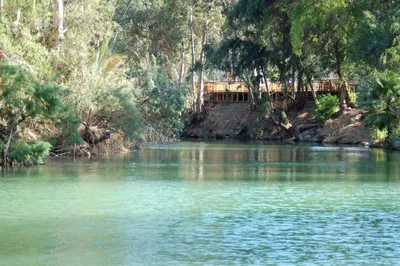
The Jordan River

Site Study | Hershel Wayne House

The Jordan River is the only major waterway between the Mediterranean and the Euphrates River. It runs north to south 223 miles through the Jordan Rift Valley, from its headwaters in the foothills of Mt. Hermon, through Lake Huleh, through the Sea of Galilee, and on to where it empties into the Dead Sea. Over its course it falls 2885 feet in elevation, from 1500 ft. above sea level at its headwaters to 1385 feet below sea level at its mouth.

Due to the geography and climate of the area, the Jordan was subject to rapid fluctuations in flow during ancient times. From the Sea of Galilee south, the climate of the Jordan River Valley dries dramatically. With very little vegetation to hold excess water, heavy rains resulted in flash flooding in the canyons prevalent along the slopes of the valley. These flash floods swelled the amount of water flowing into the Jordan, and in turn the Jordan’s water level rapidly rose. Because of this, crossing the River ranged from fairly easy to very dangerous. 

Although there are no major cities at the Jordan river, several important towns were located in the valley near the river, including Jericho in the south and Scythopolis (Beth Shean) further north, Bethsaida north of the Sea of Galilee, and Caesarea Philippi near one of the streams that form the headwaters of the Jordan.

Although there are few cities in the region of the Jordan River, it has been the scene of countless historical events. In the New Testament, it is the region where John the Baptist ministered, and the site of Jesus’ Baptism. Jesus undoubtedly traveled the route along the Jordan River valley between Galilee and Jerusalem.

Jordan River

Person & place data: Theographic Bible Metadata by Robert Rouse (Viz.Bible), CC BY-SA 4.0.
2 Chronicles 4 (WEB)

1Then he made an altar of bronze, twenty cubits long, twenty cubits wide, and ten cubits high. 2Also he made the molten sea of ten cubits from brim to brim. It was round, five cubits high, and thirty cubits in circumference. 3Under it was the likeness of oxen, which encircled it, for ten cubits, encircling the sea. The oxen were in two rows, cast when it was cast. 4It stood on twelve oxen, three looking toward the north, three looking toward the west, three looking toward the south, and three looking toward the east; and the sea was set on them above, and all their hindquarters were inward. 5It was a handbreadth thick. Its brim was made like the brim of a cup, like the flower of a lily. It received and held three thousand baths. 6He also made ten basins, and put five on the right hand and five on the left, to wash in them. The things that belonged to the burnt offering were washed in them, but the sea was for the priests to wash in.

7He made the ten lamp stands of gold according to the ordinance concerning them; and he set them in the temple, five on the right hand and five on the left. 8He made also ten tables, and placed them in the temple, five on the right side and five on the left. He made one hundred basins of gold. 9Furthermore he made the court of the priests, the great court, and doors for the court, and overlaid their doors with bronze. 10He set the sea on the right side of the house eastward, toward the south.

11Huram made the pots, the shovels, and the basins.

So Huram finished doing the work that he did for King Solomon in God’s house: 12the two pillars, the bowls, the two capitals which were on the top of the pillars, the two networks to cover the two bowls of the capitals that were on the top of the pillars, 13and the four hundred pomegranates for the two networks—two rows of pomegranates for each network, to cover the two bowls of the capitals that were on the pillars. 14He also made the bases, and he made the basins on the bases— 15one sea, and the twelve oxen under it. 16Huram-abi also made the pots, the shovels, the forks, and all its vessels for King Solomon, for Yahweh’s house, of bright bronze. 17The king cast them in the plain of the Jordan, in the clay ground between Succoth and Zeredah. 18Thus Solomon made all these vessels in great abundance, so that the weight of the bronze could not be determined.

19Solomon made all the vessels that were in God’s house: the golden altar, the tables with the show bread on them, 20and the lamp stands with their lamps to burn according to the ordinance before the inner sanctuary, of pure gold; 21and the flowers, the lamps, and the tongs of gold that was purest gold; 22and the snuffers, the basins, the spoons, and the fire pans of pure gold. As for the entry of the house, its inner doors for the most holy place and the doors of the main hall of the temple were of gold.

Jordan