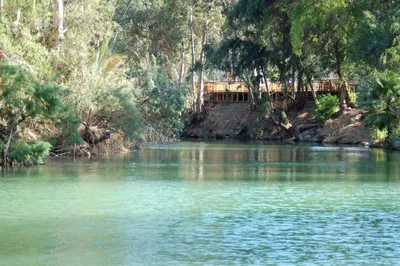
When Jesus travelled from Galilee to Judea, it is likely He traveled the Jordan Rift Valley. This was the easiest route (without going through Samaria) to get from Galilee to Judea.
The Jordan River flows through the valley and gives it its name, and runs from north of Lake Huleh to the Dead Sea. The valley itself is part of a larger geologic feature called the Great Rift Valley that runs 3,700 miles, from northern Syria to northeastern Africa. At the Dead Sea, the valley is the lowest place on land at more than 1,200 feet below sea level.
The climate of the Jordan Valley changes dramatically as it moves from north to south. In the north, near Lake Huleh, the valley is fertile, and plentiful rainfall allows substantial agriculture. South of the Sea of Galilee, the valley rapidly dries out and increases in temperature. Agriculture here is only possible by using the Jordan River for irrigation. Near the Dead Sea, the temperature is too high for most agricultural activity, although some palm crops are grown, like dates and bananas.
Humans have occupied the valley for thousands of years. Jericho, at the southern end of the valley, is considered by some to be the oldest inhabited city in the world. Other cities include Bethany Beyond the Jordan, Scythopolis (Beth Shean), Bethsaida, and Caesarea Philippi. John the Baptist ministered in the valley as well. As mentioned, it is also a major thoroughfare, allowing relatively easy travel from north to south. In the New Testament, Jesus traveled the valley several times, going from Galilee to Jerusalem and back, and was baptized in the Jordan River.
The Jordan River
Site Study
| Hershel Wayne House
The Jordan River is the only major waterway between the Mediterranean and the Euphrates River. It runs north to south 223 miles through the Jordan Rift Valley, from its headwaters in the foothills of Mt. Hermon, through Lake Huleh, through the Sea of Galilee, and on to where it empties into the Dead Sea. Over its course it falls 2885 feet in elevation, from 1500 ft. above sea level at its headwaters to 1385 feet below sea level at its mouth.
Due to the geography and climate of the area, the Jordan was subject to rapid fluctuations in flow during ancient times. From the Sea of Galilee south, the climate of the Jordan River Valley dries dramatically. With very little vegetation to hold excess water, heavy rains resulted in flash flooding in the canyons prevalent along the slopes of the valley. These flash floods swelled the amount of water flowing into the Jordan, and in turn the Jordan’s water level rapidly rose. Because of this, crossing the River ranged from fairly easy to very dangerous.
Although there are no major cities at the Jordan river, several important towns were located in the valley near the river, including Jericho in the south and Scythopolis (Beth Shean) further north, Bethsaida north of the Sea of Galilee, and Caesarea Philippi near one of the streams that form the headwaters of the Jordan.
Although there are few cities in the region of the Jordan River, it has been the scene of countless historical events. In the New Testament, it is the region where John the Baptist ministered, and the site of Jesus’ Baptism. Jesus undoubtedly traveled the route along the Jordan River valley between Galilee and Jerusalem.
1Now in the fifteenth year of the reign of Tiberius Caesar, Pontius Pilate being governor of Judea, and Herod being tetrarch of Galilee, and his brother Philip tetrarch of the region of Ituraea and Trachonitis, and Lysanias tetrarch of Abilene, 2during the high priesthood of Annas and Caiaphas, the word of God came to John, the son of Zacharias, in the wilderness. 3He came into all the region around the Jordan, preaching the baptism of repentance for remission of sins. 4As it is written in the book of the words of Isaiah the prophet,
“The voice of one crying in the wilderness,
‘Make ready the way of the Lord.
Make his paths straight.
5Every valley will be filled.
Every mountain and hill will be brought low.
The crooked will become straight,
and the rough ways smooth.
6All flesh will see God’s salvation.’”
7He said therefore to the multitudes who went out to be baptized by him, “You offspring of vipers, who warned you to flee from the wrath to come? 8Therefore produce fruits worthy of repentance, and don’t begin to say among yourselves, ‘We have Abraham for our father;’ for I tell you that God is able to raise up children to Abraham from these stones! 9Even now the ax also lies at the root of the trees. Every tree therefore that doesn’t produce good fruit is cut down and thrown into the fire.”
10The multitudes asked him, “What then must we do?”
11He answered them, “He who has two coats, let him give to him who has none. He who has food, let him do likewise.”
12Tax collectors also came to be baptized, and they said to him, “Teacher, what must we do?”
13He said to them, “Collect no more than that which is appointed to you.”
14Soldiers also asked him, saying, “What about us? What must we do?”
He said to them, “Extort from no one by violence, neither accuse anyone wrongfully. Be content with your wages.”
15As the people were in expectation, and all men reasoned in their hearts concerning John, whether perhaps he was the Christ, 16John answered them all, “I indeed baptize you with water, but he comes who is mightier than I, the strap of whose sandals I am not worthy to loosen. He will baptize you in the Holy Spirit and fire. 17His winnowing fan is in his hand, and he will thoroughly cleanse his threshing floor, and will gather the wheat into his barn; but he will burn up the chaff with unquenchable fire.”
18Then with many other exhortations he preached good news to the people, 19but Herod the tetrarch, being reproved by him for Herodias, his brother’s wife, and for all the evil things which Herod had done, 20added this also to them all, that he shut up John in prison.
21Now when all the people were baptized, Jesus also had been baptized and was praying. The sky was opened, 22and the Holy Spirit descended in a bodily form like a dove on him; and a voice came out of the sky, saying “You are my beloved Son. In you I am well pleased.”
23Jesus himself, when he began to teach, was about thirty years old, being the son (as was supposed) of Joseph, the son of Heli, 24the son of Matthat, the son of Levi, the son of Melchi, the son of Jannai, the son of Joseph, 25the son of Mattathias, the son of Amos, the son of Nahum, the son of Esli, the son of Naggai, 26the son of Maath, the son of Mattathias, the son of Semein, the son of Joseph, the son of Judah, 27the son of Joanan, the son of Rhesa, the son of Zerubbabel, the son of Shealtiel, the son of Neri, 28the son of Melchi, the son of Addi, the son of Cosam, the son of Elmodam, the son of Er, 29the son of Jose, the son of Eliezer, the son of Jorim, the son of Matthat, the son of Levi, 30the son of Simeon, the son of Judah, the son of Joseph, the son of Jonan, the son of Eliakim, 31the son of Melea, the son of Menan, the son of Mattatha, the son of Nathan, the son of David, 32the son of Jesse, the son of Obed, the son of Boaz, the son of Salmon, the son of Nahshon, 33the son of Amminadab, the son of Aram, the son of Hezron, the son of Perez, the son of Judah, 34the son of Jacob, the son of Isaac, the son of Abraham, the son of Terah, the son of Nahor, 35the son of Serug, the son of Reu, the son of Peleg, the son of Eber, the son of Shelah, 36the son of Cainan, the son of Arphaxad, the son of Shem, the son of Noah, the son of Lamech, 37the son of Methuselah, the son of Enoch, the son of Jared, the son of Mahalaleel, the son of Cainan, 38the son of Enos, the son of Seth, the son of Adam, the son of God.