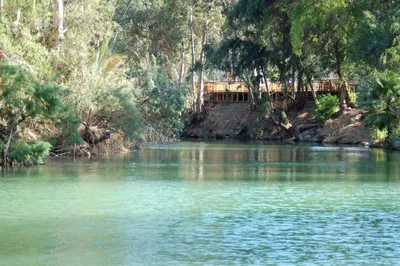
When Jesus travelled from Galilee to Judea, it is likely He traveled the Jordan Rift Valley. This was the easiest route (without going through Samaria) to get from Galilee to Judea.
The Jordan River flows through the valley and gives it its name, and runs from north of Lake Huleh to the Dead Sea. The valley itself is part of a larger geologic feature called the Great Rift Valley that runs 3,700 miles, from northern Syria to northeastern Africa. At the Dead Sea, the valley is the lowest place on land at more than 1,200 feet below sea level.
The climate of the Jordan Valley changes dramatically as it moves from north to south. In the north, near Lake Huleh, the valley is fertile, and plentiful rainfall allows substantial agriculture. South of the Sea of Galilee, the valley rapidly dries out and increases in temperature. Agriculture here is only possible by using the Jordan River for irrigation. Near the Dead Sea, the temperature is too high for most agricultural activity, although some palm crops are grown, like dates and bananas.
Humans have occupied the valley for thousands of years. Jericho, at the southern end of the valley, is considered by some to be the oldest inhabited city in the world. Other cities include Bethany Beyond the Jordan, Scythopolis (Beth Shean), Bethsaida, and Caesarea Philippi. John the Baptist ministered in the valley as well. As mentioned, it is also a major thoroughfare, allowing relatively easy travel from north to south. In the New Testament, Jesus traveled the valley several times, going from Galilee to Jerusalem and back, and was baptized in the Jordan River.
The Jordan River
Site Study
| Hershel Wayne House
The Jordan River is the only major waterway between the Mediterranean and the Euphrates River. It runs north to south 223 miles through the Jordan Rift Valley, from its headwaters in the foothills of Mt. Hermon, through Lake Huleh, through the Sea of Galilee, and on to where it empties into the Dead Sea. Over its course it falls 2885 feet in elevation, from 1500 ft. above sea level at its headwaters to 1385 feet below sea level at its mouth.
Due to the geography and climate of the area, the Jordan was subject to rapid fluctuations in flow during ancient times. From the Sea of Galilee south, the climate of the Jordan River Valley dries dramatically. With very little vegetation to hold excess water, heavy rains resulted in flash flooding in the canyons prevalent along the slopes of the valley. These flash floods swelled the amount of water flowing into the Jordan, and in turn the Jordan’s water level rapidly rose. Because of this, crossing the River ranged from fairly easy to very dangerous.
Although there are no major cities at the Jordan river, several important towns were located in the valley near the river, including Jericho in the south and Scythopolis (Beth Shean) further north, Bethsaida north of the Sea of Galilee, and Caesarea Philippi near one of the streams that form the headwaters of the Jordan.
Although there are few cities in the region of the Jordan River, it has been the scene of countless historical events. In the New Testament, it is the region where John the Baptist ministered, and the site of Jesus’ Baptism. Jesus undoubtedly traveled the route along the Jordan River valley between Galilee and Jerusalem.
1Now Jephthah the Gileadite was a mighty man of valor. He was the son of a prostitute. Gilead became the father of Jephthah. 2Gilead’s wife bore him sons. When his wife’s sons grew up, they drove Jephthah out and said to him, “You will not inherit in our father’s house, for you are the son of another woman.” 3Then Jephthah fled from his brothers and lived in the land of Tob. Outlaws joined up with Jephthah, and they went out with him.
4After a while, the children of Ammon made war against Israel. 5When the children of Ammon made war against Israel, the elders of Gilead went to get Jephthah out of the land of Tob. 6They said to Jephthah, “Come and be our chief, that we may fight with the children of Ammon.”
7Jephthah said to the elders of Gilead, “Didn’t you hate me, and drive me out of my father’s house? Why have you come to me now when you are in distress?”
8The elders of Gilead said to Jephthah, “Therefore we have turned again to you now, that you may go with us and fight with the children of Ammon. You will be our head over all the inhabitants of Gilead.”
9Jephthah said to the elders of Gilead, “If you bring me home again to fight with the children of Ammon, and Yahweh delivers them before me, will I be your head?”
10The elders of Gilead said to Jephthah, “Yahweh will be witness between us. Surely we will do what you say.”
11Then Jephthah went with the elders of Gilead, and the people made him head and chief over them. Jephthah spoke all his words before Yahweh in Mizpah.
12Jephthah sent messengers to the king of the children of Ammon, saying, “What do you have to do with me, that you have come to me to fight against my land?”
13The king of the children of Ammon answered the messengers of Jephthah, “Because Israel took away my land when he came up out of Egypt, from the Arnon even to the Jabbok, and to the Jordan. Now therefore restore that territory again peaceably.”
14Jephthah sent messengers again to the king of the children of Ammon; 15and he said to him, “Jephthah says: Israel didn’t take away the land of Moab, nor the land of the children of Ammon; 16but when they came up from Egypt, and Israel went through the wilderness to the Red Sea, and came to Kadesh, 17then Israel sent messengers to the king of Edom, saying, ‘Please let me pass through your land;’ but the king of Edom didn’t listen. In the same way, he sent to the king of Moab, but he refused; so Israel stayed in Kadesh. 18Then they went through the wilderness, and went around the land of Edom, and the land of Moab, and came by the east side of the land of Moab, and they encamped on the other side of the Arnon; but they didn’t come within the border of Moab, for the Arnon was the border of Moab. 19Israel sent messengers to Sihon king of the Amorites, the king of Heshbon; and Israel said to him, ‘Please let us pass through your land to my place.’ 20But Sihon didn’t trust Israel to pass through his border; but Sihon gathered all his people together, and encamped in Jahaz, and fought against Israel. 21Yahweh, the God of Israel, delivered Sihon and all his people into the hand of Israel, and they struck them. So Israel possessed all the land of the Amorites, the inhabitants of that country. 22They possessed all the border of the Amorites, from the Arnon even to the Jabbok, and from the wilderness even to the Jordan. 23So now Yahweh, the God of Israel, has dispossessed the Amorites from before his people Israel, and should you possess them? 24Won’t you possess that which Chemosh your god gives you to possess? So whoever Yahweh our God has dispossessed from before us, them will we possess. 25Now are you anything better than Balak the son of Zippor, king of Moab? Did he ever strive against Israel, or did he ever fight against them? 26Israel lived in Heshbon and its towns, and in Aroer and its towns, and in all the cities that are along the side of the Arnon for three hundred years! Why didn’t you recover them within that time? 27Therefore I have not sinned against you, but you do me wrong to war against me. May Yahweh the Judge be judge today between the children of Israel and the children of Ammon.”
28However, the king of the children of Ammon didn’t listen to the words of Jephthah which he sent him. 29Then Yahweh’s Spirit came on Jephthah, and he passed over Gilead and Manasseh, and passed over Mizpah of Gilead, and from Mizpah of Gilead he passed over to the children of Ammon.
30Jephthah vowed a vow to Yahweh, and said, “If you will indeed deliver the children of Ammon into my hand, 31then it shall be, that whatever comes out of the doors of my house to meet me when I return in peace from the children of Ammon, it shall be Yahweh’s, and I will offer it up for a burnt offering.”
32So Jephthah passed over to the children of Ammon to fight against them; and Yahweh delivered them into his hand. 33He struck them from Aroer until you come to Minnith, even twenty cities, and to Abelcheramim, with a very great slaughter. So the children of Ammon were subdued before the children of Israel.
34Jephthah came to Mizpah to his house; and behold, his daughter came out to meet him with tambourines and with dances. She was his only child. Besides her he had neither son nor daughter. 35When he saw her, he tore his clothes, and said, “Alas, my daughter! You have brought me very low, and you are one of those who trouble me; for I have opened my mouth to Yahweh, and I can’t go back.”
36She said to him, “My father, you have opened your mouth to Yahweh; do to me according to that which has proceeded out of your mouth, because Yahweh has taken vengeance for you on your enemies, even on the children of Ammon.” 37Then she said to her father, “Let this thing be done for me. Leave me alone two months, that I may depart and go down on the mountains, and bewail my virginity, I and my companions.”
38He said, “Go.” He sent her away for two months; and she departed, she and her companions, and mourned her virginity on the mountains. 39At the end of two months, she returned to her father, who did with her according to his vow which he had vowed. She was a virgin. It became a custom in Israel 40that the daughters of Israel went yearly to celebrate the daughter of Jephthah the Gileadite four days in a year.