Joshua 14 (WEB)

Jordan·Water

Type
Water — River
Map
View on Google Maps
Appears in

Farther Side of Jordan

Site Study | Hershel Wayne House

When Jesus travelled from Galilee to Judea, it is likely He traveled the Jordan Rift Valley. This was the easiest route (without going through Samaria) to get from Galilee to Judea. 

The Jordan River flows through the valley and gives it its name, and runs from north of Lake Huleh to the Dead Sea. The valley itself is part of a larger geologic feature called the Great Rift Valley that runs 3,700 miles, from northern Syria to northeastern Africa. At the Dead Sea, the valley is the lowest place on land at more than 1,200 feet below sea level. 

The climate of the Jordan Valley changes dramatically as it moves from north to south. In the north, near Lake Huleh, the valley is fertile, and plentiful rainfall allows substantial agriculture. South of the Sea of Galilee, the valley rapidly dries out and increases in temperature. Agriculture here is only possible by using the Jordan River for irrigation. Near the Dead Sea, the temperature is too high for most agricultural activity, although some palm crops are grown, like dates and bananas. 

Humans have occupied the valley for thousands of years. Jericho, at the southern end of the valley, is considered by some to be the oldest inhabited city in the world. Other cities include Bethany Beyond the Jordan, Scythopolis (Beth Shean), Bethsaida, and Caesarea Philippi. John the Baptist ministered in the valley as well. As mentioned, it is also a major thoroughfare, allowing relatively easy travel from north to south. In the New Testament, Jesus traveled the valley several times, going from Galilee to Jerusalem and back, and was baptized in the Jordan River.
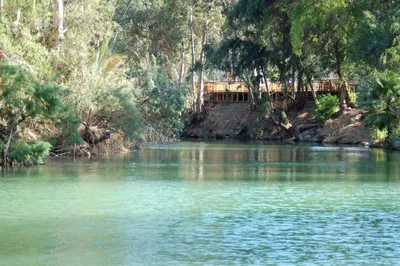
The Jordan River

Site Study | Hershel Wayne House

The Jordan River is the only major waterway between the Mediterranean and the Euphrates River. It runs north to south 223 miles through the Jordan Rift Valley, from its headwaters in the foothills of Mt. Hermon, through Lake Huleh, through the Sea of Galilee, and on to where it empties into the Dead Sea. Over its course it falls 2885 feet in elevation, from 1500 ft. above sea level at its headwaters to 1385 feet below sea level at its mouth.

Due to the geography and climate of the area, the Jordan was subject to rapid fluctuations in flow during ancient times. From the Sea of Galilee south, the climate of the Jordan River Valley dries dramatically. With very little vegetation to hold excess water, heavy rains resulted in flash flooding in the canyons prevalent along the slopes of the valley. These flash floods swelled the amount of water flowing into the Jordan, and in turn the Jordan’s water level rapidly rose. Because of this, crossing the River ranged from fairly easy to very dangerous. 

Although there are no major cities at the Jordan river, several important towns were located in the valley near the river, including Jericho in the south and Scythopolis (Beth Shean) further north, Bethsaida north of the Sea of Galilee, and Caesarea Philippi near one of the streams that form the headwaters of the Jordan.

Although there are few cities in the region of the Jordan River, it has been the scene of countless historical events. In the New Testament, it is the region where John the Baptist ministered, and the site of Jesus’ Baptism. Jesus undoubtedly traveled the route along the Jordan River valley between Galilee and Jerusalem.

Jordan River

Person & place data: Theographic Bible Metadata by Robert Rouse (Viz.Bible), CC BY-SA 4.0.
Joshua 14 (WEB)

1These are the inheritances which the children of Israel took in the land of Canaan, which Eleazar the priest, Joshua the son of Nun, and the heads of the fathers’ houses of the tribes of the children of Israel, distributed to them, 2by the lot of their inheritance, as Yahweh commanded by Moses, for the nine tribes, and for the half-tribe. 3For Moses had given the inheritance of the two tribes and the half-tribe beyond the Jordan; but to the Levites he gave no inheritance among them. 4For the children of Joseph were two tribes, Manasseh and Ephraim. They gave no portion to the Levites in the land, except cities to dwell in, with their pasture lands for their livestock and for their property. 5The children of Israel did as Yahweh commanded Moses, and they divided the land.

6Then the children of Judah came near to Joshua in Gilgal. Caleb the son of Jephunneh the Kenizzite said to him, “You know the thing that Yahweh spoke to Moses the man of God concerning me and concerning you in Kadesh Barnea. 7I was forty years old when Moses the servant of Yahweh sent me from Kadesh Barnea to spy out the land. I brought him word again as it was in my heart. 8Nevertheless, my brothers who went up with me made the heart of the people melt; but I wholly followed Yahweh my God. 9Moses swore on that day, saying, ‘Surely the land where you walked shall be an inheritance to you and to your children forever, because you have wholly followed Yahweh my God.’

10“Now, behold, Yahweh has kept me alive, as he spoke, these forty-five years, from the time that Yahweh spoke this word to Moses, while Israel walked in the wilderness. Now, behold, I am eighty-five years old, today. 11As yet I am as strong today as I was in the day that Moses sent me. As my strength was then, even so is my strength now for war, to go out and to come in. 12Now therefore give me this hill country, of which Yahweh spoke in that day; for you heard in that day how the Anakim were there, and great and fortified cities. It may be that Yahweh will be with me, and I shall drive them out, as Yahweh said.”

13Joshua blessed him; and he gave Hebron to Caleb the son of Jephunneh for an inheritance. 14Therefore Hebron became the inheritance of Caleb the son of Jephunneh the Kenizzite to this day, because he followed Yahweh, the God of Israel wholeheartedly. 15Now the name of Hebron before was Kiriath Arba, after the greatest man among the Anakim. Then the land had rest from war.

Jordan