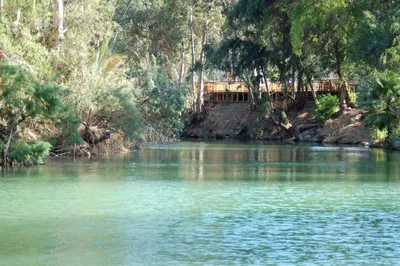
When Jesus travelled from Galilee to Judea, it is likely He traveled the Jordan Rift Valley. This was the easiest route (without going through Samaria) to get from Galilee to Judea.
The Jordan River flows through the valley and gives it its name, and runs from north of Lake Huleh to the Dead Sea. The valley itself is part of a larger geologic feature called the Great Rift Valley that runs 3,700 miles, from northern Syria to northeastern Africa. At the Dead Sea, the valley is the lowest place on land at more than 1,200 feet below sea level.
The climate of the Jordan Valley changes dramatically as it moves from north to south. In the north, near Lake Huleh, the valley is fertile, and plentiful rainfall allows substantial agriculture. South of the Sea of Galilee, the valley rapidly dries out and increases in temperature. Agriculture here is only possible by using the Jordan River for irrigation. Near the Dead Sea, the temperature is too high for most agricultural activity, although some palm crops are grown, like dates and bananas.
Humans have occupied the valley for thousands of years. Jericho, at the southern end of the valley, is considered by some to be the oldest inhabited city in the world. Other cities include Bethany Beyond the Jordan, Scythopolis (Beth Shean), Bethsaida, and Caesarea Philippi. John the Baptist ministered in the valley as well. As mentioned, it is also a major thoroughfare, allowing relatively easy travel from north to south. In the New Testament, Jesus traveled the valley several times, going from Galilee to Jerusalem and back, and was baptized in the Jordan River.
The Jordan River
Site Study
| Hershel Wayne House
The Jordan River is the only major waterway between the Mediterranean and the Euphrates River. It runs north to south 223 miles through the Jordan Rift Valley, from its headwaters in the foothills of Mt. Hermon, through Lake Huleh, through the Sea of Galilee, and on to where it empties into the Dead Sea. Over its course it falls 2885 feet in elevation, from 1500 ft. above sea level at its headwaters to 1385 feet below sea level at its mouth.
Due to the geography and climate of the area, the Jordan was subject to rapid fluctuations in flow during ancient times. From the Sea of Galilee south, the climate of the Jordan River Valley dries dramatically. With very little vegetation to hold excess water, heavy rains resulted in flash flooding in the canyons prevalent along the slopes of the valley. These flash floods swelled the amount of water flowing into the Jordan, and in turn the Jordan’s water level rapidly rose. Because of this, crossing the River ranged from fairly easy to very dangerous.
Although there are no major cities at the Jordan river, several important towns were located in the valley near the river, including Jericho in the south and Scythopolis (Beth Shean) further north, Bethsaida north of the Sea of Galilee, and Caesarea Philippi near one of the streams that form the headwaters of the Jordan.
Although there are few cities in the region of the Jordan River, it has been the scene of countless historical events. In the New Testament, it is the region where John the Baptist ministered, and the site of Jesus’ Baptism. Jesus undoubtedly traveled the route along the Jordan River valley between Galilee and Jerusalem.
1Moreover Ahithophel said to Absalom, “Let me now choose twelve thousand men, and I will arise and pursue after David tonight. 2I will come on him while he is weary and exhausted, and will make him afraid. All the people who are with him will flee. I will strike the king only, 3and I will bring back all the people to you. The man whom you seek is as if all returned. All the people shall be in peace.”
4The saying pleased Absalom well, and all the elders of Israel. 5Then Absalom said, “Now call Hushai the Archite also, and let’s hear likewise what he says.”
6When Hushai had come to Absalom, Absalom spoke to him, saying, “Ahithophel has spoken like this. Shall we do what he says? If not, speak up.”
7Hushai said to Absalom, “The counsel that Ahithophel has given this time is not good.” 8Hushai said moreover, “You know your father and his men, that they are mighty men, and they are fierce in their minds, like a bear robbed of her cubs in the field. Your father is a man of war, and will not lodge with the people. 9Behold, he is now hidden in some pit, or in some other place. It will happen, when some of them have fallen at the first, that whoever hears it will say, ‘There is a slaughter among the people who follow Absalom!’ 10Even he who is valiant, whose heart is as the heart of a lion, will utterly melt; for all Israel knows that your father is a mighty man, and those who are with him are valiant men. 11But I counsel that all Israel be gathered together to you, from Dan even to Beersheba, as the sand that is by the sea for multitude; and that you go to battle in your own person. 12So we will come on him in some place where he will be found, and we will light on him as the dew falls on the ground, then we will not leave so much as one of him and of all the men who are with him. 13Moreover, if he has gone into a city, then all Israel will bring ropes to that city, and we will draw it into the river, until there isn’t one small stone found there.”
14Absalom and all the men of Israel said, “The counsel of Hushai the Archite is better than the counsel of Ahithophel.” For Yahweh had ordained to defeat the good counsel of Ahithophel, to the intent that Yahweh might bring evil on Absalom.
15Then Hushai said to Zadok and to Abiathar the priests, “Ahithophel counseled Absalom and the elders of Israel that way; and I have counseled this way. 16Now therefore send quickly, and tell David, saying, ‘Don’t lodge tonight at the fords of the wilderness, but by all means pass over, lest the king be swallowed up, and all the people who are with him.’”
17Now Jonathan and Ahimaaz were staying by En Rogel; and a female servant used to go and report to them, and they went and told King David; for they couldn’t risk being seen coming into the city. 18But a boy saw them, and told Absalom. Then they both went away quickly and came to the house of a man in Bahurim, who had a well in his court; and they went down there. 19The woman took and spread the covering over the well’s mouth, and spread out crushed grain on it; and nothing was known. 20Absalom’s servants came to the woman to the house; and they said, “Where are Ahimaaz and Jonathan?”
The woman said to them, “They have gone over the brook of water.”
When they had sought and could not find them, they returned to Jerusalem. 21After they had departed, they came up out of the well and went and told King David; and they said to David, “Arise and pass quickly over the water; for thus has Ahithophel counseled against you.”
22Then David arose, and all the people who were with him, and they passed over the Jordan. By the morning light there lacked not one of them who had not gone over the Jordan.
23When Ahithophel saw that his counsel was not followed, he saddled his donkey, arose, and went home to his city, set his house in order, and hanged himself; and he died, and was buried in the tomb of his father.
24Then David came to Mahanaim. Absalom passed over the Jordan, he and all the men of Israel with him. 25Absalom set Amasa over the army instead of Joab. Now Amasa was the son of a man whose name was Ithra the Israelite, who went in to Abigail the daughter of Nahash, sister to Zeruiah, Joab’s mother. 26Israel and Absalom encamped in the land of Gilead.
27When David had come to Mahanaim, Shobi the son of Nahash of Rabbah of the children of Ammon, and Machir the son of Ammiel of Lodebar, and Barzillai the Gileadite of Rogelim, 28brought beds, basins, earthen vessels, wheat, barley, meal, parched grain, beans, lentils, roasted grain, 29honey, butter, sheep, and cheese of the herd, for David and for the people who were with him to eat; for they said, “The people are hungry, weary, and thirsty in the wilderness.”