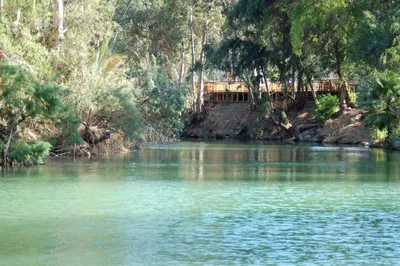
Farther Side of Jordan
When Jesus travelled from Galilee to Judea, it is likely He traveled the Jordan Rift Valley. This was the easiest route (without going through Samaria) to get from Galilee to Judea.
The Jordan River flows through the valley and gives it its name, and runs from north of Lake Huleh to the Dead Sea. The valley itself is part of a larger geologic feature called the Great Rift Valley that runs 3,700 miles, from northern Syria to northeastern Africa. At the Dead Sea, the valley is the lowest place on land at more than 1,200 feet below sea level.
The climate of the Jordan Valley changes dramatically as it moves from north to south. In the north, near Lake Huleh, the valley is fertile, and plentiful rainfall allows substantial agriculture. South of the Sea of Galilee, the valley rapidly dries out and increases in temperature. Agriculture here is only possible by using the Jordan River for irrigation. Near the Dead Sea, the temperature is too high for most agricultural activity, although some palm crops are grown, like dates and bananas.
Humans have occupied the valley for thousands of years. Jericho, at the southern end of the valley, is considered by some to be the oldest inhabited city in the world. Other cities include Bethany Beyond the Jordan, Scythopolis (Beth Shean), Bethsaida, and Caesarea Philippi. John the Baptist ministered in the valley as well. As mentioned, it is also a major thoroughfare, allowing relatively easy travel from north to south. In the New Testament, Jesus traveled the valley several times, going from Galilee to Jerusalem and back, and was baptized in the Jordan River.