Matthew 1 (WEB)
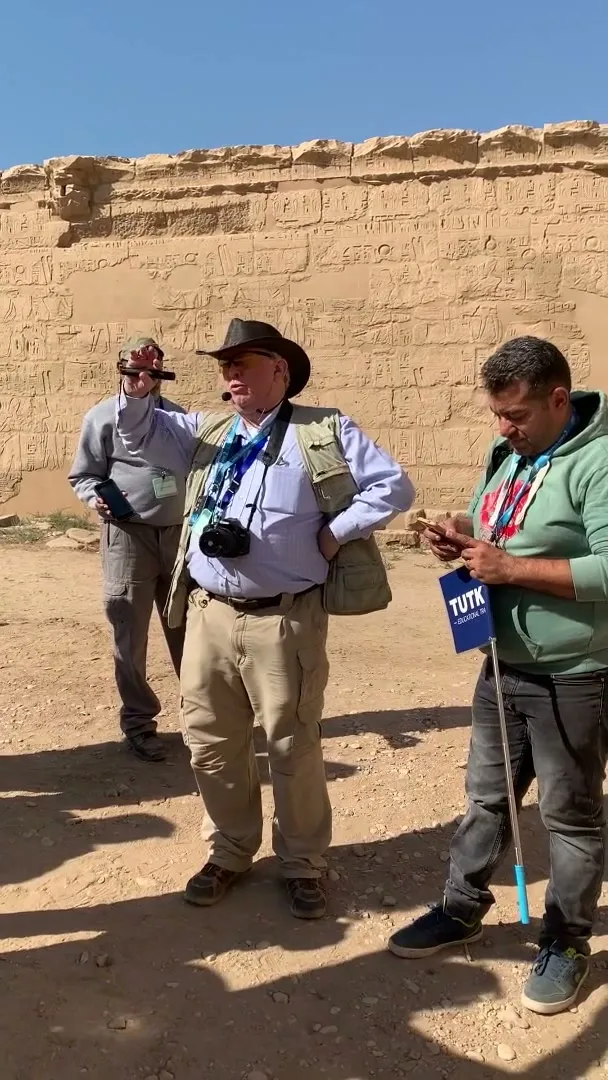
Dr. House explains to his Egypt tour group about the three archaeological proofs for the existence of King David, one being the wall of Shishak at the temple of Amun Re in Luxor, Egypt. The other two are the Tel Dan Inscription (an Aramaic stele found at Tel Dan, in upper Israel), and the Moabite Stone, that has the name of David and the name of the God of Israel, Yahweh.
If you have interest in tours of the lands of the Bible, please consult the website of Dr. House, where you will see his blog, biblical tours, and information on the House Visual Study Bible (http://www.hwhouse.com/).
Video by courtesy of Irina House
In archaeology, there's only three evidences for the existence of the king of Israel we call David, son of Jesse and all the way, obviously, to our Lord.
And one of those evidences is found in a Moabite Stone.
It's from Moab.
And I won't go into all those since we're not there right now.
But there's one evidence of David and his existence in the Moabite Stone.
And the other is one that was found not too long ago.
Matter of fact, I got to know the guy who found it.
We spent time with him at the Hebrew Union College at a place called Dan up in the north of Israel, right below Caesarea Philippi.
Caesarea Philippi is higher, from Syria down to Dan — Tel Dan.
And that's where some of the tribes of Dan went to.
Remember, Samson was supposed to have liberated the Danites from the Philistines.
It was not very successful.
He got occupied on other issues and lost his calling, really.
And finally the tribe moved from the Philistine area to Dan in the north, the Golan area.
And there is a tablet they found, it was in Aramaic, called the Tel Dan Inscription, where you have the house of David.
There is one other we know in history.
And we're not sure exactly what happened here, but early archaeologists and their drawings of this area, because people have been coming here a long time.
Archaeologists at the turn of the last, like a century ago or more, and afterwards in the early 1900s, late 1800s, when they came here, they did drawings.
And some of the drawings they did were right here at Shishak.
Now, we're not going to go into all this, but a lot of these kinds of…
Do you see the little green thing?
A lot of these things here you see, these are called name rings, they're cartouches, but they actually are speaking, and usually they operate in doubles.
It's like two parts of the word.
And talk about the various places that Shishak conquered and things that he did in Israel.
But what happened is that if you look at the actual drawings of the archaeologists, some things have fallen away right here.
You see that?
And right here, see this face right here?
Right here, about over here and down and over, were two cartouches that actually said the heights or the highlands of David.
So they talked about an area in Israel that Shishak came to, but this is only a few decades after David the king actually was king.
So when the king Shishak actually invaded Israel, he actually mentioned right here, which is not there anymore.
I wish I could just go up and draw it in there for you.
But what I did is I brought it into the picture where you can see what it actually looked like somewhat.
Is there a picture drawing of it when it was there?
Kenneth Kitchen has one, which is where I pulled mine from.
Which one?
I don't remember.
But I've seen more than one.
Because archaeologists actually at one time had drawn each of these things out, and one they had drawn out was right here, where it said the heights of David.
And you can see in that drawing I did, in the picture, this is the place we're looking at.
So even though we don't have that now, at one time the archaeological material was there.
And that would be a third proof of the existence of David, which is important.
We have three now, because a lot of people say, well, what the Bible talks about is talking about fictitious people.
David didn't live.
Saul didn't live.
Hardly anybody lived until after the Babylonian captivity, in many scholars' views.
A lot of evidence coming forward.
And one of them was the fact that the Tel Dan inscription was a masterful…
It was a great finding, because it demonstrated that even at that time David was well recognized.
But this also was another, and we at least have the historical evidence in the writings of the archaeologists, that it was here.
I just hate that it's not there now.
I don't know if somebody took it down and it fell off…
Because this temple, and actually you have seen outside where it's very big, five big systems, you have the underground water here is so high.
The underground water, when it comes here, it normally goes up by physics, it's through the stones.
So if you leave this one without respiration, right, that one becomes to be salty.
That's why for a while, it's still up until now, you see the white color, that's the salt.
And because it's still the underground water, and this salt, after a while, started to destroy these inscriptions.
That's why these things, it was existed up until maybe 1950 or 1960, they were there.
Even if we lost another one from the other wall there, for Seti the First, who was actually also fighting with the people, and there were seven forts, they were recorded.
And these seven forts, they were already existed, and it was recorded.
One of them was called the Migdol — you know Migdol, right?
If it's in Syria, or it's in Egypt here, or it was in the border between Egypt and…
In that area, Jerusalem, on the promised land, all of these things!
Can you believe that we had this register from the ancient times?
Now it's already done, it's gone.
And one of the most important things that we lost there, like this one: there was two water lines, two water lines.
If you see one lot of water line vertical, you can see turtles.
A turtles — what is it, the mean of that?
And also some of the things which is today in the Red Sea.
The other one, which is horizontal, you can find the mullet and the Nile perch, which was already a river Nile.
And because they were connected, that means this confirmed there was a branch of the river Nile goes up to the Red Sea.
And this branch was actually in the south of the land of Goshen.
This is where, according to the Jewish tradition, this is exactly where Moses was found as a baby.
Right, so it's something really interesting.
But the old, the lower part, is all gone now because of the same problem.
Today, we have to clean it, we have to put some materials.
That's why you can see some of them is already almost like wet, right?
This is already some of the people that are working here, to try to clean it from the salt all the time.
Otherwise, you can see all the lower part, most of the temple is destroyed.
Can you see that?
All of it, like that.
1The book of the genealogy of Jesus Christ, the son of David, the son of Abraham.
2Abraham became the father of Isaac. Isaac became the father of Jacob. Jacob became the father of Judah and his brothers. 3Judah became the father of Perez and Zerah by Tamar. Perez became the father of Hezron. Hezron became the father of Ram. 4Ram became the father of Amminadab. Amminadab became the father of Nahshon. Nahshon became the father of Salmon. 5Salmon became the father of Boaz by Rahab. Boaz became the father of Obed by Ruth. Obed became the father of Jesse. 6Jesse became the father of King David. David the king became the father of Solomon by her who had been Uriah’s wife. 7Solomon became the father of Rehoboam. Rehoboam became the father of Abijah. Abijah became the father of Asa. 8Asa became the father of Jehoshaphat. Jehoshaphat became the father of Joram. Joram became the father of Uzziah. 9Uzziah became the father of Jotham. Jotham became the father of Ahaz. Ahaz became the father of Hezekiah. 10Hezekiah became the father of Manasseh. Manasseh became the father of Amon. Amon became the father of Josiah. 11Josiah became the father of Jechoniah and his brothers at the time of the exile to Babylon.
12After the exile to Babylon, Jechoniah became the father of Shealtiel. Shealtiel became the father of Zerubbabel. 13Zerubbabel became the father of Abiud. Abiud became the father of Eliakim. Eliakim became the father of Azor. 14Azor became the father of Zadok. Zadok became the father of Achim. Achim became the father of Eliud. 15Eliud became the father of Eleazar. Eleazar became the father of Matthan. Matthan became the father of Jacob. 16Jacob became the father of Joseph, the husband of Mary, from whom was born Jesus, who is called Christ.
17So all the generations from Abraham to David are fourteen generations; from David to the exile to Babylon fourteen generations; and from the carrying away to Babylon to the Christ, fourteen generations.
18Now the birth of Jesus Christ was like this: After his mother, Mary, was engaged to Joseph, before they came together, she was found pregnant by the Holy Spirit. 19Joseph, her husband, being a righteous man, and not willing to make her a public example, intended to put her away secretly. 20But when he thought about these things, behold, an angel of the Lord appeared to him in a dream, saying, “Joseph, son of David, don’t be afraid to take to yourself Mary as your wife, for that which is conceived in her is of the Holy Spirit. 21She shall give birth to a son. You shall name him Jesus, for it is he who shall save his people from their sins.”
22Now all this has happened that it might be fulfilled which was spoken by the Lord through the prophet, saying,
23“Behold, the virgin shall be with child,
and shall give birth to a son.
They shall call his name Immanuel,”
which is, being interpreted, “God with us.”
24Joseph arose from his sleep, and did as the angel of the Lord commanded him, and took his wife to himself; 25and didn’t know her sexually until she had given birth to her firstborn son. He named him Jesus.