Genesis 12 (WEB)
The Relation of the Conditional Mosaic Covenant to the Unconditional Abrahamic Covenant
God’s covenant promises to Israel unfold across biblical history. The unconditional Abrahamic promise continues through the later covenants, while the conditional Mosaic law governs Israel during its appointed historical administration.
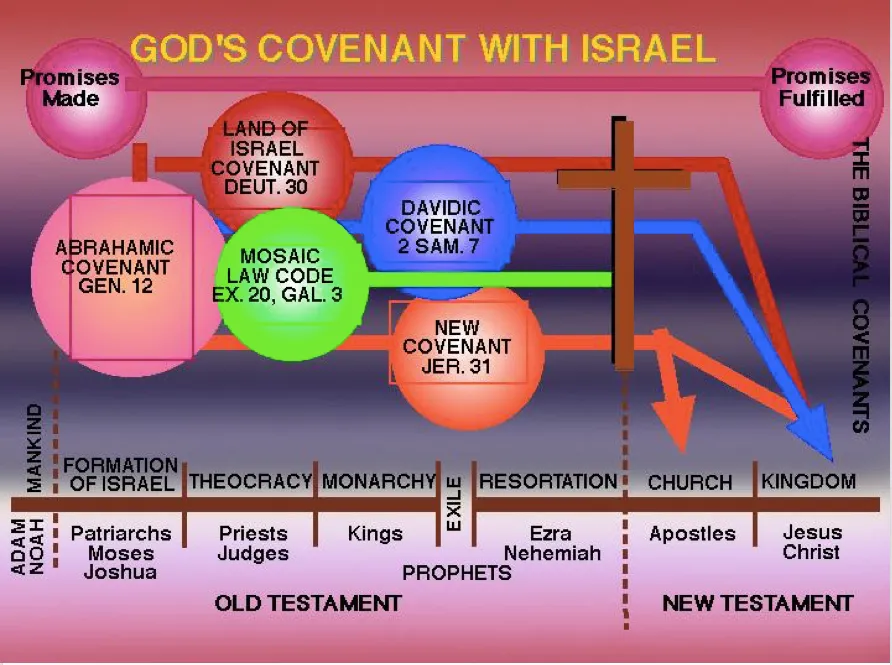
The Relation of the Conditional Mosaic Covenant to the Unconditional Abrahamic Covenant
| Covenant | Passage | Place in the relationship |
|---|---|---|
| Abrahamic covenant | Gen 12 | The foundational promises are made. |
| Israel land covenant | Deut 30 | Develops the land promise. |
| Mosaic law covenant | Exod 20; Gal 3 | A conditional administration within the continuing Abrahamic promise. |
| Davidic covenant | 2 Sam 7 | Develops the royal seed and kingdom promise. |
| New covenant | Jer 31 | Develops the promise of covenant blessing. |
| Historical period | Representative people or offices | Testament |
|---|---|---|
| Humanity before Israel | Adam and Noah | Old Testament |
| Formation of Israel | Patriarchs; Moses; Joshua | Old Testament |
| Theocracy | Priests and judges | Old Testament |
| Monarchy | Kings | Old Testament |
| Exile | Prophets | Old Testament |
| Restoration | Ezra and Nehemiah | Old Testament |
| Church | Apostles | New Testament |
| Kingdom | Jesus Christ | New Testament |
1Now Yahweh said to Abram, “Leave your country, and your relatives, and your father’s house, and go to the land that I will show you. 2I will make of you a great nation. I will bless you and make your name great. You will be a blessing. 3I will bless those who bless you, and I will curse him who treats you with contempt. All the families of the earth will be blessed through you.”
4So Abram went, as Yahweh had told him. Lot went with him. Abram was seventy-five years old when he departed from Haran. 5Abram took Sarai his wife, Lot his brother’s son, all their possessions that they had gathered, and the people whom they had acquired in Haran, and they went to go into the land of Canaan. They entered into the land of Canaan. 6Abram passed through the land to the place of Shechem, to the oak of Moreh. At that time, Canaanites were in the land.
7Yahweh appeared to Abram and said, “I will give this land to your offspring.”
He built an altar there to Yahweh, who had appeared to him. 8He left from there to go to the mountain on the east of Bethel and pitched his tent, having Bethel on the west, and Ai on the east. There he built an altar to Yahweh and called on Yahweh’s name. 9Abram traveled, still going on toward the South.
10There was a famine in the land. Abram went down into Egypt to live as a foreigner there, for the famine was severe in the land. 11When he had come near to enter Egypt, he said to Sarai his wife, “See now, I know that you are a beautiful woman to look at. 12It will happen that when the Egyptians see you, they will say, ‘This is his wife.’ They will kill me, but they will save you alive. 13Please say that you are my sister, that it may be well with me for your sake, and that my soul may live because of you.”
14When Abram had come into Egypt, some Egyptians saw that the woman was very beautiful. 15The princes of Pharaoh saw her, and praised her to Pharaoh; and the woman was taken into Pharaoh’s house. 16He dealt well with Abram for her sake. He had sheep, cattle, male donkeys, male servants, female servants, female donkeys, and camels. 17Yahweh afflicted Pharaoh and his house with great plagues because of Sarai, Abram’s wife. 18Pharaoh called Abram and said, “What is this that you have done to me? Why didn’t you tell me that she was your wife? 19Why did you say, ‘She is my sister,’ so that I took her to be my wife? Now therefore, see your wife, take her, and go your way.”
20Pharaoh commanded men concerning him, and they escorted him away with his wife and all that he had.