Mark 1 (WEB)
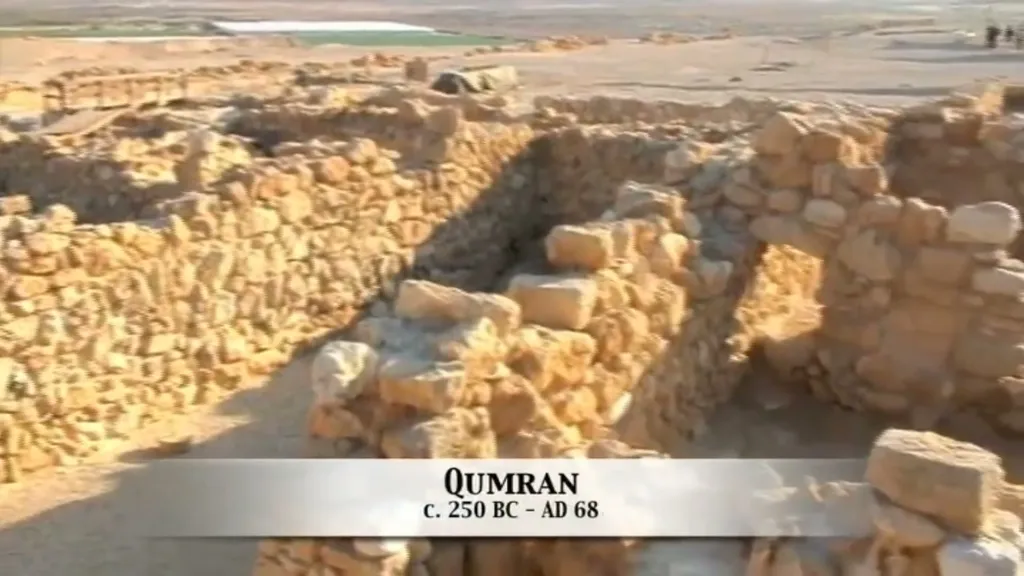
Dead Sea Portion of Video by Joseph Holden, Archaeology and the Bible, Top Ten Amazing Discoveries (Number 1 of Archaeology & Bible), used by permission.
Located on the northwest shores of the Dead Sea, the lowest place on earth, lies the ancient settlement known as Qumran.
Among the limestone cliffs of this mysterious settlement are eleven caves, which contain the now famous ancient manuscripts known as the Dead Sea Scrolls.
Among other informative writings, the scrolls contained every book of the Old Testament, except for the Book of Esther.
After the scrolls were first discovered in 1947, archaeologists began extensive excavations at Qumran, led by a Dominican monk named Pierre Roland de Vaux.
Many scholars concur with de Vaux's position that the ancient settlement of Qumran was the home of a small Jewish sect known as the Essenes.
In studying the structural remains, including a network of aqueducts, several ritual purity baths, spacious meeting halls, and water cisterns, archaeologists estimate the Essenes lived in this desolate community for over 300 years.
The dry, desolate climate surrounding Qumran was crucial in both preserving the ancient manuscripts as well as keeping them hidden for 2,000 years.
With only an occasional passing shepherd, the area surrounding Qumran remained virtually uninhabited since the days of the Essenes.
However, in 1947, a young Bedouin shepherd boy named Muhammad edh-Dhib was searching for his lost goat among the caves, and found much more than he could ever have imagined.
A relative of Muhammad edh-Dhib recounts this amazing discovery.
He saw just this hole.
He took a rock and he throw it inside this hole.
He hear that he broke a jar or a butter inside.
And he climbed from this hole.
He saw the jar, it was broken.
After he threw the rock from outside, he climbed in this hole and he go down to the cave.
He find 47 jar surrounded with this cave.
He find in one jar of them four scrolls inside one jar.
The Bedouin shepherds delivered seven scrolls from the first cave to a Christian antiquities dealer in Bethlehem named Khalil Shahin, also known as Kando.
Soon after, E.L.
Sukenik of Hebrew University acquired three of the scrolls.
In 1949, the remaining four scrolls were sold to Mar Athanasius Samuel of the Syrian Jacobite monastery of St. Mark in Jerusalem, who eventually brought them to America.
On June 1st, 1954, Samuel ran this ad in the Wall Street Journal, offering the scrolls for sale.
Samuel's ad was brought to the attention of Sukenik's son, Yigael Yadin.
Yadin purchased the four scrolls and returned them to Israel, where they are housed to this day alongside three other scrolls found in Cave One.
The Dead Sea Scrolls, discovered beginning in 1948, represent the oldest text we have of the Bible, as well as sectarian literature as well.
The importance of it is that with the Masoretic text, which underlies our English translation of the Old Testament, the transmission history only went back to the 10th century AD.
With the Dead Sea Scrolls, we close that gap another thousand years.
And if you understand that the Dead Sea Scrolls represent at least 3rd century BC text that we have now in the 1st and 2nd century BC, it goes back even further.
We have almost all of the Old Testament except for the book of Esther, and we have text both in Hebrew, some Aramaic, and even some Greek text,
which give us an amazing confirmation of the accuracy of transmission of the scribes at that time.
About 95% agreement with the Masoretic text in most things.
It's one of the most important manuscript discoveries of all time, because it tells us that the original manuscript has survived in the copies, and that our copy today is substantially the same as the original.
We also have with the sectarian manuscripts information that fills in the background, both in Judaism and in the thinking in terms of messianic and eschatological texts that underlie a lot of the drama of the New Testament, and a lot of even the interpretation of the disciples and Paul as well.
This was something that was of great surprise back in the late 1940s — 1947, winter — when these scrolls were found.
One of the most interesting things is that about one-fifth of all those scrolls that were found — these were biblical texts that we know.
Well, this was really important for us to be able to finally compare some scrolls that existed back at the time of our biblical characters, to compare that with the text that we have today.
Now, in many cases, the text is just exactly the same.
In fact, you have to go through, normally, hundreds of words before you ever find something that you can say is a translatable variant — something that, if we translated it into English, it would have any kind of a slight difference in terms of understanding.
Normally, in those cases, it's something that people would think, well, that's just the difference of the translator.
It's so insignificant.
And because of the fact that most of the scholars that were working on these scrolls that were Bible scholars, they kind of got bored with the work.
It was just, if you wanted to make a concordance of the biblical texts from Qumran, why not just go to the concordances of the Masoretic texts that we have, that we translate our Bibles from today, because it's just so close.
Well, we do in fact have some real gems for the philologists, for the ones who want to study scribal practice, want to see whether it's written in Paleo-Hebrew script or just normal square Aramaic or a Jewish script.
All of these different peculiar differences for each given scroll actually does tell part of the history of the group, and separates them in terms of scribal schools and scribal practice.
We see the development of writing going on there.
It testifies to the meticulous, faithful nature that the scribes used in transcribing these copies generation after generation, centuries before the printing press was ever invented.
The book of Isaiah was found in its entirety, and except for very minor mistakes, deviations, it virtually matches what we have in our Bibles today.
Now, that's not to say that there weren't some scribal errors that crept in.
It doesn't mean that they sometimes didn't spell things differently, and there's enough of that around for us to be able to say, aha, we can work through spelling differences.
But still, in our English Bibles, it won't even show up.
1The beginning of the Good News of Jesus Christ, the Son of God.
2As it is written in the prophets,
“Behold, I send my messenger before your face,
who will prepare your way before you:
3the voice of one crying in the wilderness,
‘Make ready the way of the Lord!
Make his paths straight!’”
4John came baptizing in the wilderness and preaching the baptism of repentance for forgiveness of sins. 5All the country of Judea and all those of Jerusalem went out to him. They were baptized by him in the Jordan river, confessing their sins. 6John was clothed with camel’s hair and a leather belt around his waist. He ate locusts and wild honey. 7He preached, saying, “After me comes he who is mightier than I, the strap of whose sandals I am not worthy to stoop down and loosen. 8I baptized you in water, but he will baptize you in the Holy Spirit.”
9In those days, Jesus came from Nazareth of Galilee, and was baptized by John in the Jordan. 10Immediately coming up from the water, he saw the heavens parting and the Spirit descending on him like a dove. 11A voice came out of the sky, “You are my beloved Son, in whom I am well pleased.”
12Immediately the Spirit drove him out into the wilderness. 13He was there in the wilderness forty days, tempted by Satan. He was with the wild animals; and the angels were serving him.
14Now after John was taken into custody, Jesus came into Galilee, preaching the Good News of God’s Kingdom, 15and saying, “The time is fulfilled, and God’s Kingdom is at hand! Repent, and believe in the Good News.”
16Passing along by the sea of Galilee, he saw Simon and Andrew, the brother of Simon, casting a net into the sea, for they were fishermen. 17Jesus said to them, “Come after me, and I will make you into fishers for men.”
18Immediately they left their nets, and followed him.
19Going on a little further from there, he saw James the son of Zebedee, and John his brother, who were also in the boat mending the nets. 20Immediately he called them, and they left their father, Zebedee, in the boat with the hired servants, and went after him.
21They went into Capernaum, and immediately on the Sabbath day he entered into the synagogue and taught. 22They were astonished at his teaching, for he taught them as having authority, and not as the scribes. 23Immediately there was in their synagogue a man with an unclean spirit, and he cried out, 24saying, “Ha! What do we have to do with you, Jesus, you Nazarene? Have you come to destroy us? I know who you are: the Holy One of God!”
25Jesus rebuked him, saying, “Be quiet, and come out of him!”
26The unclean spirit, convulsing him and crying with a loud voice, came out of him. 27They were all amazed, so that they questioned among themselves, saying, “What is this? What can this new doctrine be? For with authority he commands even the unclean spirits, and they obey him!” 28The report of him went out immediately into all the region of Galilee and its surrounding area.
29Immediately, when they had come out of the synagogue, they came into the house of Simon and Andrew, with James and John. 30Now Simon’s wife’s mother lay sick with a fever, and immediately they told him about her. 31He came and took her by the hand and raised her up. The fever left her immediately, and she served them.
32At evening, when the sun had set, they brought to him all who were sick and those who were possessed by demons. 33All the city was gathered together at the door. 34He healed many who were sick with various diseases and cast out many demons. He didn’t allow the demons to speak, because they knew him.
35Early in the morning, while it was still dark, he rose up and went out, and departed into a deserted place, and prayed there. 36Simon and those who were with him searched for him. 37They found him and told him, “Everyone is looking for you.”
38He said to them, “Let’s go elsewhere into the next towns, that I may preach there also, because I came out for this reason.” 39He went into their synagogues throughout all Galilee, preaching and casting out demons.
40A leper came to him, begging him, kneeling down to him, and saying to him, “If you want to, you can make me clean.”
41Being moved with compassion, he stretched out his hand, and touched him, and said to him, “I want to. Be made clean.” 42When he had said this, immediately the leprosy departed from him and he was made clean. 43He strictly warned him and immediately sent him out, 44and said to him, “See that you say nothing to anybody, but go show yourself to the priest and offer for your cleansing the things which Moses commanded, for a testimony to them.”
45But he went out, and began to proclaim it much, and to spread about the matter, so that Jesus could no more openly enter into a city, but was outside in desert places. People came to him from everywhere.