Site Study
| Daniel G Garland • Hershel Wayne House
Matthew's reference to a high mountain in Matt 17:1 probably refers to a spur of Mt. Hermon, which rises about 9,400 feet above sea level, and may be the same high mountain to which he took Jesus during his third temptation in Matt 4:8. Mt. Hermon is in the upper Golan in the vicinity of Caesarea Philippi. Since it is by far the highest mountain in the area, its selection for the transfiguration is probably a more likely location than Mt. Tabor, the traditional site in lower Galilee, which is less than 1,900 feet in elevation. If Mt. Hermon were the location of both the temptation and transfiguration of Christ, it would account not only for Matthew’s choice of the same phrase to describe them, but also provide a satisfying symmetry: The glory of this world’s kingdoms that Jesus refused to seize apart from the Father’s good pleasure and timing, is the glory with which He will one day return as the beloved Son with whom the Father is well pleased (cf., Matt 16:27; 17:5)!
After Peter's affirmation in Matt 16:16 that Jesus was the Messiah, Son of God, something that could only come from God's revelation, Jesus said that upon this confession Jesus would build His church. The spectacular appearance of Jesus on Mt. Hermon, in which He appeared as the sun (reflecting the Shekinah glory of Yahweh to Moses in the bush that was burning but not consumed in Exod 3:6), was in combination with the representative of the Law and the Prophets, Moses and Elijah (also see Luke 24:27 statement of the risen Messiah).
After Peter's expression to building tents for the three of them, God speaks from heaven (similar to the statement at Jesus' baptism, "This is my beloved Son, in whom I am well pleased. Listen to him" (Matt 3:17; see Ps 2:7; Isa 42:1). God's latter statement may reflect Deut 18:15).
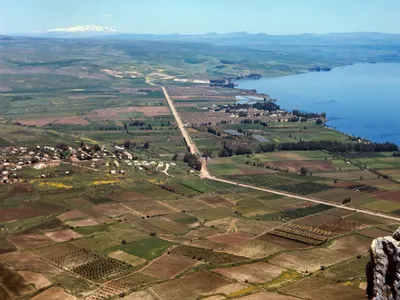
The Galilee in Israel with Mt Hermon in Background
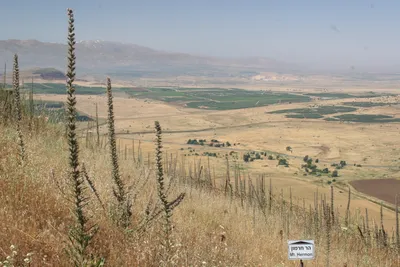
Mt. Hermon in the Summer (with Sign)
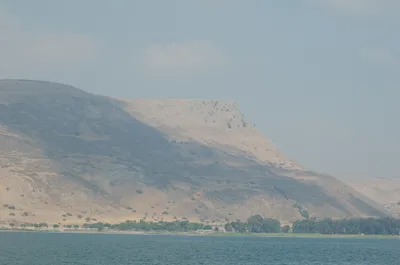
Mt. Arbel from the Sea of Galilee
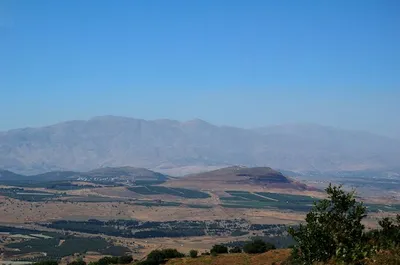
The Transfiguration on Mt. Hermon
Site Study
| Daniel G Garland
The phrase translated high mountain is found only in reference to the unnamed locations from which Satan showed Jesus “all the kingdoms of the world and their glory” (Matt 4:8 NKJV), and where Jesus was transfigured before Peter, James and John (Matt 17:1; Mark 9:2). Since Mt. Hermon is by far the highest mountain in the area, with peaks above 9,000 feet, it has been suggested as a more likely location for the transfiguration than Mt. Tabor, the traditional site in lower Galilee which is less than 1,900 feet in elevation. If Mt. Hermon were the location of both the temptation and transfiguration of Christ, it would account not only for Matthew’s choice of the same phrase to describe them, but also provide a satisfying symmetry: The glory of this world’s kingdoms that Jesus refused to seize apart from the Father’s good pleasure and timing, is the glory with which He will one day return as the beloved Son with whom the Father is well pleased (cf., Matt 16:27; 17:5)!
1Now Joshua was old and well advanced in years. Yahweh said to him, “You are old and advanced in years, and there remains yet very much land to be possessed.
2“This is the land that still remains: all the regions of the Philistines, and all the Geshurites; 3from the Shihor, which is before Egypt, even to the border of Ekron northward, which is counted as Canaanite; the five lords of the Philistines; the Gazites, and the Ashdodites, the Ashkelonites, the Gittites, and the Ekronites; also the Avvim, 4on the south; all the land of the Canaanites, and Mearah that belongs to the Sidonians, to Aphek, to the border of the Amorites; 5and the land of the Gebalites, and all Lebanon, toward the sunrise, from Baal Gad under Mount Hermon to the entrance of Hamath; 6all the inhabitants of the hill country from Lebanon to Misrephoth Maim, even all the Sidonians. I will drive them out from before the children of Israel. Just allocate it to Israel for an inheritance, as I have commanded you. 7Now therefore divide this land for an inheritance to the nine tribes and the half-tribe of Manasseh.” 8With him the Reubenites and the Gadites received their inheritance, which Moses gave them, beyond the Jordan eastward, even as Moses the servant of Yahweh gave them: 9from Aroer, that is on the edge of the valley of the Arnon, and the city that is in the middle of the valley, and all the plain of Medeba to Dibon; 10and all the cities of Sihon king of the Amorites, who reigned in Heshbon, to the border of the children of Ammon; 11and Gilead, and the border of the Geshurites and Maacathites, and all Mount Hermon, and all Bashan to Salecah; 12all the kingdom of Og in Bashan, who reigned in Ashtaroth and in Edrei (who was left of the remnant of the Rephaim); for Moses attacked these, and drove them out. 13Nevertheless the children of Israel didn’t drive out the Geshurites, nor the Maacathites: but Geshur and Maacath live within Israel to this day. 14Only he gave no inheritance to the tribe of Levi. The offerings of Yahweh, the God of Israel, made by fire are his inheritance, as he spoke to him. 15Moses gave to the tribe of the children of Reuben according to their families. 16Their border was from Aroer, that is on the edge of the valley of the Arnon, and the city that is in the middle of the valley, and all the plain by Medeba; 17Heshbon, and all its cities that are in the plain; Dibon, Bamoth Baal, Beth Baal Meon, 18Jahaz, Kedemoth, Mephaath, 19Kiriathaim, Sibmah, Zereth Shahar in the mount of the valley, 20Beth Peor, the slopes of Pisgah, Beth Jeshimoth, 21all the cities of the plain, and all the kingdom of Sihon king of the Amorites, who reigned in Heshbon, whom Moses struck with the chiefs of Midian, Evi, Rekem, Zur, Hur, and Reba, the princes of Sihon, who lived in the land. 22The children of Israel also killed Balaam the son of Beor, the soothsayer, with the sword, among the rest of their slain.
23The border of the children of Reuben was the bank of the Jordan. This was the inheritance of the children of Reuben according to their families, the cities and its villages.
24Moses gave to the tribe of Gad, to the children of Gad, according to their families. 25Their border was Jazer, and all the cities of Gilead, and half the land of the children of Ammon, to Aroer that is near Rabbah; 26and from Heshbon to Ramath Mizpeh, and Betonim; and from Mahanaim to the border of Debir; 27and in the valley, Beth Haram, Beth Nimrah, Succoth, and Zaphon, the rest of the kingdom of Sihon king of Heshbon, the Jordan’s bank, to the uttermost part of the sea of Chinnereth beyond the Jordan eastward. 28This is the inheritance of the children of Gad according to their families, the cities and its villages.
29Moses gave an inheritance to the half-tribe of Manasseh. It was for the half-tribe of the children of Manasseh according to their families. 30Their border was from Mahanaim, all Bashan, all the kingdom of Og king of Bashan, and all the villages of Jair, which are in Bashan, sixty cities. 31Half Gilead, Ashtaroth, and Edrei, the cities of the kingdom of Og in Bashan, were for the children of Machir the son of Manasseh, even for the half of the children of Machir according to their families.
32These are the inheritances which Moses distributed in the plains of Moab, beyond the Jordan at Jericho, eastward. 33But Moses gave no inheritance to the tribe of Levi. Yahweh, the God of Israel, is their inheritance, as he spoke to them.