1 Chronicles 5 (WEB)

Mount Hermon·Mountain

Map
View on Google Maps
Appears in

The Transfiguration of Jesus on Mt. Hermon

Site Study | Daniel G Garland • Hershel Wayne House

Matthew's reference to a high mountain in Matt 17:1 probably refers to a spur of Mt. Hermon, which rises about 9,400 feet above sea level, and may be the same high mountain to which he took Jesus during his third temptation in Matt 4:8.  Mt. Hermon is in the upper Golan in the vicinity of Caesarea Philippi. Since it is by far the highest mountain in the area, its selection for the transfiguration is probably a more likely location than Mt. Tabor, the traditional site in lower Galilee, which is less than 1,900 feet in elevation. If Mt. Hermon were the location of both the temptation and transfiguration of Christ, it would account not only for Matthew’s choice of the same phrase to describe them, but also provide a satisfying symmetry:  The glory of this world’s kingdoms that Jesus refused to seize apart from the Father’s good pleasure and timing, is the glory with which He will one day return as the beloved Son with whom the Father is well pleased (cf., Matt 16:27; 17:5)!

After Peter's affirmation in Matt 16:16 that Jesus was the Messiah, Son of God, something that could only come from God's revelation, Jesus said that upon this confession Jesus would build His church. The spectacular appearance of Jesus on Mt. Hermon, in which He appeared as the sun (reflecting the Shekinah glory of Yahweh to Moses in the bush that was burning but not consumed in Exod 3:6), was in combination with the representative of the Law and the Prophets, Moses and Elijah (also see Luke 24:27 statement of the risen Messiah). 

After Peter's expression to building tents for the three of them, God speaks from heaven (similar to the statement at Jesus' baptism, "This is my beloved Son, in whom I am well pleased. Listen to him" (Matt 3:17; see Ps 2:7; Isa 42:1). God's latter statement may reflect Deut 18:15).
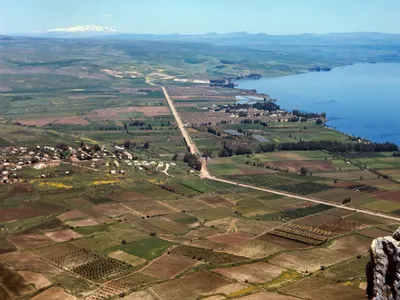
The Galilee in Israel with Mt Hermon in Background
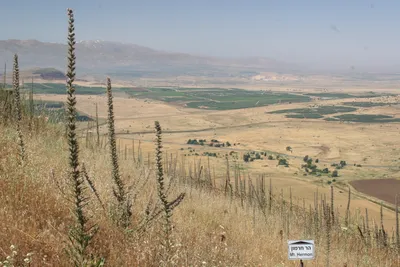
The Galilee in Israel with Mt Hermon in Background

Mt. Hermon in the Summer (with Sign)
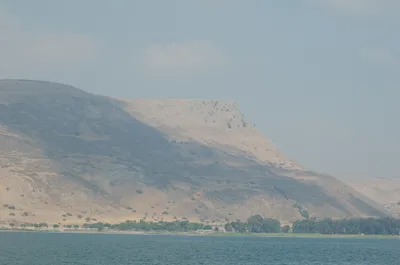
Mt. Hermon in the Summer (with Sign)
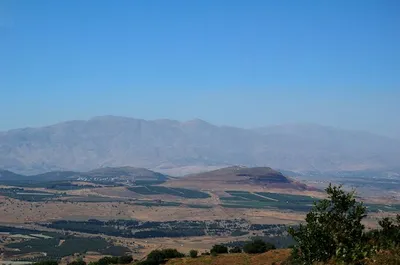
Mt. Arbel from the Sea of Galilee

Mt. Arbel from the Sea of Galilee

The Transfiguration on Mt. Hermon

Site Study | Daniel G Garland

The phrase translated high mountain is found only in reference to the unnamed locations from which Satan showed Jesus “all the kingdoms of the world and their glory” (Matt 4:8 NKJV), and where Jesus was transfigured before Peter, James and John (Matt 17:1; Mark 9:2).  Since Mt. Hermon is by far the highest mountain in the area, with peaks above 9,000 feet, it has been suggested as a more likely location for the transfiguration than Mt. Tabor, the traditional site in lower Galilee which is less than 1,900 feet in elevation.  If Mt. Hermon were the location of both the temptation and transfiguration of Christ, it would account not only for Matthew’s choice of the same phrase to describe them, but also provide a satisfying symmetry:  The glory of this world’s kingdoms that Jesus refused to seize apart from the Father’s good pleasure and timing, is the glory with which He will one day return as the beloved Son with whom the Father is well pleased (cf., Matt 16:27; 17:5)!

Mt. Hermon

Person & place data: Theographic Bible Metadata by Robert Rouse (Viz.Bible), CC BY-SA 4.0.
1 Chronicles 5 (WEB)

1The sons of Reuben the firstborn of Israel (for he was the firstborn, but because he defiled his father’s couch, his birthright was given to the sons of Joseph the son of Israel; and the genealogy is not to be listed according to the birthright. 2For Judah prevailed above his brothers, and from him came the prince; but the birthright was Joseph’s)— 3the sons of Reuben the firstborn of Israel: Hanoch, Pallu, Hezron, and Carmi. 4The sons of Joel: Shemaiah his son, Gog his son, Shimei his son, 5Micah his son, Reaiah his son, Baal his son, 6and Beerah his son, whom Tilgath Pilneser king of Assyria carried away captive. He was prince of the Reubenites. 7His brothers by their families, when the genealogy of their generations was listed: the chief, Jeiel, and Zechariah, 8and Bela the son of Azaz, the son of Shema, the son of Joel, who lived in Aroer, even to Nebo and Baal Meon; 9and he lived eastward even to the entrance of the wilderness from the river Euphrates, because their livestock were multiplied in the land of Gilead.

10In the days of Saul, they made war with the Hagrites, who fell by their hand; and they lived in their tents throughout all the land east of Gilead.

11The sons of Gad lived beside them in the land of Bashan to Salecah: 12Joel the chief, Shapham the second, Janai, and Shaphat in Bashan. 13Their brothers of their fathers’ houses: Michael, Meshullam, Sheba, Jorai, Jacan, Zia, and Eber, seven. 14These were the sons of Abihail, the son of Huri, the son of Jaroah, the son of Gilead, the son of Michael, the son of Jeshishai, the son of Jahdo, the son of Buz; 15Ahi the son of Abdiel, the son of Guni, chief of their fathers’ houses. 16They lived in Gilead in Bashan and in its towns, and in all the pasture lands of Sharon as far as their borders. 17All these were listed by genealogies in the days of Jotham king of Judah, and in the days of Jeroboam king of Israel.

18The sons of Reuben, the Gadites, and the half-tribe of Manasseh, of valiant men, men able to bear buckler and sword, able to shoot with bow, and skillful in war, were forty-four thousand seven hundred sixty that were able to go out to war. 19They made war with the Hagrites, with Jetur, and Naphish, and Nodab. 20They were helped against them, and the Hagrites were delivered into their hand, and all who were with them; for they cried to God in the battle, and he answered them because they put their trust in him. 21They took away their livestock: of their camels fifty thousand, and of sheep two hundred fifty thousand, and of donkeys two thousand, and of men one hundred thousand. 22For many fell slain, because the war was of God. They lived in their place until the captivity.

23The children of the half-tribe of Manasseh lived in the land. They increased from Bashan to Baal Hermon, Senir, and Mount Hermon. 24These were the heads of their fathers’ houses: Epher, Ishi, Eliel, Azriel, Jeremiah, Hodaviah, and Jahdiel—mighty men of valor, famous men, heads of their fathers’ houses. 25They trespassed against the God of their fathers, and played the prostitute after the gods of the peoples of the land whom God destroyed before them. 26So the God of Israel stirred up the spirit of Pul king of Assyria, and the spirit of Tilgath Pilneser king of Assyria, and he carried away the Reubenites, the Gadites, and the half-tribe of Manasseh, and brought them to Halah, Habor, Hara, and to the river of Gozan, to this day.

Mount Hermon