Exodus 3 (WEB)
The Transfiguration of Jesus on Mt. Hermon
Matthew's reference to a high mountain in Matt 17:1 probably refers to a spur of Mt. Hermon, which rises about 9,400 feet above sea level, and may be the same high mountain to which he took Jesus during his third temptation in Matt 4:8. Mt. Hermon is in the upper Golan in the vicinity of Caesarea Philippi. Since it is by far the highest mountain in the area, its selection for the transfiguration is probably a more likely location than Mt. Tabor, the traditional site in lower Galilee, which is less than 1,900 feet in elevation. If Mt. Hermon were the location of both the temptation and transfiguration of Christ, it would account not only for Matthew’s choice of the same phrase to describe them, but also provide a satisfying symmetry: The glory of this world’s kingdoms that Jesus refused to seize apart from the Father’s good pleasure and timing, is the glory with which He will one day return as the beloved Son with whom the Father is well pleased (cf., Matt 16:27; 17:5)!
After Peter's affirmation in Matt 16:16 that Jesus was the Messiah, Son of God, something that could only come from God's revelation, Jesus said that upon this confession Jesus would build His church. The spectacular appearance of Jesus on Mt. Hermon, in which He appeared as the sun (reflecting the Shekinah glory of Yahweh to Moses in the bush that was burning but not consumed in Exod 3:6), was in combination with the representative of the Law and the Prophets, Moses and Elijah (also see Luke 24:27 statement of the risen Messiah).
After Peter's expression to building tents for the three of them, God speaks from heaven (similar to the statement at Jesus' baptism, "This is my beloved Son, in whom I am well pleased. Listen to him" (Matt 3:17; see Ps 2:7; Isa 42:1). God's latter statement may reflect Deut 18:15).
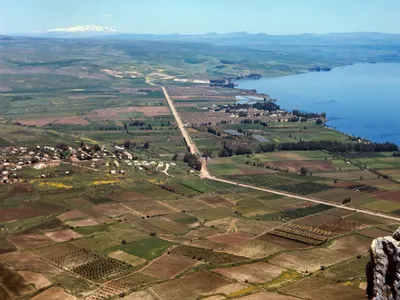
The Galilee in Israel with Mt Hermon in Background
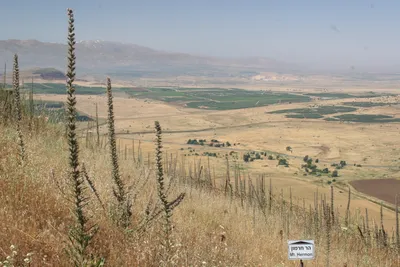
Mt. Hermon in the Summer (with Sign)
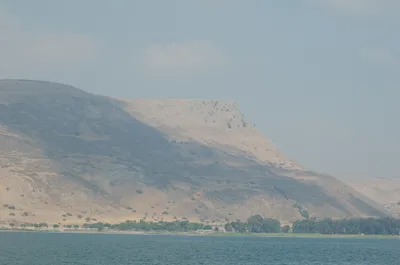
Mt. Arbel from the Sea of Galilee
1Now Moses was keeping the flock of Jethro, his father-in-law, the priest of Midian, and he led the flock to the back of the wilderness, and came to God’s mountain, to Horeb. 2Yahweh’s angel appeared to him in a flame of fire out of the middle of a bush. He looked, and behold, the bush burned with fire, and the bush was not consumed. 3Moses said, “I will go now, and see this great sight, why the bush is not burned.”
4When Yahweh saw that he came over to see, God called to him out of the middle of the bush, and said, “Moses! Moses!”
He said, “Here I am.”
5He said, “Don’t come close. Take off your sandals, for the place you are standing on is holy ground.” 6Moreover he said, “I am the God of your father, the God of Abraham, the God of Isaac, and the God of Jacob.”
Moses hid his face because he was afraid to look at God.
7Yahweh said, “I have surely seen the affliction of my people who are in Egypt, and have heard their cry because of their taskmasters, for I know their sorrows. 8I have come down to deliver them out of the hand of the Egyptians, and to bring them up out of that land to a good and large land, to a land flowing with milk and honey; to the place of the Canaanite, the Hittite, the Amorite, the Perizzite, the Hivite, and the Jebusite. 9Now, behold, the cry of the children of Israel has come to me. Moreover I have seen the oppression with which the Egyptians oppress them. 10Come now therefore, and I will send you to Pharaoh, that you may bring my people, the children of Israel, out of Egypt.”
11Moses said to God, “Who am I, that I should go to Pharaoh, and that I should bring the children of Israel out of Egypt?”
12He said, “Certainly I will be with you. This will be the token to you, that I have sent you: when you have brought the people out of Egypt, you shall serve God on this mountain.”
13Moses said to God, “Behold, when I come to the children of Israel, and tell them, ‘The God of your fathers has sent me to you,’ and they ask me, ‘What is his name?’ what should I tell them?”
14God said to Moses, “I AM WHO I AM,” and he said, “You shall tell the children of Israel this: ‘I AM has sent me to you.’” 15God said moreover to Moses, “You shall tell the children of Israel this, ‘Yahweh, the God of your fathers, the God of Abraham, the God of Isaac, and the God of Jacob, has sent me to you.’ This is my name forever, and this is my memorial to all generations. 16Go and gather the elders of Israel together, and tell them, ‘Yahweh, the God of your fathers, the God of Abraham, of Isaac, and of Jacob, has appeared to me, saying, “I have surely visited you, and seen that which is done to you in Egypt. 17I have said, I will bring you up out of the affliction of Egypt to the land of the Canaanite, the Hittite, the Amorite, the Perizzite, the Hivite, and the Jebusite, to a land flowing with milk and honey.”’ 18They will listen to your voice. You shall come, you and the elders of Israel, to the king of Egypt, and you shall tell him, ‘Yahweh, the God of the Hebrews, has met with us. Now please let us go three days’ journey into the wilderness, that we may sacrifice to Yahweh, our God.’ 19I know that the king of Egypt won’t give you permission to go, no, not by a mighty hand. 20I will reach out my hand and strike Egypt with all my wonders which I will do among them, and after that he will let you go. 21I will give this people favor in the sight of the Egyptians, and it will happen that when you go, you shall not go empty-handed. 22But every woman shall ask of her neighbor, and of her who visits her house, jewels of silver, jewels of gold, and clothing. You shall put them on your sons, and on your daughters. You shall plunder the Egyptians.”