Titus 1 (WEB)
Funerary Monuments and Sarcophagi (Aphrodisias)
The Older Women in the Church
The apostle Paul wrote a letter to his co-worker, Titus, who was laboring on the island of Crete that instructed him to “set in order the things that are lacking [in the churches on Crete], and appoint elders in every city” (Titus 1:5, all Scripture quotes are from the New King James Bible). He also told Titus to instruct the people in the churches about “things which are proper for sound doctrine” (2:1).
Of the older women in the churches, the Apostle Paul says they should be “reverent in behavior, not slanderers, not given to much wine, teachers of good things – that they admonish the younger women to love their husbands, to love their children, to be discreet, chaste, homemakers, good, obedient to their own husbands, that the Word of God may not be blasphemed” (2:3-5). I would like to look at two phrases in this admonition: “to be lovers of (their) husbands, lovers of (their) children (philandrous einai philoteknous).”
Funerary Inscriptions
The epitaphs on tombstones reveal much about an individual and how people viewed their life. In the graveyard of Trinity Church Wall Street in New York City is the tombstone of Alexander Hamilton (1755-1804). Among other things, he was an army officer in the American Revolution, the first Secretary of the Treasury (1789-1795) and lost his life in a duel with Aaron Burr the vice president of the United States. His epitaph reads: “In testimony of their respect for the Patriot of incorruptible integrity, the Soldier of approved valour, the Statesman of consummate wisdom; whose talents and virtues will be admired by grateful posterity long after this marble shall have mouldered into dust.” The one thing we admire about Hamilton today is that we can carry him around in our wallet because he is on the front of the ten dollar bill! I can also report that after 204 years, his marble gravestone is still there. It has survived the air pollution in New York City, as well as the September 11th attack.
A Sarcophagus from Aphrodisias
The ancient city of Aphrodisias is located in the Caria region of southwestern Asia Minor in Turkey today. It was named after its patron goddess Aphrodite, the goddess of love and beauty, and had an impressive sanctuary built in her honor. The city was situated next to a marble quarry and was famous throughout the Greek and Roman world for the marble statues that were sculptured there.
Just outside the entrance of the Museum of Aphrodisias, there is a marble sarcophagus that was found in the area at the end of the 19th century. On it there is a Greek inscription with three panels that describe why this sarcophagus was made and who was placed in it. It said that the city council and the people of Aphrodisias wanted to honor the deceased – Pereitas Kallimedes, and his wife Tatia, because of certain characteristics and virtues they had observed in this couple. On the third panel, on the right side of the sarcophagus, is the dedication to Tatia. It is translated: “The City Council and the People honored Tatia, daughter of Diogenes, son of Diogenes, grandson of Demrtrios Phileman, a woman who was modest, who loved her husband and children and throughout her life was endowed with dignity and virtue, and who was wife of Pereitas Kallimedes, son of Diogenes, grandson of Apollonios a man who acted piously and munificently in his public offices, embassies and public duties and in his capacity as temple overseer” [emphasis mine]. She was known for her modesty, dignity, virtue, and she loved her husband and children. The same Greek words for “loved her husband and children” are used on this epitaph that is mentioned in Titus 2:4. There are hundreds of tombstones and sarcophagi in the Greek and Roman world that have these two phrases on them describing the deceased women, several were even found on the island of Crete.
Conclusion
There is no indication that Tatia was a Christian (her husband was the priest of a pagan temple), but we do know that she exemplified some of the things the Apostle Paul instructed the older women to teach the younger women to do in the book of Titus. Today, the older Christian woman should be modeling by her life and teaching by her lips, so that the younger Christian woman will know how to love her husband and children. Perhaps someday her tombstone will also read, “She loved her husband, she loved her children.”
Gordon Franz, "Lovers of Husbands and Children," http://www.lifeandland.org/2009/02/lovers-of-husbands-and-children/, 2021. Used by Permission
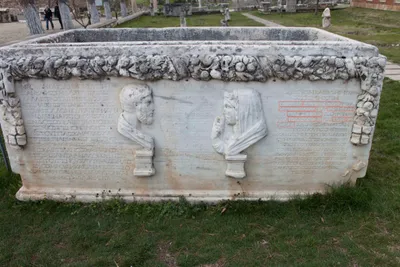
Funerary Inscription at Aphrodisias (Young wives to love their husbands and love their children)
1Paul, a servant of God and an apostle of Jesus Christ, according to the faith of God’s chosen ones and the knowledge of the truth which is according to godliness, 2in hope of eternal life, which God, who can’t lie, promised before time began; 3but in his own time revealed his word in the message with which I was entrusted according to the commandment of God our Savior, 4to Titus, my true child according to a common faith: Grace, mercy, and peace from God the Father and the Lord Jesus Christ our Savior.
5I left you in Crete for this reason, that you would set in order the things that were lacking and appoint elders in every city, as I directed you— 6if anyone is blameless, the husband of one wife, having children who believe, who are not accused of loose or unruly behavior. 7For the overseer must be blameless, as God’s steward, not self-pleasing, not easily angered, not given to wine, not violent, not greedy for dishonest gain; 8but given to hospitality, a lover of good, sober minded, fair, holy, self-controlled, 9holding to the faithful word which is according to the teaching, that he may be able to exhort in the sound doctrine, and to convict those who contradict him.
10For there are also many unruly men, vain talkers and deceivers, especially those of the circumcision, 11whose mouths must be stopped: men who overthrow whole houses, teaching things which they ought not, for dishonest gain’s sake. 12One of them, a prophet of their own, said, “Cretans are always liars, evil beasts, and idle gluttons.” 13This testimony is true. For this cause, reprove them sharply, that they may be sound in the faith, 14not paying attention to Jewish fables and commandments of men who turn away from the truth. 15To the pure, all things are pure, but to those who are defiled and unbelieving, nothing is pure; but both their mind and their conscience are defiled. 16They profess that they know God, but by their deeds they deny him, being abominable, disobedient, and unfit for any good work.