Matthew 5 (WEB)
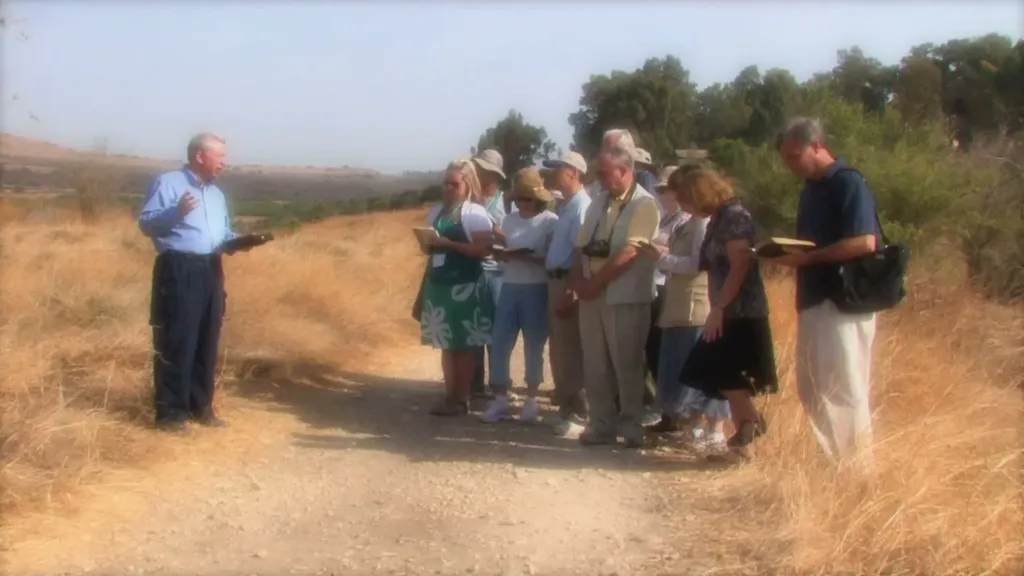
We are standing by the Sea of Galilee close to where Jesus most likely would have delivered His sermon to the multitude that followed Him.
What a spectacular view that we have here on what is called the Mount of Beatitudes in Israel, overlooking the Sea of Galilee.
This particular place that we find ourselves is the most natural location in the northwestern shore of the sea that would be the place in which Jesus gave what we think of as the Beatitudes, and also the Sermon on the Mount.
Now, we don't know exactly where Jesus was standing or sitting in this location, but we know within a few hundred meters of where we are, for sure Jesus stood.
How many, we don't know, but somewhere in this area.
And at this location we have an account from the Gospel writers — thinking particularly now this morning from Matthew — where it says that, "And seeing the multitudes,
he went up on a mountain.
And when he was seated, his disciples came to him.
Then he opened his mouth and taught them, saying, 'Blessed are the poor in spirit, for theirs is the kingdom of heaven.'"
Now, a lot can be taught in this Matthew 5 and 6 and 7, far more than a short video can do.
But rather, we see Jesus starting out with what I believe to be the most important questions that have to be addressed as you continue on in your study of what is known as the Sermon on the Mount.
Luke talks about it being the Sermon on the Plain, and I don't believe you actually have two accounts here, although it's possible that he said the same basic teaching at two places.
That's not unheard of for a preacher.
But if it is the same place, this actual location allows for there to be a plain and a hill at the same time.
So Jesus, probably as a peripatetic teacher, one who walked around, may have been here, may have been there as he continued his teaching, and the disciples would have recorded the entire account.
But if you notice the first statements of Jesus, these are not incidental or accidental.
They are deliberate, because they set the stage for what follows.
If He had not said the first statement, then in reality the rest of the Sermon on the Mount would not have the significance to us that it does.
So the words are deliberate and important.
Blessed are the poor in spirit, for theirs is the kingdom of heaven.
Blessed are those who mourn, for they shall be comforted.
Blessed are the meek, for they shall inherit the earth.
Blessed are those who hunger and thirst for righteousness…
Now, without going on further into the text, those are called the Beatitudes.
But if you'll notice, it begins and ends with the same phrase.
For theirs is the kingdom of heaven.
This is a fairly characteristic kind of device in rhetoric, where you give a beginning and ending to your talk by some kind of milestone, some kind of statement.
And the statement here is, "for theirs is the kingdom of heaven."
We know we have a beginning and an ending, like a quotation mark.
And his first statement is, "blessed are the poor in spirit."
Now, what does that mean?
The fact is, I think what the author is saying here — and by the author here I would say Matthew, as he's recording Jesus' words — is that you are blessed.
It's an unction from God, it's a recognition from God of a position, a favor.
You're blessed if you recognize your poverty rather than your greatness, if you recognize you have needs instead of having it all.
If you recognize you need help instead of you're self-sufficient.
The person that can receive God's teaching, the person who can receive God's blessings, the person who can receive God's forgiveness and assistance, is only the person who recognizes that they can't do it on their own.
See, the Pharisees had this problem.
They thought that they could do the righteousness of the commandments, all 613 of them as they developed them, because they would work for them and they would practice them and they would keep going with them until they would do it right.
And so they had a righteousness of man, but unfortunately one that never proved true.
I remember when I was in high school, I read Benjamin Franklin's autobiography, and I read a statement that he actually kept a listing of his issues in his life, and he would keep a list,
and he would work on improving it and grading himself on how he had done.
And he had all these things in life he wanted to correct — I talk too much, or I don't talk enough, or I do this and I don't do that — and he kept a record of trying to improve his life.
And the difficulty with that, as I tried to emulate Benjamin Franklin, is that I would begin to do better in an area, but something else began to slide.
Things would never get in sync.
And that's a problem with human righteousness, is that we can't really do it.
We keep falling short, like James says, to offend in one point is to break the whole law.
The fact is, God says do this, be perfect, be holy, do it right, and we start working on it and we get it partly right but partly wrong.
We never measure up to God's standards.
But there's a reason why God gave standards like that.
It's because it's to tell us that as humans we are frail and we need Him.
Can you imagine that if we could in reality do everything perfect, then we would sense no need for God.
And many people who do not do what John says in 1 John, to acknowledge their sins — "he doesn't have any need to forgive us our sins, for we have none to be forgiven."
But obviously we do.
It's a question of whether — John says, "they who say they have no sin deceive themselves," not somebody else.
And so that's what we have here.
Blessed are the poor in spirit.
When you recognize your spiritual impoverishment, yours is the kingdom of heaven.
See, if you're that kind of person who has difficulties, you're going to be comforted by God, because you've got problems and He wants to do it.
See, blessed are those that have strength but hold it back.
They could do more, but they hold their tongue.
Those people, in fact, shall inherit the earth.
See, that is just inimical to our way of thinking.
That's contrary to the way people think today.
If you want to do something, be strong, be overbearing, fight your way, make your way up the ladder.
Anybody in the way gets knocked off.
It's that kind of view.
And they're the ones that are going to inherit the earth.
And Jesus says, no, actually it's the ones that are meek.
They'll inherit the earth.
You know why?
Because we can't inherit the earth.
It's not ours to inherit.
It's God's work.
It's God's world.
The way we inherit is the fact that we have God, who is our inheritance, and we inherit it with Him.
Blessed are those who hunger and thirst — not for riches, not for fame, not for station in life, for righteousness.
You don't have it, but you want it; you'll be filled.
I'm reminded the statement of Jesus later on in the Sermon on the Mount, where he tells the disciples, unless their righteousness exceeds that of the Pharisees and the scribes,
they'll never enter the kingdom of heaven.
And that must have seemed such an insurmountable task to these rude disciples, who were not skilled in the law, not skilled — they weren't professional religious people.
They were just run-of-the-mill fishermen and tax collectors and people that seemed not to have anything going for them in the religious world.
And you have these people that are, as far as the people looking at them, these guys are the righteous ones.
They do everything right according to the law.
And Jesus says, unless your righteousness exceeds the righteousness of these people who are professionals at doing it, then you'll never enter the kingdom.
They miss it.
Why am I here?
I can't do that.
That's too much to do.
See, Jesus was trying to bring to bear what I said with the law.
That God wants us to see our incapacity so he can fill us, where he can be our righteousness.
That's what Paul means in Romans 3, when he says we have a righteousness that is apart from the law, one that is by faith.
Not faith in something irrelevant, faith in speculation, but faith in an object, the one who actually is the one who fulfilled the law and the prophets.
Jesus says, I'm the fulfillment.
So our faith in Jesus is counted to us, like Abraham, for righteousness.
So in view of the fact that we can't be righteous like the Pharisees thought they were and were not, we can, in fact, be righteous in Jesus by faith, the one who, in fact, fulfilled the law and the prophets.
So blessed are those who hunger and thirst for it, for you're going to get it.
You get it in Jesus.
Blessed are the merciful, for they shall obtain mercy.
Some people say mercy is weak.
No, mercy is strong.
Mercy is strong, not weak, because God had mercy on us, and he's certainly not weak.
Blessed are the pure in heart.
That is not to say you're sinless.
I don't think he's saying, pure in heart, blessed are the sinless people, because sinless people would not be impoverished in spirit.
He says blessed are the pure in heart.
That is, those individuals who recognize truth for what it is, and have purity of thought about it.
They are not deceivers.
They're like Nathanael, in whom is no guile.
He is not trying to make it up.
He's not trying to be a hypocrite.
He's acknowledging the truth of the matter.
That's a person who's pure in heart.
Not one who's sinless, but someone who recognizes that what he's to be doing is to be honest before God.
Integrity.
Not trying to hide himself.
For they shall see God.
Blessed are the peacemakers, for they shall be called the sons of God.
That is, people who try to get along.
As much as within you, Paul said, live at peace with all men.
Not always can you do it.
Jesus couldn't live at peace with the Roman soldiers who were crucifying him and the Jews were fighting him.
You can't always maintain peace, shalom.
But as much as within you, you don't be the person who causes the problem.
And those who are persecuted for righteousness' sake — could that be that when you're trying to do what's right, people don't respect it?
You're trying to follow the rules of God and knowing you can't, but people don't work with you on it.
They actually fight against you.
I've been in situations, and I think you have too, in which you're trying to follow the rules.
You're trying to do what is right.
You're trying to have a good attitude.
And they won't let it be.
And because you are, they're persecuting you for it.
They did that with Jesus, in whom was no guile.
For theirs is the kingdom of heaven.
These beatitudes set the stage for everything that follows, which we call the Sermon on the Mount, where he talks about all sorts of conditions in life in which we have frailty,
but God will help us.
1Seeing the multitudes, he went up onto the mountain. When he had sat down, his disciples came to him. 2He opened his mouth and taught them, saying,
3“Blessed are the poor in spirit,
for theirs is the Kingdom of Heaven.
4Blessed are those who mourn,
for they shall be comforted.
5Blessed are the gentle,
for they shall inherit the earth.
6Blessed are those who hunger and thirst for righteousness,
for they shall be filled.
7Blessed are the merciful,
for they shall obtain mercy.
8Blessed are the pure in heart,
for they shall see God.
9Blessed are the peacemakers,
for they shall be called children of God.
10Blessed are those who have been persecuted for righteousness’ sake,
for theirs is the Kingdom of Heaven.
11“Blessed are you when people reproach you, persecute you, and say all kinds of evil against you falsely, for my sake. 12Rejoice, and be exceedingly glad, for great is your reward in heaven. For that is how they persecuted the prophets who were before you.
13“You are the salt of the earth, but if the salt has lost its flavor, with what will it be salted? It is then good for nothing, but to be cast out and trodden under the feet of men.
14“You are the light of the world. A city located on a hill can’t be hidden. 15Neither do you light a lamp and put it under a measuring basket, but on a stand; and it shines to all who are in the house. 16Even so, let your light shine before men, that they may see your good works and glorify your Father who is in heaven.
17“Don’t think that I came to destroy the law or the prophets. I didn’t come to destroy, but to fulfill. 18For most certainly, I tell you, until heaven and earth pass away, not even one smallest letter or one tiny pen stroke shall in any way pass away from the law, until all things are accomplished. 19Therefore, whoever shall break one of these least commandments and teach others to do so, shall be called least in the Kingdom of Heaven; but whoever shall do and teach them shall be called great in the Kingdom of Heaven. 20For I tell you that unless your righteousness exceeds that of the scribes and Pharisees, there is no way you will enter into the Kingdom of Heaven.
21“You have heard that it was said to the ancient ones, ‘You shall not murder;’ and ‘Whoever murders will be in danger of the judgment.’ 22But I tell you that everyone who is angry with his brother without a cause will be in danger of the judgment. Whoever says to his brother, ‘Raca!’ will be in danger of the council. Whoever says, ‘You fool!’ will be in danger of the fire of Gehenna.
23“If therefore you are offering your gift at the altar, and there remember that your brother has anything against you, 24leave your gift there before the altar, and go your way. First be reconciled to your brother, and then come and offer your gift. 25Agree with your adversary quickly while you are with him on the way; lest perhaps the prosecutor deliver you to the judge, and the judge deliver you to the officer, and you be cast into prison. 26Most certainly I tell you, you shall by no means get out of there until you have paid the last penny.
27“You have heard that it was said, ‘You shall not commit adultery;’ 28but I tell you that everyone who gazes at a woman to lust after her has committed adultery with her already in his heart. 29If your right eye causes you to stumble, pluck it out and throw it away from you. For it is more profitable for you that one of your members should perish than for your whole body to be cast into Gehenna. 30If your right hand causes you to stumble, cut it off, and throw it away from you. For it is more profitable for you that one of your members should perish, than for your whole body to be cast into Gehenna.
31“It was also said, ‘Whoever shall put away his wife, let him give her a writing of divorce,’ 32but I tell you that whoever puts away his wife, except for the cause of sexual immorality, makes her an adulteress; and whoever marries her when she is put away commits adultery.
33“Again you have heard that it was said to the ancient ones, ‘You shall not make false vows, but shall perform to the Lord your vows,’ 34but I tell you, don’t swear at all: neither by heaven, for it is the throne of God; 35nor by the earth, for it is the footstool of his feet; nor by Jerusalem, for it is the city of the great King. 36Neither shall you swear by your head, for you can’t make one hair white or black. 37But let your ‘Yes’ be ‘Yes’ and your ‘No’ be ‘No.’ Whatever is more than these is of the evil one.
38“You have heard that it was said, ‘An eye for an eye, and a tooth for a tooth.’ 39But I tell you, don’t resist him who is evil; but whoever strikes you on your right cheek, turn to him the other also. 40If anyone sues you to take away your coat, let him have your cloak also. 41Whoever compels you to go one mile, go with him two. 42Give to him who asks you, and don’t turn away him who desires to borrow from you.
43“You have heard that it was said, ‘You shall love your neighbor and hate your enemy.’ 44But I tell you, love your enemies, bless those who curse you, do good to those who hate you, and pray for those who mistreat you and persecute you, 45that you may be children of your Father who is in heaven. For he makes his sun to rise on the evil and the good, and sends rain on the just and the unjust. 46For if you love those who love you, what reward do you have? Don’t even the tax collectors do the same? 47If you only greet your friends, what more do you do than others? Don’t even the tax collectors do the same? 48Therefore you shall be perfect, just as your Father in heaven is perfect.