Joshua 19 (WEB)
Possible Site of Bethsaida
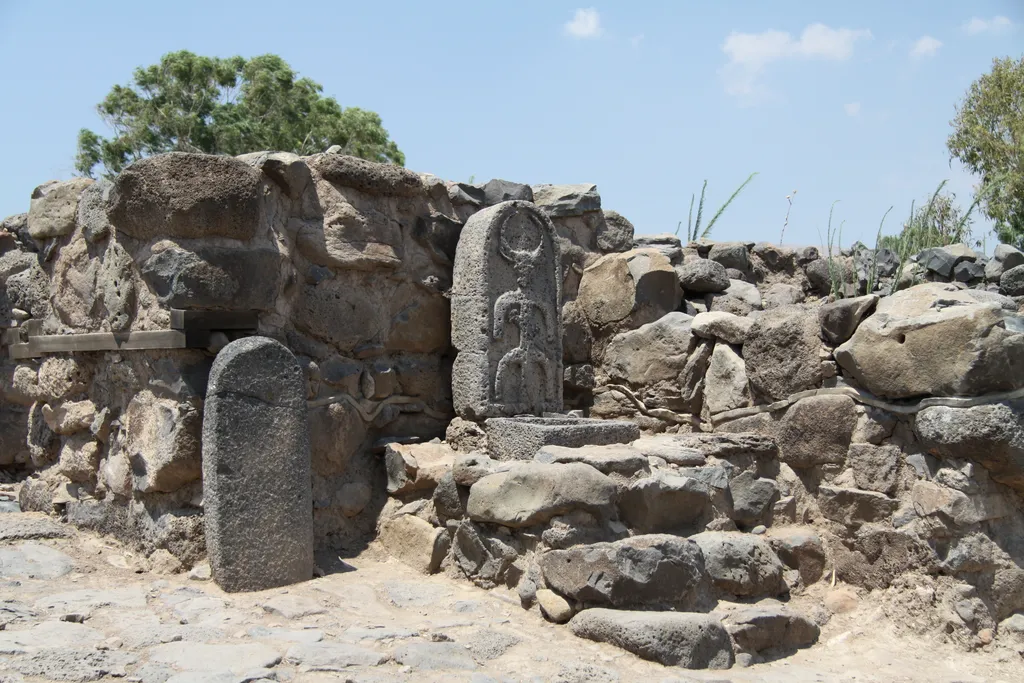
The town of Bethsaida is mentioned several times in the Gospels, and is found in each one at least once. In fact, the area between Bethsaida and Capernaum is where the majority of Jesus’ activities in Galilee took place. Here in John’s account, Bethsaida is said to be where Philip, Andrew and Peter were from (although it seems Peter moved to Capernaum at some point). In Mark’s Gospel, Jesus visits the city and heals a blind man (Mark 8:22-26), while in Matthew and Luke’s account, Jesus includes Bethsaida in His “woes” (along with Chorazin and Capernaum – Matt. 11:21, Luke 10:13).
The location of the city is to this day not known with certainty. The historical record does narrow the locality down somewhat. The Jewish historian Josephus says that Bethsaida was in the territory of Philip the Tetrarch and that he renamed the town Julias, after the wife of the emperor Augustus (and mother of Tiberias), and raised its status from village to city.1 Josephus also says that the Jordan “passes by” Bethsaida-Julius.2 Since Philip’s territory was east of the Jordan River, this puts Bethsaida on or near the East bank of the river. Theodosius, writing around A. D. 530, says that Bethsaida was six miles from Capernaum, and that the headwaters of the Jordan River was fifty miles from Bethsaida.3 This suggests that the site of the town was not far from where the Jordan empties into the Sea of Galilee. The proximity of Bethsaida to the lake is also suggested by the name of the city itself, which means “place of the fishers” in Aramaic.4 Thus two sites are identified as the most likely locations of Bethsaida: Khirbet el-Araj and et-Tell. Roman pottery has been found on the surface at both sites, confirming habitation during Jesus’ life, and both are geographically located near where the historical record says they should be.
Khirbet el-Araj is located only about fifty yards from the shore of the Sea of Galilee on the current West bank of the Jordan River. Although it is on the wrong side of the river today, this was not necessarily the case two thousand years ago, as the Jordan at this spot has changed its course many times. Gottlieb Schumacher, citing the difficulty of et-Tell’s distance from the Sea of Galilee proposed Khirbet el-Araj as the true site of Bethsaida. Although Byzantine-era artifacts have been found at the site, archaeological surveys using ground penetrating RADAR have shown that there is nothing but sand below the Byzantine layer, strongly suggesting that there was no village here during Jesus’ ministry. However, Mendel Nun, an acknowledged expert on the Sea of Galilee, has argued that the level of the Sea of Galilee was actually lower than it is today in ancient times, and therefore much of the Khirbet el-Araj site is under water.
et-Tell is about 1.2 miles from the lake on a rocky hill on the East side of the Jordan. As the name (the Mound) suggests, the site’s original name has been lost even to the locals. Although it was identified as Bethsaida by Edward Robinson in 1838, it has only been excavated since 1990 by the Consortium of the Bethsaida Excavations Project (BEP), led by Rami Arav, Richard A. Freund and John F. Shroder, Jr. and hosted by the University of Nebraska, Omaha. The site itself covers twenty acres, making it the largest archaeological site on the Sea of Galilee. They have identified et-Tell as the ancient capital of the kingdom of Geshur, perhaps called Tzer or Tzed (Josh 19:35).5 The city was therefore one of the most important cities of the Iron Age. In the ninth century B.C. it was surrounded by a nearly twenty-foot-thick wall and featured the largest biblical era gate found in Israel.6 Archaeologists found the remains of several Hellenistic courtyard type houses, inside which they found fishing net weights and needles for repairing nets, iron anchors and fish hooks.7 In another house an almost intact wine cellar was discovered. The cellar contained several wine amphorae and vine pruning hooks, leading archaeologists to the conclusion that the house belonged to a vintner.8
One of the most interesting finds was a Roman-era temple, which the BEP argues may have been built to commemorate Philip’s renaming the city after Julia. The temple follows the typical plan of Roman temples, having a columned porch, a hallway leading to a long, narrow “holy of holies,” and a rear porch. An incense shovel and several religious figurines were also found near the temple.9 Archaeologists also found decorated stones near the temple that are almost identical to stones found in the Chorazim synagogue, leading them to argue that the Chorazim stones were actually taken from the et-Tell site (they are only about three miles apart).
Although the BEP did find limestone containers, suggesting the presence of Jews in the city, the population of et-Tell was most likely almost totally gentile.10 Limestone was used exclusively by Jews for food storage due to stone’s ability to remain ritually pure, as opposed to clay pottery.
As mentioned before, a major problem with identifying et-Tell as ancient Bethsaida is et-Tell’s distance from the Sea of Galilee. However John Shroder, a geological expert and member of the BEP, examined geological maps of the area and concluded that the current shoreline of the Sea is “not necessarily the ancient shoreline.”11 Shroder argues that et-Tell sits on a very active fault line, the level of the lake is constantly changing, and that the mouth of the northern branch of the Jordan River has built up a delta where it flows into the Sea of Galilee. Thus, the site of et-Tell may very well have been near the shore in Jesus’ time.12 Other examples of this phenomenon include Ephesus, once on the shore of the Aegean, but now about six miles from the sea.
Subsequent geological investigation has lent credibility to Shroder’s argument. At the base of et-Tell sedimentary clay containing crustacean microorganisms was discovered. Further, large boulders and gravel cover the clay. Carbon 14 tests were conducted on organic material underneath this layer of boulders and gravel revealed a date range of A.D. 68-375. Shroder theorizes the cataclysmic earthquake of A.D. 363 caused a large landslide to flow across the plain where et-Tell is located, “cutting Bethsaida off from the shore.”13 After the city was cut off from the shore the city was abandoned by the fourth century. It appears Jesus’ condemnation of Bethsaida came to pass, as the city was so quickly forgotten that Byzantine pilgrims (who have been shown to be fairly accurate in their identifications of biblical sites) could not find the site, and some of them misidentified the Khirbet el-Araj site as ancient Bethsaida.
Associate photos “John 1_44 Fig 1-Bethsaida Overview,” “John 1_44 Fig 2-Bethsaida Aerial,” “John 1_44 Fig 3-Plan of Bethsaida,” “John 1_44 Fig 4-Fish net weight Bethsaida,” “John 1_44 Fig 5-Incense Shovel from et-Tell,” “John 1_44 Fig 6-Jewish Limestone pot handle,” “John 1_44 Fig 7-Diagram Showing the Shifting Shore of Galilee.”
Josephus, Antiquities, 18.2.1.28 ↩︎
Josephus, Wars, 3.10.7.515 ↩︎
Theodosius, de situ terrae sancte, ed, Geyer, ()138. ↩︎
Jack Finegan, The Archaeology of the New Testament: The Life of Jesus and the Beginning of the Early Church, (Princeton, NJ: Princeton University Press, 1992) 114. ↩︎
Rami Arav, “Toward a Comprehensive History of Geshur” pages 1-48 in Bethsaida: A City By the North Shore of the Sea of Galilee, Vol. 3, ed. by Rami Arav and Richard A. Freund (Kirksville, MO: Truman State University Press, 2004) 1. ↩︎
Israel Ministry of Foreign Affairs, “Bethsaida: An Ancient Fishing Village on the shore of the Sea of Galilee.” Online: http://www.mfa.gov.il/MFA/History/Early History - Archaeology/Bethsaida- An Ancient Fishing Village on the shore (accessed March 11, 2010). ↩︎
Mendel Nun has challenged the identification of these artefacts as fishing implements, while the BEP says that some of the artefacts initially found were misidentified, many more fishing artefacts have subsequently been found. See Steven Feldman, “The Case for el-Araj” Biblical Archaeology Review, Vol. 26, No.1 (Jan/Feb 2000). ↩︎
Israel Ministry of Foreign Affairs, “Bethsaida: An Ancient Fishing Village on the shore of the Sea of Galilee.” Online: http://www.mfa.gov.il/MFA/History/Early History - Archaeology/Bethsaida- An Ancient Fishing Village on the shore (accessed March 11, 2010). ↩︎
Rami Arav, Richard A. Freund, and John F. Shroder, Jr., “Bethsaida Rediscovered.” Biblical Archaeology Review, Vol.26, No. 1 (Jan/Feb 2000): 44-51, 53-56. ↩︎
Mark Appold, “Peter in Profile: From Bethsaida to Rome,” pages 133-148 in Bethsaida: A City By the North Shore of the Sea of Galilee, Vol. 3, ed. by Rami Arav and Richard A. Freund (Kirksville, MO: Truman State University Press, 2004) 142 ↩︎
Rami Arav, Richard A. Freund, and John F. Shroder, Jr., “Bethsaida Rediscovered.” Biblical Archaeology Review, Vol.26, No. 1 (Jan/Feb 2000): 44-51, 53-56. ↩︎
Rami Arav, Richard A. Freund, and John F. Shroder, Jr., “Bethsaida Rediscovered.” Biblical Archaeology Review, Vol.26, No. 1 (Jan/Feb 2000): 44-51, 53-56. ↩︎
Rami Arav, Richard A. Freund, and John F. Shroder, Jr., “Bethsaida Rediscovered.” Biblical Archaeology Review, Vol.26, No. 1 (Jan/Feb 2000): 44-51, 53-56. ↩︎
1The second lot came out for Simeon, even for the tribe of the children of Simeon according to their families. Their inheritance was in the middle of the inheritance of the children of Judah. 2They had for their inheritance Beersheba (or Sheba), Moladah, 3Hazar Shual, Balah, Ezem, 4Eltolad, Bethul, Hormah, 5Ziklag, Beth Marcaboth, Hazar Susah, 6Beth Lebaoth, and Sharuhen; thirteen cities with their villages; 7Ain, Rimmon, Ether, and Ashan; four cities with their villages; 8and all the villages that were around these cities to Baalath Beer, Ramah of the South. This is the inheritance of the tribe of the children of Simeon according to their families. 9Out of the part of the children of Judah was the inheritance of the children of Simeon; for the portion of the children of Judah was too much for them. Therefore the children of Simeon had inheritance in the middle of their inheritance.
10The third lot came up for the children of Zebulun according to their families. The border of their inheritance was to Sarid. 11Their border went up westward, even to Maralah, and reached to Dabbesheth. It reached to the brook that is before Jokneam. 12It turned from Sarid eastward toward the sunrise to the border of Chisloth Tabor. It went out to Daberath, and went up to Japhia. 13From there it passed along eastward to Gath Hepher, to Ethkazin; and it went out at Rimmon which stretches to Neah. 14The border turned around it on the north to Hannathon; and it ended at the valley of Iphtah El; 15Kattath, Nahalal, Shimron, Idalah, and Bethlehem: twelve cities with their villages. 16This is the inheritance of the children of Zebulun according to their families, these cities with their villages.
17The fourth lot came out for Issachar, even for the children of Issachar according to their families. 18Their border was to Jezreel, Chesulloth, Shunem, 19Hapharaim, Shion, Anaharath, 20Rabbith, Kishion, Ebez, 21Remeth, Engannim, En Haddah, and Beth Pazzez. 22The border reached to Tabor, Shahazumah, and Beth Shemesh. Their border ended at the Jordan: sixteen cities with their villages. 23This is the inheritance of the tribe of the children of Issachar according to their families, the cities with their villages.
24The fifth lot came out for the tribe of the children of Asher according to their families. 25Their border was Helkath, Hali, Beten, Achshaph, 26Allammelech, Amad, Mishal. It reached to Carmel westward, and to Shihorlibnath. 27It turned toward the sunrise to Beth Dagon, and reached to Zebulun, and to the valley of Iphtah El northward to Beth Emek and Neiel. It went out to Cabul on the left hand, 28and Ebron, Rehob, Hammon, and Kanah, even to great Sidon. 29The border turned to Ramah, to the fortified city of Tyre; and the border turned to Hosah. It ended at the sea by the region of Achzib; 30Ummah also, and Aphek, and Rehob: twenty-two cities with their villages. 31This is the inheritance of the tribe of the children of Asher according to their families, these cities with their villages.
32The sixth lot came out for the children of Naphtali, even for the children of Naphtali according to their families. 33Their border was from Heleph, from the oak in Zaanannim, Adami-nekeb, and Jabneel, to Lakkum. It ended at the Jordan. 34The border turned westward to Aznoth Tabor, and went out from there to Hukkok. It reached to Zebulun on the south, and reached to Asher on the west, and to Judah at the Jordan toward the sunrise. 35The fortified cities were Ziddim, Zer, Hammath, Rakkath, Chinnereth, 36Adamah, Ramah, Hazor, 37Kedesh, Edrei, En Hazor, 38Iron, Migdal El, Horem, Beth Anath, and Beth Shemesh; nineteen cities with their villages. 39This is the inheritance of the tribe of the children of Naphtali according to their families, the cities with their villages.
40The seventh lot came out for the tribe of the children of Dan according to their families. 41The border of their inheritance was Zorah, Eshtaol, Irshemesh, 42Shaalabbin, Aijalon, Ithlah, 43Elon, Timnah, Ekron, 44Eltekeh, Gibbethon, Baalath, 45Jehud, Bene Berak, Gath Rimmon, 46Me Jarkon, and Rakkon, with the border opposite Joppa. 47The border of the children of Dan went out beyond them; for the children of Dan went up and fought against Leshem, and took it, and struck it with the edge of the sword, and possessed it, and lived therein, and called Leshem, Dan, after the name of Dan their forefather. 48This is the inheritance of the tribe of the children of Dan according to their families, these cities with their villages.
49So they finished distributing the land for inheritance by its borders. The children of Israel gave an inheritance to Joshua the son of Nun among them. 50According to Yahweh’s commandment, they gave him the city which he asked, even Timnathserah in the hill country of Ephraim; and he built the city, and lived there. 51These are the inheritances, which Eleazar the priest, Joshua the son of Nun, and the heads of the fathers’ houses of the tribes of the children of Israel, distributed for inheritance by lot in Shiloh before Yahweh, at the door of the Tent of Meeting. So they finished dividing the land.