Joshua 15 (WEB)
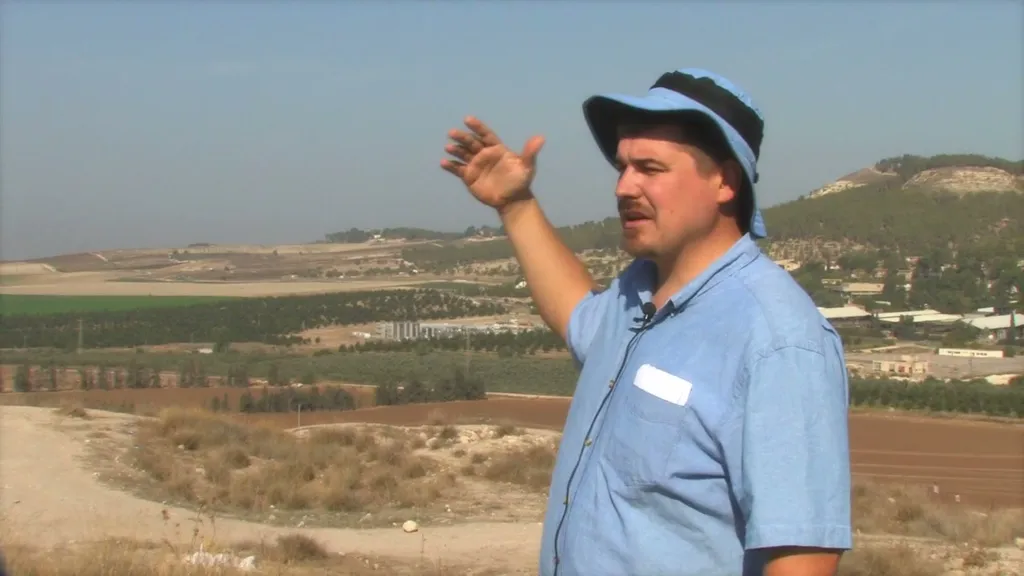
Brian Kvasnica talks about various locations around Beth Shemesh, including the return of the Ark of the Covenant.
Here we are at Beit Shemesh, a town allotted to Dan, but then taken over by Judah.
Both are mentioned in the Bible.
It is a place that is also a Levite city, a city of Levites.
It has excavation remains from the Byzantine period here all the way back to the Iron Age period, with the caves and the water cistern and gate as well.
It commands a strong view of the Sorek Valley, which controlled one access point to the hill country of Judah.
Beyond us, we see Tel Tzorah and Tel Eshtaol, the two tells and towns related to Samson.
We're very much in Samson country.
We're here on the border of the Shephelah and the Mishor, the Philistine plain.
And so Tel Batash, we can see just on the edge of the yellow field there — that is biblical Timnah.
And so Samson's tying of the foxes takes place here.
Samson grows up and is buried here.
He goes down to the Philistine cities, and here, all in the Sorek Valley.
Sorek being a prime grape, which has great irony, because Samson is not allowed to touch these grapes.
Here we can see Nahal Sorek, the little water channel spring here of the Sorek River.
And so here at Beit Shemesh we can have a grand view of where the Israelites were battling between the Philistines in the plain and the Israelites up on the hill.
This exact valley is the location where the cart is taken back by the cows, right?
The Philistines no longer want the ark.
And they send it back, and at some point — maybe a border such as we see here between the green and the yellow — the Philistines stop,
and the cows continue on, and the ark returns.
1 Samuel 6 records great rejoicing, the sacrifice of those animals, and then peeking into the ark.
So many people died.
There was great fear, that Kiryat Yarim, just up in the hill country, was called — not Israelites, but part of the Gibeonites, yes — to come and take the ark, because people were so fearful because of the thousands that had died.
Maybe to be related from a later time period, or probably buried in the same levels, are the graves, the Iron Age graves on the western side of Tel Beit Shemesh.
This tel is preserved in name for centuries, both in Arabic as well as the monastery preserving its name, both in literature as well as in archaeology.
So we have a very strong connection with the archaeology data, the literature data, and what we see here in the land.
1The lot for the tribe of the children of Judah according to their families was to the border of Edom, even to the wilderness of Zin southward, at the uttermost part of the south. 2Their south border was from the uttermost part of the Salt Sea, from the bay that looks southward; 3and it went out southward of the ascent of Akrabbim, and passed along to Zin, and went up by the south of Kadesh Barnea, and passed along by Hezron, went up to Addar, and turned toward Karka; 4and it passed along to Azmon, went out at the brook of Egypt; and the border ended at the sea. This shall be your south border. 5The east border was the Salt Sea, even to the end of the Jordan. The border of the north quarter was from the bay of the sea at the end of the Jordan. 6The border went up to Beth Hoglah, and passed along by the north of Beth Arabah; and the border went up to the stone of Bohan the son of Reuben. 7The border went up to Debir from the valley of Achor, and so northward, looking toward Gilgal, that faces the ascent of Adummim, which is on the south side of the river. The border passed along to the waters of En Shemesh, and ended at En Rogel. 8The border went up by the valley of the son of Hinnom to the side of the Jebusite (also called Jerusalem) southward; and the border went up to the top of the mountain that lies before the valley of Hinnom westward, which is at the farthest part of the valley of Rephaim northward. 9The border extended from the top of the mountain to the spring of the waters of Nephtoah, and went out to the cities of Mount Ephron; and the border extended to Baalah (also called Kiriath Jearim); 10and the border turned about from Baalah westward to Mount Seir, and passed along to the side of Mount Jearim (also called Chesalon) on the north, and went down to Beth Shemesh, and passed along by Timnah; 11and the border went out to the side of Ekron northward; and the border extended to Shikkeron, and passed along to Mount Baalah, and went out at Jabneel; and the goings out of the border were at the sea. 12The west border was to the shore of the great sea. This is the border of the children of Judah according to their families.
13He gave to Caleb the son of Jephunneh a portion among the children of Judah, according to the commandment of Yahweh to Joshua, even Kiriath Arba, named after the father of Anak (also called Hebron). 14Caleb drove out the three sons of Anak: Sheshai, and Ahiman, and Talmai, the children of Anak. 15He went up against the inhabitants of Debir: now the name of Debir before was Kiriath Sepher. 16Caleb said, “He who strikes Kiriath Sepher, and takes it, to him I will give Achsah my daughter as wife.” 17Othniel the son of Kenaz, the brother of Caleb, took it: and he gave him Achsah his daughter as wife. 18When she came, she had him ask her father for a field. She got off her donkey, and Caleb said, “What do you want?”
19She said, “Give me a blessing. Because you have set me in the land of the South, give me also springs of water.”
So he gave her the upper springs and the lower springs.
20This is the inheritance of the tribe of the children of Judah according to their families. 21The farthest cities of the tribe of the children of Judah toward the border of Edom in the South were Kabzeel, Eder, Jagur, 22Kinah, Dimonah, Adadah, 23Kedesh, Hazor, Ithnan, 24Ziph, Telem, Bealoth, 25Hazor Hadattah, Kerioth Hezron (also called Hazor), 26Amam, Shema, Moladah, 27Hazar Gaddah, Heshmon, Beth Pelet, 28Hazar Shual, Beersheba, Biziothiah, 29Baalah, Iim, Ezem, 30Eltolad, Chesil, Hormah, 31Ziklag, Madmannah, Sansannah, 32Lebaoth, Shilhim, Ain, and Rimmon. All the cities are twenty-nine, with their villages.
33In the lowland, Eshtaol, Zorah, Ashnah, 34Zanoah, En Gannim, Tappuah, Enam, 35Jarmuth, Adullam, Socoh, Azekah, 36Shaaraim, Adithaim and Gederah (or Gederothaim); fourteen cities with their villages.
37Zenan, Hadashah, Migdal Gad, 38Dilean, Mizpah, Joktheel, 39Lachish, Bozkath, Eglon, 40Cabbon, Lahmam, Chitlish, 41Gederoth, Beth Dagon, Naamah, and Makkedah; sixteen cities with their villages.
42Libnah, Ether, Ashan, 43Iphtah, Ashnah, Nezib, 44Keilah, Achzib, and Mareshah; nine cities with their villages.
45Ekron, with its towns and its villages; 46from Ekron even to the sea, all that were by the side of Ashdod, with their villages. 47Ashdod, its towns and its villages; Gaza, its towns and its villages; to the brook of Egypt, and the great sea with its coastline.
48In the hill country, Shamir, Jattir, Socoh, 49Dannah, Kiriath Sannah (which is Debir), 50Anab, Eshtemoh, Anim, 51Goshen, Holon, and Giloh; eleven cities with their villages.
52Arab, Dumah, Eshan, 53Janim, Beth Tappuah, Aphekah, 54Humtah, Kiriath Arba (also called Hebron), and Zior; nine cities with their villages.
55Maon, Carmel, Ziph, Jutah, 56Jezreel, Jokdeam, Zanoah, 57Kain, Gibeah, and Timnah; ten cities with their villages.
58Halhul, Beth Zur, Gedor, 59Maarath, Beth Anoth, and Eltekon; six cities with their villages. 60Kiriath Baal (also called Kiriath Jearim), and Rabbah; two cities with their villages.
61In the wilderness, Beth Arabah, Middin, Secacah, 62Nibshan, the City of Salt, and En Gedi; six cities with their villages.
63As for the Jebusites, the inhabitants of Jerusalem, the children of Judah couldn’t drive them out; but the Jebusites live with the children of Judah at Jerusalem to this day.