2 Timothy 4 (WEB)
Erastus Inscription in Corinth
Three persons by the name of Erastus are mentioned in the New Testament. One is mentioned alongside Timothy as a helper of Paul in Ephesus (Acts 19:22), and another is said by Paul to have remained at Corinth (2 Tim 4:20), though Paul continued his trip. Since Paul mentions him in his epistle, Timothy likely knew him. Last of all, Paul sent greetings from a man known as Erastus to the recipients of the apostle’s letter to the Romans, “Erastus, the city treasurer, and our brother Quartus greet you.” (Rom 16:23b HCSB). Paul identified this person as the ὁ οἰκόνομος τῆς πολεῶς, (ho oikonomos tes poleos) the treasurer, manager, or administrator of the city.1 The first and second Erastus listed above very likely are the same person because of the nexus with Timothy, and persons two and three are the same because of the connection to Corinth. Consequently, all three are probably the same person.2
Gillman has argued that the latter Erastus may have been a city slave,3 the likelihood is that Erastus had an important status in Corinth to warrant Paul’s mention of him as the οἰκόνομος, in the view of Thiessen.4 The Roman colony of Corinth would have had a Roman municipal structure, with the οἰκονομος as the Greek equivalent of the Latin office of aedilis.
One finds at Corinth a startling connection with Romans 16:23 in a grassy area not normally visited by tour groups today. At the head of a pavement is a long slab about a person named Erastus. Scholars agree that the inscription dates to the middle of the first century A.D. The pavement is located east of the city theater. An aedilis was commissioned with the task to manage public markets. If indeed this builder of the pavement is the same person mentioned by Paul, Erastus and Paul may have become acquainted while Erastus was about his duties of collecting rent or taxes, according to Murphy-O’Connor.5
The inscription regarding Erastus reads, “Erastus laid this pavement at his own expense, in appreciation of his appointment as aedile.”6 Only two of the three slabs of the inscription have been found. The central slab found in situ in April 1929, reads:
ERASTUS.PRO.AED
S.P.STRAVIT
Two portions of right slab were found in March 1928 and August 1947, allowing more complete reading,
ERASTUS.PRO.AEDILITatE
S.P.STRAVIT7
Thus the extant text reads in Latin,
ERASTUS PRO AEDILITATE
S.P. STRAVIT
However, Clarke, with likely wording of missing first slab, renders the inscription “Praenomen nomen Erastus in return for his aedileship laid (the pavement) at his own expense.”8
This entry is based on an article I wrote on the Erastus Inscription for a book edited by Joseph M. Holden and Norman Geisler, The Popular Handbook of Archaeology and the Bible: Discoveries That Confirm the Reliability of Scripture (2013), 358-359. I have retained copyright in the article. © 2013 H. Wayne House. All Rights Reserved.
BDAG defines οἰκονόμος as public treasurer, treasurer ὁ οικ. τῆς πόλεως the city treasurer (SIG 1252 πόλεως Κῳων οἰκονόμος; other exx. in PLandvogt, Epigr. Untersuchungen üb. den oi˙kono/moß, diss. Strassb. 1908; HCadbury, JBL 50, ’31, 47ff) Rom 16:23. BDAG, 698. ↩︎
G. A. Lee in Geoffrey W. Bromiley, The International Standard Bible Encyclopedia, Revised (Wm. B. Eerdmans, 1988; 2002). ↩︎
Florence Morgan Gillman Associate Professor, University of San Diego, San Diego, CA David Noel Freedman, The Anchor Yale Bible Dictionary (New York: Doubleday, 1996). ↩︎
G. Theissen, 1982: 76. Theissen, G. 1982. The Social Setting of Pauline Christianity. Essays on Corinth. Philadelphia. ↩︎
(Murphy-O’Connor, 1984: 155) Murphy-O’Connor, J. 1984. The Corinth That Saint Paul Saw. BA 47: 147–59. ↩︎
A. F. Walls, in D. R. W. Wood and I. Howard Marshall, New Bible Dictionary (3rd ed.; Leicester, England; Downers Grove, Ill.: InterVarsity Press, 1996), 332. ↩︎
“S.P is a standard abbreviation for sua pecunia, ‘with his own money’ (See J.H. Kent, Corinth—Inscriptions, #231 for a similar inscription celebrating a benefaction given sua pecunia).” ↩︎
For a more complete study of Erastus and the Erastus inscription, see Andrew D. Clarke, Secular & Christian Leadership in Corinth: A Socio-Historical & Exegetical Study of 1 Corinthians 1-6 (Leiden: E.J. Brill, 1993), 46-57. ↩︎
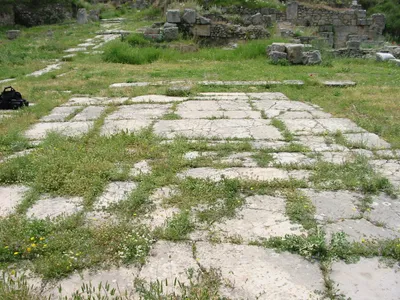
Pavement Funded by Erastus, with Inscription at the Far End
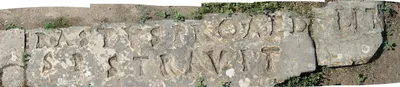
The Erastus Inscription
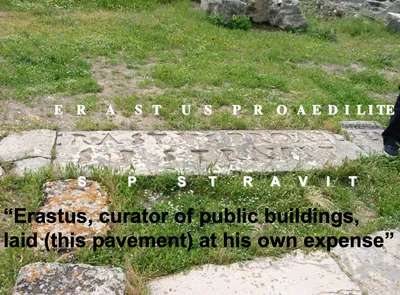
Erastus Inscription at Corinth
1I command you therefore before God and the Lord Jesus Christ, who will judge the living and the dead at his appearing and his Kingdom: 2preach the word; be urgent in season and out of season; reprove, rebuke, and exhort with all patience and teaching. 3For the time will come when they will not listen to the sound doctrine, but having itching ears, will heap up for themselves teachers after their own lusts, 4and will turn away their ears from the truth, and turn away to fables. 5But you be sober in all things, suffer hardship, do the work of an evangelist, and fulfill your ministry.
6For I am already being offered, and the time of my departure has come. 7I have fought the good fight. I have finished the course. I have kept the faith. 8From now on, the crown of righteousness is stored up for me, which the Lord, the righteous judge, will give to me on that day; and not to me only, but also to all those who have loved his appearing.
9Be diligent to come to me soon, 10for Demas left me, having loved this present world, and went to Thessalonica; Crescens to Galatia; and Titus to Dalmatia. 11Only Luke is with me. Take Mark and bring him with you, for he is useful to me for service. 12But I sent Tychicus to Ephesus. 13Bring the cloak that I left at Troas with Carpus when you come—and the books, especially the parchments. 14Alexander the coppersmith did much evil to me. The Lord will repay him according to his deeds. 15Beware of him, for he greatly opposed our words.
16At my first defense, no one came to help me, but all left me. May it not be held against them. 17But the Lord stood by me and strengthened me, that through me the message might be fully proclaimed, and that all the Gentiles might hear. So I was delivered out of the mouth of the lion. 18And the Lord will deliver me from every evil work and will preserve me for his heavenly Kingdom. To him be the glory forever and ever. Amen.
19Greet Prisca and Aquila, and the house of Onesiphorus. 20Erastus remained at Corinth, but I left Trophimus at Miletus sick. 21Be diligent to come before winter. Eubulus salutes you, as do Pudens, Linus, Claudia, and all the brothers.
22The Lord Jesus Christ be with your spirit. Grace be with you. Amen.