Revelation 1 (WEB)
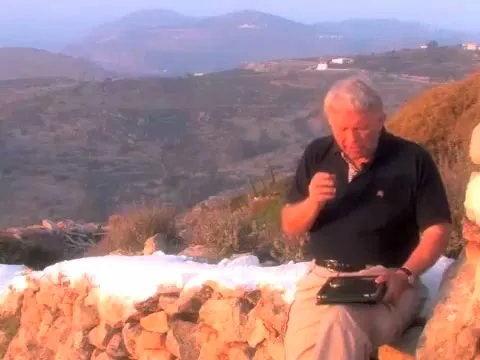
I spoke at Elijah Monastery on the highest mountain on Island of Patmos in the Aegean Sea about the proper method to interpret the book of Revelation, written by the apostle John in the late 90s of the first century A.D.
For a brief treatment (ebook) of the basic four views of interpreting the book of Revelation, see H. Wayne House, Last Things: Four Views of Revelation, https://www.amazon.com/Last-Things-Four-Views-Revelation-ebook/dp/B083NQ6D6D.
John the Apostle, when he was here on the island of Patmos that is around me right now, was visited by an angel who represented the living Lord, Jesus, the resurrected one, the one who was and is to come, the one who died and rose again,
the first and the last, the Almighty God.
So many attributes, so many statements about Jesus.
He was here receiving a vision from Jesus regarding himself and what would take place.
And in this book, in the first chapter, he provides for us an understanding of the organization of the book.
If you look in your Bibles, you'll notice that Jesus reveals himself in verse 17 of chapter 1 when he says to John, Don't be afraid, I am the first and the last.
I am he who lives and was dead, and behold, I am alive forevermore.
Amen, and I have the keys of Hades and of death.
Now verse 19 provides for us then the organization to the book, the basic structure.
Listen to the words.
He said, write the things which you have seen.
Well, that's everything that he received prior to this verse, all the way back to the beginning of chapter 1, which in fact John did.
And he says, and then the things that are, and that's what's being discussed in chapters 2 and 3, where you have the letters that go to the seven churches.
But then he says, and the things which shall take place after this, which begins in chapter 4.
As a matter of fact, when you go back and read chapter 4, you see that the angel at that point tells him that he wants to show him the things that will be.
This is the basic organizational structure to the book.
If you understand this structure that's given to us in the text, it's no mystery, it's laid out.
We understand that John's writing occurs regarding his personal interaction with Jesus, and then the seven churches, and then the future.
And based on this I would understand that the book of Revelation from chapter four on speaks not to anything present in John's day, but actually is a continuation of what Daniel attempted to do in his book.
To state forth the future of God's kingdom, the future of the coming of Christ, the future of the people of Israel, the future of all those things prophesied in the Old Testament that were not yet fulfilled and yet are to be fulfilled.
And that's what I understand happening in the book.
And not everybody understands the book that way.
There is one view called the Idealist view, that says that really the book is just sort of giving us an understanding of good and evil and the triumph of God's kingdom over Satan.
It's talking in more general terms, about almost like a parable, or it's like a story like Pilgrim's Progress or something like that, where it's telling ideals or using metaphors and symbols about good and bad.
Another view is called the Preterist view, that says that everything that's talked about in this letter from John to these churches was a discussion of what would occur prior to AD 70 and the destruction of Jerusalem.
And the fact is the book of Revelation has virtually nothing to do whatsoever with the destruction of Jerusalem.
You won't find any discussion of that here.
You will not find a discussion of the kind of cataclysmic events that are prophesied in this book that never happened in the days of the destruction of Jerusalem.
And even though some people have tried to say Josephus sought to argue something similar, my investigation of Josephus demonstrates that to be quite inaccurate.
Thirdly, we have a perspective that would be called the Historicist view, which is to say the book of Revelation largely, when talking about the seven churches, and chapter four on to the end of the book, is just talking about human history.
So they find individuals throughout the book of Revelation in history, people like Napoleon, people like various popes, Charlemagne and other rulers and people throughout history, and so the book of Revelation is sort of
a history-in-advance discussion of church history.
And I don't think that view holds either.
I think the futuristic view makes the most sense, because this is very characteristic.
This book is not merely an apocalypse.
It is also a prophetic book in the genre of what we see in the book of Isaiah or other books in the Old Testament or the book of Daniel,
where there is the attempt on the part of the prophets to say, what is God going to do as he culminates his kingdom and brings the end of the world?
How is he going to do it?
And what kind of events are going to transpire within that period of time?
And how does Jesus relate to this?
How do the Jews relate to this?
Are they going to receive back their promises that would come to them from the Old Testament, like in Zechariah, or like in the book of Isaiah, and the Millennial Kingdom, and these kinds of things?
Is this what's going to happen?
I think the book of Revelation must be read in combination with the prophets of the Old Testament, as well as the book of Daniel, and you have more of a futuristic perspective.
Now, one of the responses to that is the fact, well, how could this have any significance to people in Asia Minor if these events that John talks about really are not events that would transpire in their days, but instead 2,000 years or maybe even 3,000 years later?
How can that relate to them?
And, of course, the response to that is, well, how do you relate the prophecy of Isaiah about the virgin birth, which would be eight centuries later?
Nobody for eight centuries would have appreciated Isaiah's prophecy about a coming Messiah until Messiah came in the fullness of times.
What about those eight centuries of people?
Or even more so, what about the prophecy of Genesis 3:15, which is thousands of years removed, or Abraham in the second millennium?
These prophecies, I believe in the Revelation, are futuristic of things that will come to pass prior to the coming of Jesus.
1This is the Revelation of Jesus Christ, which God gave him to show to his servants the things which must happen soon, which he sent and made known by his angel to his servant, John, 2who testified to God’s word and of the testimony of Jesus Christ, about everything that he saw.
3Blessed is he who reads and those who hear the words of the prophecy, and keep the things that are written in it, for the time is near.
4John, to the seven assemblies that are in Asia: Grace to you and peace from God, who is and who was and who is to come; and from the seven Spirits who are before his throne; 5and from Jesus Christ, the faithful witness, the firstborn of the dead, and the ruler of the kings of the earth. To him who loves us, and washed us from our sins by his blood— 6and he made us to be a Kingdom, priests to his God and Father—to him be the glory and the dominion forever and ever. Amen.
7Behold, he is coming with the clouds, and every eye will see him, including those who pierced him. All the tribes of the earth will mourn over him. Even so, Amen.
8“I am the Alpha and the Omega,” says the Lord God, “who is and who was and who is to come, the Almighty.”
9I John, your brother and partner with you in the oppression, Kingdom, and perseverance in Christ Jesus, was on the isle that is called Patmos because of God’s Word and the testimony of Jesus Christ. 10I was in the Spirit on the Lord’s day, and I heard behind me a loud voice, like a trumpet 11saying, “What you see, write in a book and send to the seven assemblies: to Ephesus, Smyrna, Pergamum, Thyatira, Sardis, Philadelphia, and to Laodicea.”
12I turned to see the voice that spoke with me. Having turned, I saw seven golden lamp stands. 13And among the lamp stands was one like a son of man, clothed with a robe reaching down to his feet, and with a golden sash around his chest. 14His head and his hair were white as white wool, like snow. His eyes were like a flame of fire. 15His feet were like burnished brass, as if it had been refined in a furnace. His voice was like the voice of many waters. 16He had seven stars in his right hand. Out of his mouth proceeded a sharp two-edged sword. His face was like the sun shining at its brightest. 17When I saw him, I fell at his feet like a dead man.
He laid his right hand on me, saying, “Don’t be afraid. I am the first and the last, 18and the Living one. I was dead, and behold, I am alive forever and ever. Amen. I have the keys of Death and of Hades. 19Write therefore the things which you have seen, and the things which are, and the things which will happen hereafter. 20The mystery of the seven stars which you saw in my right hand, and the seven golden lamp stands is this: The seven stars are the angels of the seven assemblies. The seven lamp stands are seven assemblies.