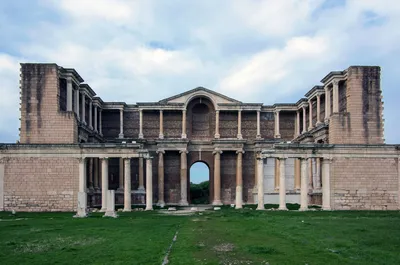
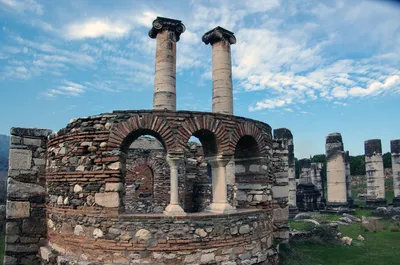
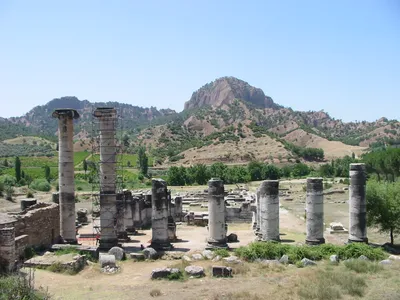
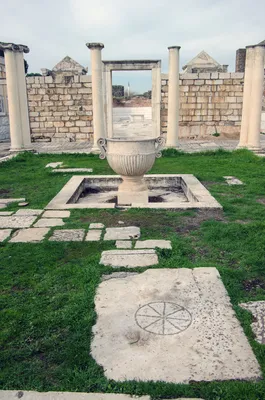
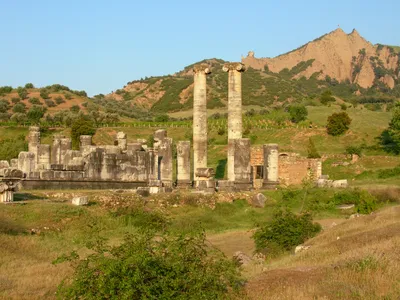
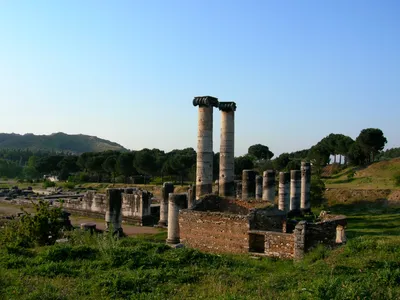
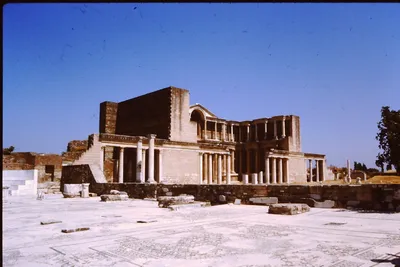
Sardis was situated inland on the south side of the fertile Hermus River valley approximately 35 miles southeast of Thyatira and 60 miles east of Smyrna. It was the capital of the Lydian empire (ca 680–547 BC). The legendary king Croesus (c 560–547 BC) derived his wealth from the gold of the Pactolus River that flowed through the city. As the west terminus of the Royal Road that ran east to the Persian capitals of Susa and Persepolis, Sardis prospered greatly from trade, especially its textiles. Following Alexander the Great’s capture of the city from the Persians in 334 B.C., it served as the western capital of the Seleucid Empire (281–190 BC). The Attalid dynasty in Pergamum controlled Sardis from 190–133 B.C. The city then became part of the Roman province of Asia. In AD 17 Sardis was devastated by an earthquake but rebuilt with aid from the emperor Tiberius. The population during the Roman period numbered between 60,000 and 100,000 residents. Sardis was the fifth church addressed by John in the book of Revelation (Rev 3:1-6). Melito was a prominent bishop of Sardis in the second century A.D. Melito’s only extant work is the Homily on the Passion as well as a letter he preserved from Antoninus Pius forbidding the koinon (commoners) of Asia to continue the persecution of Christians.
To the angel of the church at Sardis
Site Study
| Hershel Wayne House | Sardis, Turkey
The archaeological site of Sardis is 32 miles to the southeast from Thyatira and was on the Roman road between Laodicea and Pergamon, which was 38 miles away.1 Until the sixth century B.C. it was the capital of Lydia in southern Turkey, and was one of the most significant cities of Asia Minor. The city was well fortified with a moat surrounding the virtually impregnable walls, but on two occurrences was entered by foreign soldiers who scaled its walls. Wide knowledge of this may have given rise to the apostle John's statements regarding staying awake and the need to watch (Rev 3:2, 3). During emperor Tiberius' reign he helped rebuild the city from an earthquake that destroyed it in A.D. 17. Because of this the people of Sardis built a large monument in his honor, possibly contrasted by John with the pillar or monument in the pillar of God's temple (Rev 3:12). Sardis was known for its fruit, wool (cf Rev 3:4, 5), and the temple of the goddess Cybele. The gold found near the city in the river Pactolus made it wealthy, and it was the first place that coins of gold and silver were struck.2
Sardis was situated inland on the south side of the fertile Hermus River valley approximately 35 miles southeast of Thyatira and 60 miles east of Smyrna. It was the capital of the Lydian empire (ca 680–547 BC). The legendary king Croesus (c 560–547 BC) derived his wealth from the gold of the Pactolus River that flowed through the city. As the west terminus of the Royal Road that ran east to the Persian capitals of Susa and Persepolis, Sardis prospered greatly from trade, especially its textiles. Following Alexander the Great’s capture of the city from the Persians in 334 B.C., it served as the western capital of the Seleucid Empire (281–190 BC). The Attalid dynasty in Pergamum controlled Sardis from 190–133 B.C. The city then became part of the Roman province of Asia. In AD 17 Sardis was devastated by an earthquake but rebuilt with aid from the emperor Tiberius. The population during the Roman period numbered between 60,000 and 100,000 residents.
Sardis was the fifth church addressed by John in the book of Revelation (Rev 3:1-6). Melito was a prominent bishop of Sardis in the second century A.D. Melito’s only extant work is the Homily on the Passion as well as a letter he preserved from Antoninus Pius forbidding the koinon (commoners) of Asia to continue the persecution of Christians.
1This is the Revelation of Jesus Christ, which God gave him to show to his servants the things which must happen soon, which he sent and made known by his angel to his servant, John, 2who testified to God’s word and of the testimony of Jesus Christ, about everything that he saw.
3Blessed is he who reads and those who hear the words of the prophecy, and keep the things that are written in it, for the time is near.
4John, to the seven assemblies that are in Asia: Grace to you and peace from God, who is and who was and who is to come; and from the seven Spirits who are before his throne; 5and from Jesus Christ, the faithful witness, the firstborn of the dead, and the ruler of the kings of the earth. To him who loves us, and washed us from our sins by his blood— 6and he made us to be a Kingdom, priests to his God and Father—to him be the glory and the dominion forever and ever. Amen.
7Behold, he is coming with the clouds, and every eye will see him, including those who pierced him. All the tribes of the earth will mourn over him. Even so, Amen.
8“I am the Alpha and the Omega,” says the Lord God, “who is and who was and who is to come, the Almighty.”
9I John, your brother and partner with you in the oppression, Kingdom, and perseverance in Christ Jesus, was on the isle that is called Patmos because of God’s Word and the testimony of Jesus Christ. 10I was in the Spirit on the Lord’s day, and I heard behind me a loud voice, like a trumpet 11saying, “What you see, write in a book and send to the seven assemblies:to Ephesus, Smyrna, Pergamum, Thyatira, Sardis, Philadelphia, and to Laodicea.”
12I turned to see the voice that spoke with me. Having turned, I saw seven golden lamp stands. 13And among the lamp stands was one like a son of man, clothed with a robe reaching down to his feet, and with a golden sash around his chest. 14His head and his hair were white as white wool, like snow. His eyes were like a flame of fire. 15His feet were like burnished brass, as if it had been refined in a furnace. His voice was like the voice of many waters. 16He had seven stars in his right hand. Out of his mouth proceeded a sharp two-edged sword. His face was like the sun shining at its brightest. 17When I saw him, I fell at his feet like a dead man.
He laid his right hand on me, saying, “Don’t be afraid. I am the first and the last, 18and the Living one. I was dead, and behold, I am alive forever and ever. Amen. I have the keys of Death and of Hades.19Write therefore the things which you have seen, and the things which are, and the things which will happen hereafter. 20The mystery of the seven stars which you saw in my right hand, and the seven golden lamp stands is this: The seven stars are the angelsof the seven assemblies. The seven lamp stands are seven assemblies.