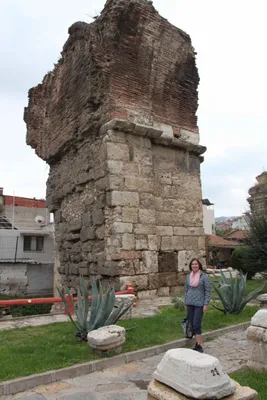
Philadelphia was located about thirty miles southeast of Sardis. Its acropolis rests on a spur of the Tmolus range with the basin of the Cogamus River stretching below. Philadelphia was founded by the king of Pergamum, Attalus II (159–138 BC). When the Romans attempted to turn Attalus against his brother Eumenes, he remained loyal, thereby earning the nickname “Philadelphus.” The city’s name thus reflects the love between these brothers.
The city’s coins featured a Macedonian shield, suggesting that Macedonians were early settlers in Philadelphia. Because of its newness, the city had few religious traditions. An inscription from around 100 B.C. documents the presence of cultic altars in the city for at least ten gods and goddesses. Inscriptional evidence shows the city having a priest of Rome and Augustus as early as 27/26 B.C. There is no archaeological evidence for a synagogue (“of Satan”; Rev 3:9). A third century A.D. inscription found east of the city does mention a “synagogue of the Hebrews.”
The city was located in an earthquake-prone region called the Catacecaumene, the “burnt land.” Both Sardis and Philadelphia were devastated by an earthquake in A.D. 17. The only crop that would produce in the volcanic soil was grapes, and vineyards dotted the countryside (and continue to do so until today). Philadelphia received a new name twice in the first century; first after the A.D. 17 earthquake to “Neocaesarea” in gratitude for Tiberius’ generosity, second to “Flavia” after Vespasian gave financial assistance following a similar catastrophe. Philadelphia is the sixth of the seven churches addressed by John in Revelation. Ammia and Quadratus are known Christian prophets from Philadelphia in the early second century. At Polycarp’s martyrdom, eleven Christians from Philadelphia were also martyred with him.
1This is the Revelation of Jesus Christ, which God gave him to show to his servants the things which must happen soon, which he sent and made known by his angel to his servant, John, 2who testified to God’s word and of the testimony of Jesus Christ, about everything that he saw.
3Blessed is he who reads and those who hear the words of the prophecy, and keep the things that are written in it, for the time is near.
4John, to the seven assemblies that are in Asia: Grace to you and peace from God, who is and who was and who is to come; and from the seven Spirits who are before his throne; 5and from Jesus Christ, the faithful witness, the firstborn of the dead, and the ruler of the kings of the earth. To him who loves us, and washed us from our sins by his blood— 6and he made us to be a Kingdom, priests to his God and Father—to him be the glory and the dominion forever and ever. Amen.
7Behold, he is coming with the clouds, and every eye will see him, including those who pierced him. All the tribes of the earth will mourn over him. Even so, Amen.
8“I am the Alpha and the Omega,” says the Lord God, “who is and who was and who is to come, the Almighty.”
9I John, your brother and partner with you in the oppression, Kingdom, and perseverance in Christ Jesus, was on the isle that is called Patmos because of God’s Word and the testimony of Jesus Christ. 10I was in the Spirit on the Lord’s day, and I heard behind me a loud voice, like a trumpet 11saying, “What you see, write in a book and send to the seven assemblies:to Ephesus, Smyrna, Pergamum, Thyatira, Sardis, Philadelphia, and to Laodicea.”
12I turned to see the voice that spoke with me. Having turned, I saw seven golden lamp stands. 13And among the lamp stands was one like a son of man, clothed with a robe reaching down to his feet, and with a golden sash around his chest. 14His head and his hair were white as white wool, like snow. His eyes were like a flame of fire. 15His feet were like burnished brass, as if it had been refined in a furnace. His voice was like the voice of many waters. 16He had seven stars in his right hand. Out of his mouth proceeded a sharp two-edged sword. His face was like the sun shining at its brightest. 17When I saw him, I fell at his feet like a dead man.
He laid his right hand on me, saying, “Don’t be afraid. I am the first and the last, 18and the Living one. I was dead, and behold, I am alive forever and ever. Amen. I have the keys of Death and of Hades.19Write therefore the things which you have seen, and the things which are, and the things which will happen hereafter. 20The mystery of the seven stars which you saw in my right hand, and the seven golden lamp stands is this: The seven stars are the angelsof the seven assemblies. The seven lamp stands are seven assemblies.