Mark 2 (WEB)
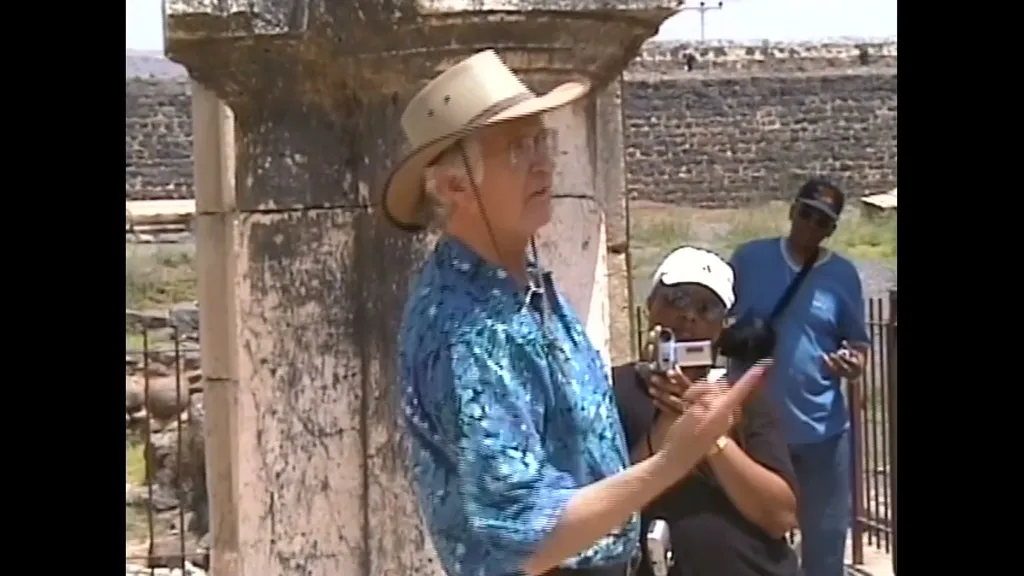
Dr. Ronning speaks about "the real Jesus of the Scriptures," the one who raises the sick and forgives sins at Capernaum.
Let's take something that happened here where the man comes down through the roof.
We all know this story.
Because there was such a crowd, they had to open the roof tiles and let the man down.
And Jesus says, God forgives you, I forgive you, you're healed.
No, none of these.
He says, "Your sins are forgiven you."
The grammar of that sentence never bothered us English speakers.
And it doesn't bother Greek speakers.
But one of my friends was looking at that, asking, what did Jesus say in Hebrew?
He said, that's strange.
Passive is very unusual in ancient Hebrew.
He said, I wonder if the Greek translator just flipped it into the passive, your sins are forgiven you.
So what do you do?
You go to Jesus' Bible.
Find out where it talks about sins, what kind of words are used when it talks about sins.
And he thought that he wouldn't find the passive construction.
But he did, to his own surprise.
It's in Leviticus, four, five, six, seven, eight, in those chapters.
And that's all, however.
It's repeated twice in Numbers, that's it.
Very special, unusual, stereotype of an expression in one context only, and that's when somebody has offered a sacrifice for the forgiveness of sins, and it says that the priest is standing at the door of the sanctuary and will make atonement for that person, and his sins will be forgiven him.
What did his Jewish people standing around him say?
Only God can forgive sins.
Or in one of the other parallel gospels, this man is blaspheming.
Now, Jesus knew that that's what they were thinking.
So what does he say?
He goes humorous, ironic.
Which is easier to say?
Your sins are forgiven, or rise, take up your bed and walk?
But so that you may know the Son of Man has authority on earth to forgive sins, take up your bed and walk.
And their hair stood up on their arms.
They said, "We have seen strange things today."
Now, see, this is the honest thing to do when we read about Jesus.
Not try to make out that he's a wonderful, ethical teacher and some of his disciples got hyper and started claiming he was divine.
And all of this kind of stuff that we can read among our liberal Christians.
Are they brothers or aren't they brothers?
And that's not fair, that's not honest.
The people, his own people knew what he was claiming.
And then you can accept or you can reject.
But it's not fair to try to write him off as the Galilean peasant.
There's a book called that.
The marginal Jew, there's a book called that, as some of our liberal scholars already…
Jesus knew who he was.
He didn't go around beating his chest on the Messiah.
But even when he said the Son of Man has authority…
Now, Son of Man in our Christian theology, we agree that's his humanity.
Son of God is his divinity.
But if you think about it in the Hebrew culture, where's Son of Man coming from?
Daniel.
The Son of Man who sits at the right hand of the Ancient of Days is coming in power and great glory, judge the quick and the dead at the end of time.
This is the kind of imagery in Daniel and in Enoch that didn't get into the canon.
And Jesus is using a word that is much more divine than Messiah, which could be a political leader to kick the Romans out.
He's saying, so you know the Son of Man has authority to forgive sins.
And he uses a word in Hebrew that in the entire Hebrew Bible is used only about God.
Nowadays, if you just bump, you can say, forgive me or excuse me, if you bump somebody.
And in modern Hebrew too, you can, but not in biblical Hebrew.
So he's using that passive construction, he's using the word for forgiveness that's used only about God in the whole Hebrew Bible, and they knew what he was claiming,
and some accepted, and some rejected.
We're only two and a half percent of us in this whole country that are Christians, and that's true whether it's in the state of Israel or in the Palestine Authority.
We're two and a half percent, and it's a real challenge to the faith of a young person.
What have I got that they don't have?
Because there's a tremendous variety of religiosity in Islam, a tremendous variety of religiosity in Judaism, and unless we remember what we just heard up on the hill of Beatitudes,
that we have to invite in the spirit of Jesus, because he's recommending a way of life that it's not humanly possible to live unless we invite in his spirit and start stretching to be more like him,
we can't do it.
I did what Wayne did up there once on the Mount of Beatitudes.
I had a group of theology students from Emory University, and one of them said, oh, this is wonderful.
High moral, ethical teachings.
There is nothing like it anywhere.
There is no religion that commands Christianity.
It doesn't really matter if Jesus ever lived or not.
We've got the greatest ethics of all.
And you knew that he had never, ever tried to live that.
Because the Ten Commandments are enough to let us know that we're not fully obeying God's will.
And Jesus takes the last commandment, the intention.
Don't even want what belongs to somebody else, and he applies it all across the board.
He doesn't throw out the Ten Commandments, he intensifies them.
Don't murder, don't even think about it, don't hate.
And so, we're confronted with the real Jesus.
Jesus Christ Superstar, the rock opera.
Do you really think you are who they say you are?
And in that rock opera, the cynical implication is no. And Judas is kind of a more interesting character.
I know personally a young Jewish person who asked himself that question seriously for the first time in his life.
Do you really think you are who they say you are?
And that's where the Holy Spirit got ahold of him and let him become a Messianic believer.
Well, Jesus knew who he was.
He claimed it.
His own people understood it.
And some accepted it.
Some rejected it.
That's the honest thing to do.
And so let's hold out for the real Jesus of the Scriptures.
And now we have seen what we can learn.
And so send your young people to come and to live here if they have a flair for languages and can learn Hebrew and Greek, like the situation in the first century.
People in this country, some of them knew five languages, because, of course, they knew Hebrew with their own language as Jews.
They knew Aramaic, which was like the French of those days, the outgoing international language.
They knew Greek, which was the English of those days, the main international language.
Some of them knew Latin to deal with the Roman authorities.
And some of them who were traders knew Arabic to deal with the Nabataean Arabs that are over on the other side of the rift valley.
So, Jesus is speaking Hebrew for sure, knows some Aramaic and Greek, I assume, and look what we found out by asking what did he say in his own language in Hebrew.
The insights that are there to help our church stay true to the Bible and to the Jesus of the Bible, and not what some of our scholars are doing with Him.
Because they don't want to commit their lives, and don't realize what we've heard this morning before, that without His Spirit, we are not going to be able to live what He's teaching, what He's being an example for,
for us.
1When he entered again into Capernaum after some days, it was heard that he was at home. 2Immediately many were gathered together, so that there was no more room, not even around the door; and he spoke the word to them. 3Four people came, carrying a paralytic to him. 4When they could not come near to him for the crowd, they removed the roof where he was. When they had broken it up, they let down the mat that the paralytic was lying on. 5Jesus, seeing their faith, said to the paralytic, “Son, your sins are forgiven you.”
6But there were some of the scribes sitting there and reasoning in their hearts, 7“Why does this man speak blasphemies like that? Who can forgive sins but God alone?”
8Immediately Jesus, perceiving in his spirit that they so reasoned within themselves, said to them, “Why do you reason these things in your hearts? 9Which is easier, to tell the paralytic, ‘Your sins are forgiven;’ or to say, ‘Arise, and take up your bed, and walk’? 10But that you may know that the Son of Man has authority on earth to forgive sins”—he said to the paralytic— 11“I tell you, arise, take up your mat, and go to your house.”
12He arose, and immediately took up the mat and went out in front of them all, so that they were all amazed and glorified God, saying, “We never saw anything like this!”
13He went out again by the seaside. All the multitude came to him, and he taught them. 14As he passed by, he saw Levi the son of Alphaeus sitting at the tax office. He said to him, “Follow me.” And he arose and followed him.
15He was reclining at the table in his house, and many tax collectors and sinners sat down with Jesus and his disciples, for there were many, and they followed him. 16The scribes and the Pharisees, when they saw that he was eating with the sinners and tax collectors, said to his disciples, “Why is it that he eats and drinks with tax collectors and sinners?”
17When Jesus heard it, he said to them, “Those who are healthy have no need for a physician, but those who are sick. I came not to call the righteous, but sinners to repentance.”
18John’s disciples and the Pharisees were fasting, and they came and asked him, “Why do John’s disciples and the disciples of the Pharisees fast, but your disciples don’t fast?”
19Jesus said to them, “Can the groomsmen fast while the bridegroom is with them? As long as they have the bridegroom with them, they can’t fast. 20But the days will come when the bridegroom will be taken away from them, and then they will fast in that day. 21No one sews a piece of unshrunk cloth on an old garment, or else the patch shrinks and the new tears away from the old, and a worse hole is made. 22No one puts new wine into old wineskins; or else the new wine will burst the skins, and the wine pours out, and the skins will be destroyed; but they put new wine into fresh wineskins.”
23He was going on the Sabbath day through the grain fields; and his disciples began, as they went, to pluck the ears of grain. 24The Pharisees said to him, “Behold, why do they do that which is not lawful on the Sabbath day?”
25He said to them, “Did you never read what David did when he had need and was hungry—he, and those who were with him? 26How he entered into God’s house at the time of Abiathar the high priest, and ate the show bread, which is not lawful to eat except for the priests, and gave also to those who were with him?”
27He said to them, “The Sabbath was made for man, not man for the Sabbath. 28Therefore the Son of Man is lord even of the Sabbath.”