Matthew 3 (WEB)
The Transfiguration of Jesus on Mt. Hermon
Matthew's reference to a high mountain in Matt 17:1 probably refers to a spur of Mt. Hermon, which rises about 9,400 feet above sea level, and may be the same high mountain to which he took Jesus during his third temptation in Matt 4:8. Mt. Hermon is in the upper Golan in the vicinity of Caesarea Philippi. Since it is by far the highest mountain in the area, its selection for the transfiguration is probably a more likely location than Mt. Tabor, the traditional site in lower Galilee, which is less than 1,900 feet in elevation. If Mt. Hermon were the location of both the temptation and transfiguration of Christ, it would account not only for Matthew’s choice of the same phrase to describe them, but also provide a satisfying symmetry: The glory of this world’s kingdoms that Jesus refused to seize apart from the Father’s good pleasure and timing, is the glory with which He will one day return as the beloved Son with whom the Father is well pleased (cf., Matt 16:27; 17:5)!
After Peter's affirmation in Matt 16:16 that Jesus was the Messiah, Son of God, something that could only come from God's revelation, Jesus said that upon this confession Jesus would build His church. The spectacular appearance of Jesus on Mt. Hermon, in which He appeared as the sun (reflecting the Shekinah glory of Yahweh to Moses in the bush that was burning but not consumed in Exod 3:6), was in combination with the representative of the Law and the Prophets, Moses and Elijah (also see Luke 24:27 statement of the risen Messiah).
After Peter's expression to building tents for the three of them, God speaks from heaven (similar to the statement at Jesus' baptism, "This is my beloved Son, in whom I am well pleased. Listen to him" (Matt 3:17; see Ps 2:7; Isa 42:1). God's latter statement may reflect Deut 18:15).
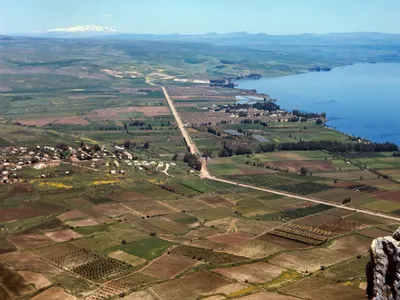
The Galilee in Israel with Mt Hermon in Background
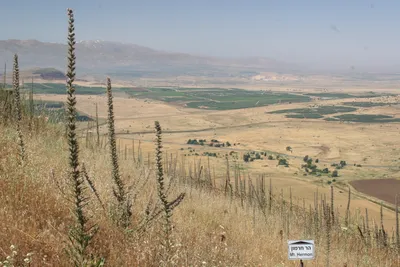
Mt. Hermon in the Summer (with Sign)
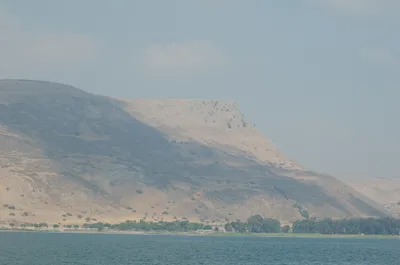
Mt. Arbel from the Sea of Galilee
1In those days, John the Baptizer came, preaching in the wilderness of Judea, saying, 2“Repent, for the Kingdom of Heaven is at hand!” 3For this is he who was spoken of by Isaiah the prophet, saying,
“The voice of one crying in the wilderness,
make the way of the Lord ready!
Make his paths straight!”
4Now John himself wore clothing made of camel’s hair with a leather belt around his waist. His food was locusts and wild honey. 5Then people from Jerusalem, all of Judea, and all the region around the Jordan went out to him. 6They were baptized by him in the Jordan, confessing their sins.
7But when he saw many of the Pharisees and Sadducees coming for his baptism, he said to them, “You offspring of vipers, who warned you to flee from the wrath to come? 8Therefore produce fruit worthy of repentance! 9Don’t think to yourselves, ‘We have Abraham for our father,’ for I tell you that God is able to raise up children to Abraham from these stones. 10Even now the ax lies at the root of the trees. Therefore every tree that doesn’t produce good fruit is cut down, and cast into the fire.
11“I indeed baptize you in water for repentance, but he who comes after me is mightier than I, whose sandals I am not worthy to carry. He will baptize you in the Holy Spirit. 12His winnowing fork is in his hand, and he will thoroughly cleanse his threshing floor. He will gather his wheat into the barn, but the chaff he will burn up with unquenchable fire.”
13Then Jesus came from Galilee to the Jordan to John, to be baptized by him. 14But John would have hindered him, saying, “I need to be baptized by you, and you come to me?”
15But Jesus, answering, said to him, “Allow it now, for this is the fitting way for us to fulfill all righteousness.” Then he allowed him.
16Jesus, when he was baptized, went up directly from the water: and behold, the heavens were opened to him. He saw the Spirit of God descending as a dove, and coming on him. 17Behold, a voice out of the heavens said, “This is my beloved Son, with whom I am well pleased.”