Matthew 16 (WEB)
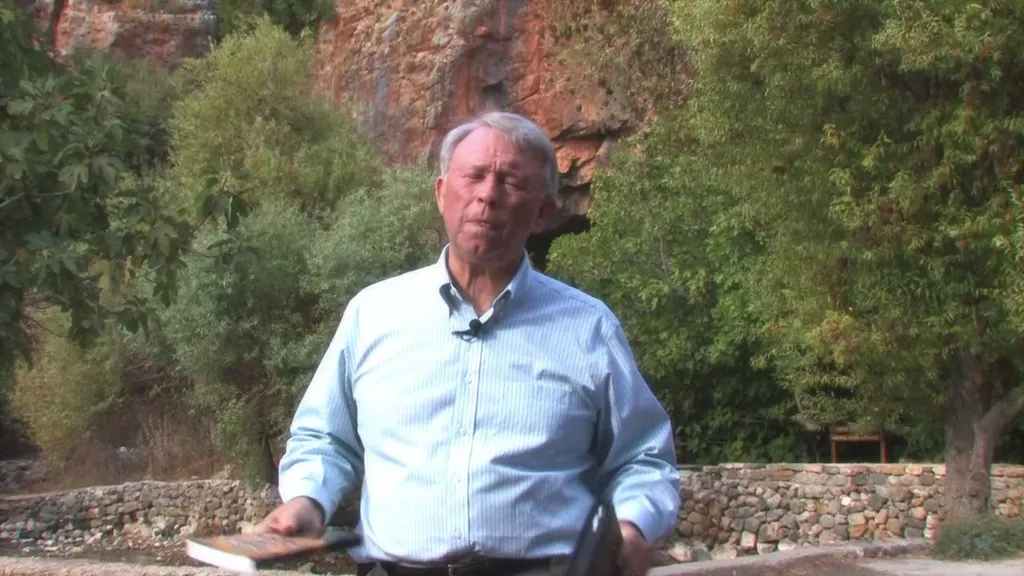
This talk was given at Caesarea Philippi in the Golan area of Israel. Upon entering that area, near the famous Gentile worship center of Panias, named for the god Pan, he asked the disciples what people said about him, and what the disciples believed Him to be. The response of Peter is the most important answer that a human can give to the question by Jesus.
I'm standing at Caesarea Philippi in Upper Israel called the Golan, in a place that's named today Banias, but in the days of the Greeks, Panias, after the god Pan,
a person who is worshipped at this particular shrine — also called Caesarea Philippi in the New Testament, named after Caesar Augustus, but also Philip, one of the sons of Herod who was reigning in this particular region of Israel.
And it's here that, in my way of thinking, the two most important questions and answers that could ever be given were made.
It's here where Jesus, on the road to this area — we don't know exactly whether he came here, but the text indicates on a road to this area — he posed the question,
"Whom do men say that I am?"
And then another question: "Whom do you say that I am?"
It's that very duet of questions that caused me to write a book called The Jesus Who Never Lived.
And I start off the book with this issue.
How have we come to understand Jesus?
Is Jesus really the way he is portrayed in the media, in world religions, in the cults, in ancient heresies, in the medieval church, and even in the contemporary Christian church — the Jesus who actually existed?
Or have we, in these variations, come up with another Jesus?
It says in Matthew chapter 16 verse 13, when Jesus came into the region of Caesarea Philippi, he asked his disciples, saying, "Who do men say that I, the Son of Man, am?"
And so they said, "Some say John the Baptist, and some Elijah, and others Jeremiah or one of the prophets."
Now, when I read this passage about a year ago, standing in this very place we're standing now — why would the people around this area, to whom his disciples had inquired apparently, or they had heard about Jesus, why would they come up with these four characters?
For all of them are dead.
Why would they think that Jesus was John the Baptist, who had been beheaded over in Jordan?
Why would they think Elijah, who was transfigured in some way up in a fiery chariot and is no longer around?
Why Jeremiah, who was killed in the days of the Babylonian period?
And why one of the prophets, who existed in the past, because there was no prophet during the intertestamental period?
So why do they think that Jesus might have been one of these people?
And I try to work through this a little bit in my mind: what would give rise to that?
Well, one thing is that these people believed in resurrection.
They thought it was possible for the dead to come back to life.
But why John the Baptist, if he is one of the ones who came back to life?
It's possible they had not heard about John being beheaded, and they had never seen him on the nightly news; they didn't know what he looked like.
But it may very well be that they believe that, even though he had been put to death by Herod, that he in fact had been brought back, because Jesus preached with the intensity of a John.
He also baptized in a similar fashion to John, so maybe that's the reason.
And then I thought, well, what about Elijah?
Why would it be Elijah?
Well, it has certainly nothing to do with the fact of some kind of transfiguration, because they didn't observe that.
But there is something about Elijah that's interesting.
Elijah was a man who did miracles.
And Jesus was known as a great wonder worker, a miracle person.
Someone who proliferated bread and fishes.
And that surely would have traveled.
And yet we know that Elijah himself did a similar kind of miracle.
What about Jeremiah?
Some people have thought maybe Jesus was — maybe Jeremiah — that has come back to life, because the weeping prophet…
People say Jesus weeped.
You know that famous passage, "Jesus wept."
But actually there's something else.
I don't think it's the fact that Jeremiah was sorrowful that gave rise to this identification of Jeremiah and Jesus.
Rather, Jeremiah was a person who preached a statement of judgment, and Jesus did too.
I know we tend to think of Jesus as someone who just goes around telling people to be nice and obey God, and talks about little children and everybody — meek and mild, lowly Jesus.
But Jesus actually was a prophet of judgment.
Read the text.
When you read through the Gospels, he talks about judgment that has come upon places like Chorazin and Tyre and Sidon and other places in this nation.
He talks about judgment that's coming upon Jerusalem, even in Matthew 24 and Mark 13.
He talks about judgment on the Jewish people because they have followed false teaching and false religion.
This sounds like Jeremiah to me.
Matter of fact, Jeremiah chapter 7, it talks about the sermon that Jeremiah did, where he talked about the leaders who trusted in the temple, who said, "This is the temple of the Lord, this is the temple of the Lord, this is the temple of the Lord."
And yet, even though that was the temple of the Lord, that first temple, the Babylonians destroyed it.
They could not trust in the temple and at the same time be disobedient to the God of the temple.
Same is true in A.D. 70.
Jesus prophesied the destruction of the second temple.
People were trusting in that temple too, because we even know from reading Josephus that people were saying, "The Romans can't take this, because we have the temple."
And yet they were not obedient to the God of the temple.
Matter of fact, they had even rejected the son who came from the father to this nation.
Well, Jeremiah seems like maybe a good choice too.
And then they say, well, if it's not them, who is it?
But we know one thing: he's some kind of resurrection of some prophet, because he's clearly prophetic in his approach, in his message, in his acts.
Well, I suppose if you or me were to be viewed as one of these people, that might be okay; that would be a pay raise, as it were; that would be a move up for me.
But Jesus was God in the flesh, and since he was God in the flesh, it's no promotion to be Jeremiah or John — even though he was the greatest of the prophets — or Jeremiah or Elijah, any of these.
The fact is, Philippians chapter 2 tells us, though, "Who, being in very nature God, thought it not something to take advantage of," that is, being equal with God,
"but He took upon Himself the form of a servant and endured the death on the cross."
So even though the people may have had some kind of sense of Jesus and His character, they really didn't fully understand.
But the question is, did the disciples understand?
For he came back to them and said, "But who do you say that I am?"
Now Simon Peter, in one of his better days — because he had bad days too — he said, "You are the Messiah, the Son of the living God."
What a pronouncement.
I said, what's the most important question you can ever ask?
Who is this person called Jesus?
I'm reminded of the movie and the play called Jesus Christ Superstar, and the woman called Mary Magdalene in that particular play says, "Are you," speaking of Jesus, "who you really think you are?"
And she had a hard time, because she said, well, he's just a man.
He's just a man.
Well, he is a man.
We know he is man and God in one person.
And so the question to the disciples is, who am I?
And Peter gets it right.
He says, "You're the Messiah.
You're the Son of the living God."
But Peter then receives an answer from Jesus, maybe that he wasn't anticipating, but he says, you know what?
He says, "Peter," he says, "you are Simon bar Jonah.
You are the son of Jonah.
For flesh and blood has not revealed this to you, but my Father who is in heaven."
Do you catch what he's saying?
He says here, you would never have figured this out any more than all these people who came up with bad answers, wrong answers, inadequate answers.
You wouldn't have done any better had it not been for one thing.
The Father has revealed it to you.
I think that's an important lesson for us to know, because we do not come to understand the divine apart from the divine revealing it to us.
We by searching cannot find out God.
God is too great for us to know apart from Him deciding to make Himself known.
And so God has revealed Himself in Jesus, He who is the very image of the Father.
And the fact is he tells Simon, he says, the Father revealed this to you, and that's why you got it right.
Then we come to this passage that a lot of people think about.
It says something about, "Peter, on this rock I will build my church, and the gates of Hades shall not prevail against it."
What is he referring to?
Well, we sort of get an idea of what he's referring to here, because they are in the region of Caesarea Philippi, and I don't know how close they were to this structure that you see behind me.
This structure has a temple to Augustus in its past.
Not there now, but it used to be.
Also had niches in the wall to gods, including the god Pan, after whom the site was originally Panias, today called Banias, because the Arabs do not use the P but instead the B.
And of course Caesarea Philippi, that we know from scripture.
But this was a worship shrine.
This was a place of pagan worship, not worship of the true and living God.
What an ideal contrast that Jesus can use.
Because here he says, "upon this rock" — what rock?
What rock are we talking about?
Remember that Jesus very regularly uses those things that are around him to teach lessons.
When he's near the fields, he will talk about the sower and the farming.
When he's near the Sea of Galilee, he talks about fishermen.
He talks about nets and boats.
And may I suggest that it's reasonable to believe that near Caesarea Philippi, whether he was here in front of this structure or not, certainly he knew about it.
And they thought this to be one of the entrances to Hades.
There were several in the Greek world, places that you could get to the underworld.
This is one such.
So does it make sense to say — he says, "upon this rock"?
What rock?
Well, see, there are two Greek words here.
The word for Peter is a rock that really is just a small stone.
Something that's like a piece of the rock.
But he says, "No, no, you're Peter, a small stone.
And upon this rock" — and that rock is another Greek word.
And that word means a massive structure, like you see behind you.
Not a small stone lying on the ground, but something that protrudes out of the earth in magnificence, that it would take an atomic explosion to destroy, and probably not even then.
See, it's upon this rock, illustratively, I will build my church.
But what is that rock?
Is that rock Peter?
Some people think so.
I really don't.
I think Jesus is saying this.
He says, I've asked a question of you.
Who am I?
And Peter says, I know who you are.
You're the Messiah, the Son of the living God.
And then Jesus responds and says, you know what?
You're right.
I am.
And you're Peter.
And it's on this confession that you've made of me, Peter, it's on that confession of faith in me as the Son of the living God, it's that strong rock, that Gibraltar,
that I'm building the church.
And with that, even the gates of Hades, like at Caesarea Philippi as people view it, it cannot prevail against the church, because it's built upon the proclamation of who Jesus really is — the Jesus who truly lived, and not one that we've imagined or patterned after ourselves and our desires,
but one who comes as a living God into our midst to lead us to salvation in his kingdom.
1The Pharisees and Sadducees came, and testing him, asked him to show them a sign from heaven. 2But he answered them, “When it is evening, you say, ‘It will be fair weather, for the sky is red.’ 3In the morning, ‘It will be foul weather today, for the sky is red and threatening.’ Hypocrites! You know how to discern the appearance of the sky, but you can’t discern the signs of the times! 4An evil and adulterous generation seeks after a sign, and there will be no sign given to it, except the sign of the prophet Jonah.”
He left them and departed. 5The disciples came to the other side and had forgotten to take bread. 6Jesus said to them, “Take heed and beware of the yeast of the Pharisees and Sadducees.”
7They reasoned among themselves, saying, “We brought no bread.”
8Jesus, perceiving it, said, “Why do you reason among yourselves, you of little faith, because you have brought no bread? 9Don’t you yet perceive or remember the five loaves for the five thousand, and how many baskets you took up, 10or the seven loaves for the four thousand, and how many baskets you took up? 11How is it that you don’t perceive that I didn’t speak to you concerning bread? But beware of the yeast of the Pharisees and Sadducees.”
12Then they understood that he didn’t tell them to beware of the yeast of bread, but of the teaching of the Pharisees and Sadducees.
13Now when Jesus came into the parts of Caesarea Philippi, he asked his disciples, saying, “Who do men say that I, the Son of Man, am?”
14They said, “Some say John the Baptizer, some, Elijah, and others, Jeremiah or one of the prophets.”
15He said to them, “But who do you say that I am?”
16Simon Peter answered, “You are the Christ, the Son of the living God.”
17Jesus answered him, “Blessed are you, Simon Bar Jonah, for flesh and blood has not revealed this to you, but my Father who is in heaven. 18I also tell you that you are Peter, and on this rock I will build my assembly, and the gates of Hades will not prevail against it. 19I will give to you the keys of the Kingdom of Heaven, and whatever you bind on earth will have been bound in heaven; and whatever you release on earth will have been released in heaven.” 20Then he commanded the disciples that they should tell no one that he was Jesus the Christ.
21From that time, Jesus began to show his disciples that he must go to Jerusalem and suffer many things from the elders, chief priests, and scribes, and be killed, and the third day be raised up.
22Peter took him aside and began to rebuke him, saying, “Far be it from you, Lord! This will never be done to you.”
23But he turned and said to Peter, “Get behind me, Satan! You are a stumbling block to me, for you are not setting your mind on the things of God, but on the things of men.”
24Then Jesus said to his disciples, “If anyone desires to come after me, let him deny himself, take up his cross, and follow me. 25For whoever desires to save his life will lose it, and whoever will lose his life for my sake will find it. 26For what will it profit a man if he gains the whole world and forfeits his life? Or what will a man give in exchange for his life? 27For the Son of Man will come in the glory of his Father with his angels, and then he will give to everyone according to his deeds. 28Most certainly I tell you, there are some standing here who will in no way taste of death until they see the Son of Man coming in his Kingdom.”