Hebrews 9 (WEB)
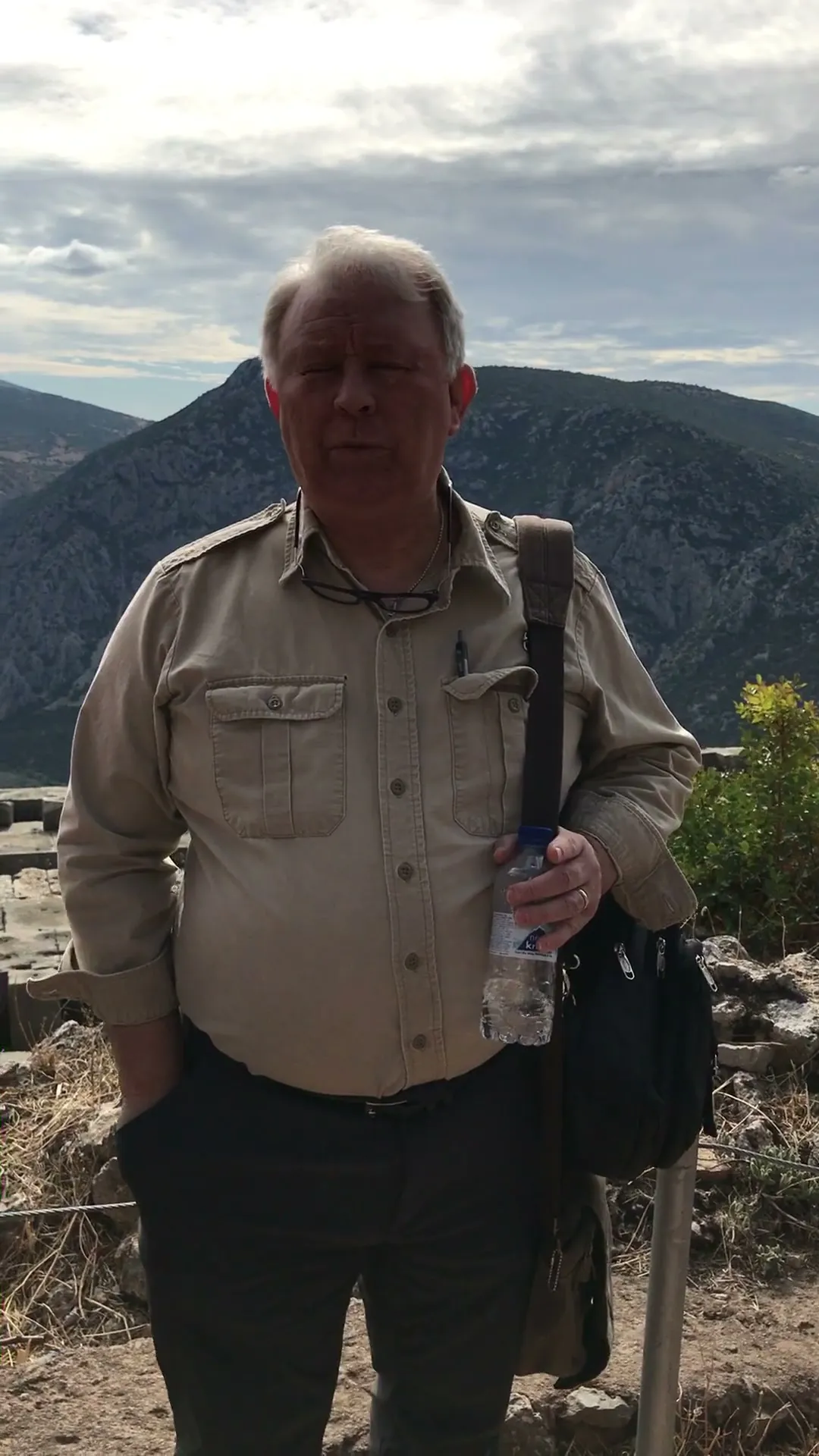
Many ancient temples had a Holy of Holies, such as the Temple of Apollo at Delphi and Temple of Ramses II in Egypt, but though the Jewish temple and the pagan temples had this similar feature within their temples, the Holy of Holies was different in many important respects and for important reasons.
Video by courtesy of Irina House
Something that might be running across your mind right now is you have a temple and you have a holy of holies.
You think about the Bible, right?
Because the Bible has a holy of holies.
So a lot of scholars have argued, not only in that question, but the issue of sacrifice, the matters relating to the temple itself, that all Israel did was just basically duplicate what everybody else did.
So there's nothing unique about the Israelite religion.
It's not a revealed religion, and what is forgotten in all of that, it is not what is similar, but what is dissimilar that's most important.
Just like I told you about the fact that the apostle, he followed the procedures of the time, right, about how you write letters.
He didn't come up with something new, but what he wrote was certainly different than what other people had written, right?
And when you see the Holy of Holies, you don't only have a Holy of Holies here.
You have a Holy of Holies down in Egypt.
You go to Ramses II Temple, and you have a Holy of Holies.
The same thing in Karnak.
You find a lot of similarities, but it's the dissimilarities.
For example, in Israel, they had no idols.
And the Holy of Holies, what actually was inside, was not idols to worship, but the absence of… a decided absence of the actual physical image of deity.
In fact, it's said in some respects that Yahweh dwelt between the cherubim, but actually he's not visibly there.
He's only unrepresentative there.
So that what you find in the box is fairly unusual.
You find some similarities though.
For example, the Hittite Kingdom's practices regarding how they wrote law and how they consider deities were known to Moses.
Moses was a person trained in the wisdom of the Egyptians.
He was politically and socially and linguistically and always, he was very adept.
And then he spent 40 years in the desert for the purpose of getting ready for another task.
But when you put it all together, he had what he needed to lead all these people out of Egypt and to establish a land.
But you find that many things that are written in the Bible follow exactly the format as found in Hittite treaties, the kingdom of the Hittites.
But what's interesting is that in the Hittite rules, which were followed by the world at that time, in a similar fashion, when you had a victory of the kings over what are called the suzerains, those who became servants then because they were conquered, like Babylonian conquered and Assyria conquered.
You became a servant kingdom, a client kingdom, that they would create agreements.
And one copy of that agreement, they would write it all out in short form, just a list.
And then they had more detailed documents.
But they would take one of those and put it in the temple of the god of the suzerain, and one of the stone tablets would be put in the temple of the god of the vassal.
And yet Yahweh, there's only one God.
So when God did it, He put two tablets in the same…
The Ark of the Covenant, they put two copies of the same exact document.
I know when you went and saw Charlton Heston do this with the Ten Commandments, you were impressed because you get five on each side, but there actually was ten on each one.
Because it was a duplication.
So, yes, Yahweh communicated with people in the way that they understood.
He didn't try to create something totally unique that no one would have a clue what's going on.
But what He did is, in addition to keeping things familiar, He also distinguished Himself from them, and particularly based on His own nature.
One example, for example, is the fact that in all the Canaanite religion, when you have the altar, you would have steps.
And Yahweh specifically said, no, you must have a ramp of some sort.
The reason why, because part of Canaanite religion was sexuality.
And what they would do is reveal part of themselves as they climb the thing.
Yahweh said, we're not going to do it that way.
So there were uniquenesses because of the nature of the people, but there were commonalities based on being in a community and how to think.
One other quick thing, and I'll quit on this, is that you find accounts of the creation of the world in Assyria, Babylonia, Egypt, all sorts of places,
and you find some things in common.
But in the Hebrew Bible, when they talked about the creation, they used some of the same terminology as do the Babylonians.
But in Babylonia, these were living creatures and actually in combat.
In the Hebrew text of chapter 1, he uses the same terms, but he makes them pliable, the hands of God the Creator.
They have no living force, they actually are manipulated by the deity.
So you have some things in common, but some things different.
So the Holy of Holies is found throughout the Mediterranean world, including here and down in Egypt and out in Babylonia.
It's just that Yahweh had a different way to develop it.
So does that make sense to you?
1Now indeed even the first covenant had ordinances of divine service and an earthly sanctuary. 2For a tabernacle was prepared. In the first part were the lamp stand, the table, and the show bread, which is called the Holy Place. 3After the second veil was the tabernacle which is called the Holy of Holies, 4having a golden altar of incense and the ark of the covenant overlaid on all sides with gold, in which was a golden pot holding the manna, Aaron’s rod that budded, and the tablets of the covenant; 5and above it cherubim of glory overshadowing the mercy seat, of which things we can’t speak now in detail.
6Now these things having been thus prepared, the priests go in continually into the first tabernacle, accomplishing the services, 7but into the second the high priest alone, once in the year, not without blood, which he offers for himself and for the errors of the people. 8The Holy Spirit is indicating this, that the way into the Holy Place wasn’t yet revealed while the first tabernacle was still standing. 9This is a symbol of the present age, where gifts and sacrifices are offered that are incapable, concerning the conscience, of making the worshiper perfect, 10being only (with foods and drinks and various washings) fleshly ordinances, imposed until a time of reformation.
11But Christ having come as a high priest of the coming good things, through the greater and more perfect tabernacle, not made with hands, that is to say, not of this creation, 12nor yet through the blood of goats and calves, but through his own blood, entered in once for all into the Holy Place, having obtained eternal redemption. 13For if the blood of goats and bulls, and the ashes of a heifer sprinkling those who have been defiled, sanctify to the cleanness of the flesh, 14how much more will the blood of Christ, who through the eternal Spirit offered himself without defect to God, cleanse your conscience from dead works to serve the living God? 15For this reason he is the mediator of a new covenant, since a death has occurred for the redemption of the transgressions that were under the first covenant, that those who have been called may receive the promise of the eternal inheritance. 16For where a last will and testament is, there must of necessity be the death of him who made it. 17For a will is in force where there has been death, for it is never in force while he who made it lives. 18Therefore even the first covenant has not been dedicated without blood. 19For when every commandment had been spoken by Moses to all the people according to the law, he took the blood of the calves and the goats, with water and scarlet wool and hyssop, and sprinkled both the book itself and all the people, 20saying, “This is the blood of the covenant which God has commanded you.”
21He sprinkled the tabernacle and all the vessels of the ministry in the same way with the blood. 22According to the law, nearly everything is cleansed with blood, and apart from shedding of blood there is no remission.
23It was necessary therefore that the copies of the things in the heavens should be cleansed with these, but the heavenly things themselves with better sacrifices than these. 24For Christ hasn’t entered into holy places made with hands, which are representations of the true, but into heaven itself, now to appear in the presence of God for us; 25nor yet that he should offer himself often, as the high priest enters into the holy place year by year with blood not his own, 26or else he must have suffered often since the foundation of the world. But now once at the end of the ages, he has been revealed to put away sin by the sacrifice of himself. 27Inasmuch as it is appointed for men to die once, and after this, judgment, 28so Christ also, having been offered once to bear the sins of many, will appear a second time, not to deal with sin, but to save those who are eagerly waiting for him.