Genesis 49 (WEB)
Machpelah, Location of the Patriarchs and Matriarchs of the Jewish People
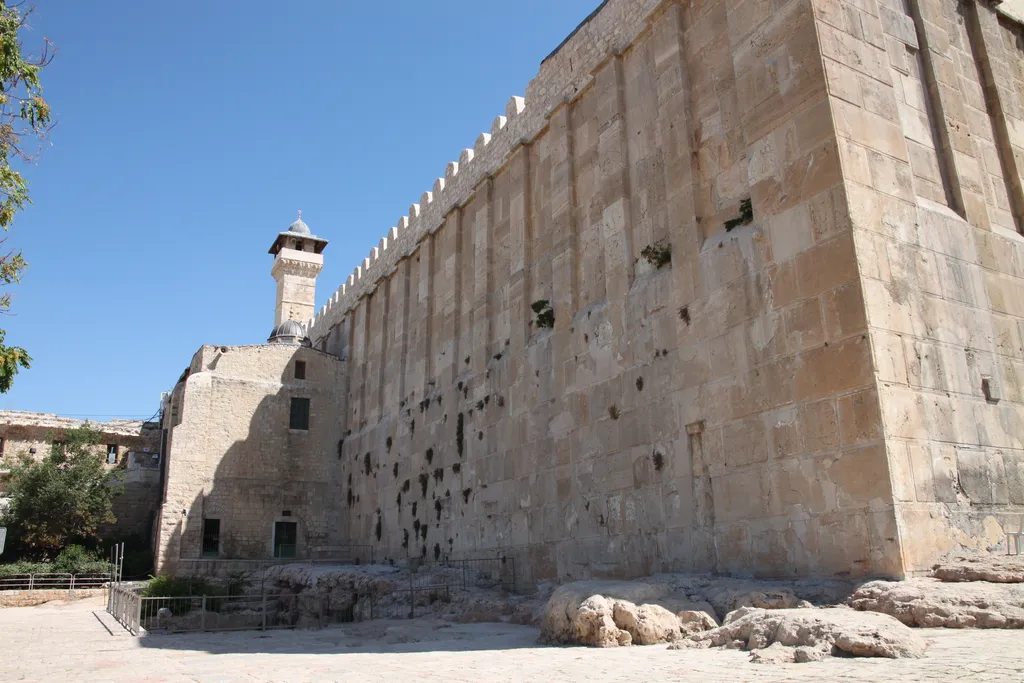
The biblical site of Machpelah, also known as the Cave of Machpelah, is a significant location mentioned in the Hebrew Bible (Old Testament). It is traditionally associated with the burial place of several prominent figures from the Bible, particularly the patriarchs and matriarchs of the Israelite people. Here is some information about the biblical site of Machpelah:
Location: Machpelah is in the West Bank, in the city of Hebron, in modern-day Israel. It is situated in the southern part of the city.
Biblical Significance: The Cave of Machpelah is mentioned in the Book of Genesis, particularly in Genesis 23 and Genesis 49. According to the biblical account, it is the burial site purchased by the patriarch Abraham to bury his wife, Sarah. Later, Abraham and several other biblical figures, including Isaac, Rebekah, Jacob, and Leah, were also buried there. The cave is traditionally seen as the family tomb of these prominent ancestors.
Abraham's Purchase: In Genesis 23, Abraham, mourning the death of his wife Sarah, negotiates with the Hittites to purchase the cave and the field of Machpelah as a burial site. He pays a significant price for the land, making it a legally recognized possession. This transaction is considered one of the earliest land acquisitions in the Bible.
Religious Significance: Machpelah is considered a sacred site by both Jews and Muslims. It is one of the holiest places in Judaism and is associated with the patriarchs and matriarchs. In Islam, it is known as the Sanctuary of Abraham and is also a significant religious site.
Architectural Features: Over the centuries, various structures have been built over the Cave of Machpelah. The current structure, known as the Tomb of the Patriarchs, is a massive rectangular building with sections designated for Jewish and Muslim prayer. The structure reflects architectural influences from different periods, including Herodian, Byzantine, and Islamic.
Access Restrictions: Access to the Tomb of the Patriarchs is controlled and divided between Jewish and Muslim authorities. It is considered a holy site and place of worship for both religious communities.
Machpelah holds a central place in biblical history and religious traditions. It is significant as the burial place of the patriarchs and matriarchs and as a symbol of the deep historical and spiritual connections between these figures and the land of Canaan (later known as Israel). The site continues to be a place of religious pilgrimage and devotion for Jews and Muslims alike.
1Jacob called to his sons, and said: “Gather yourselves together, that I may tell you that which will happen to you in the days to come.
2Assemble yourselves, and hear, you sons of Jacob.
Listen to Israel, your father.
3“Reuben, you are my firstborn, my might, and the beginning of my strength,
excelling in dignity, and excelling in power.
4Boiling over like water, you shall not excel,
because you went up to your father’s bed,
then defiled it. He went up to my couch.
5“Simeon and Levi are brothers.
Their swords are weapons of violence.
6My soul, don’t come into their council.
My glory, don’t be united to their assembly;
for in their anger they killed men.
In their self-will they hamstrung cattle.
7Cursed be their anger, for it was fierce;
and their wrath, for it was cruel.
I will divide them in Jacob,
and scatter them in Israel.
8“Judah, your brothers will praise you.
Your hand will be on the neck of your enemies.
Your father’s sons will bow down before you.
9Judah is a lion’s cub.
From the prey, my son, you have gone up.
He stooped down, he crouched as a lion,
as a lioness.
Who will rouse him up?
10The scepter will not depart from Judah,
nor the ruler’s staff from between his feet,
until he comes to whom it belongs.
The obedience of the peoples will be to him.
11Binding his foal to the vine,
his donkey’s colt to the choice vine,
he has washed his garments in wine,
his robes in the blood of grapes.
12His eyes will be red with wine,
his teeth white with milk.
13“Zebulun will dwell at the haven of the sea.
He will be for a haven of ships.
His border will be on Sidon.
14“Issachar is a strong donkey,
lying down between the saddlebags.
15He saw a resting place, that it was good,
the land, that it was pleasant.
He bows his shoulder to the burden,
and becomes a servant doing forced labor.
16“Dan will judge his people,
as one of the tribes of Israel.
17Dan will be a serpent on the trail,
an adder in the path,
that bites the horse’s heels,
so that his rider falls backward.
18I have waited for your salvation, Yahweh.
19“A troop will press on Gad,
but he will press on their heel.
20“Asher’s food will be rich.
He will produce royal dainties.
21“Naphtali is a doe set free,
who bears beautiful fawns.
22“Joseph is a fruitful vine,
a fruitful vine by a spring.
His branches run over the wall.
23The archers have severely grieved him,
shot at him, and persecuted him:
24But his bow remained strong.
The arms of his hands were made strong,
by the hands of the Mighty One of Jacob,
(from there is the shepherd, the stone of Israel),
25even by the God of your father, who will help you,
by the Almighty, who will bless you,
with blessings of heaven above,
blessings of the deep that lies below,
blessings of the breasts, and of the womb.
26The blessings of your father have prevailed above the blessings of my ancestors,
above the boundaries of the ancient hills.
They will be on the head of Joseph,
on the crown of the head of him who is separated from his brothers.
27“Benjamin is a ravenous wolf.
In the morning he will devour the prey.
At evening he will divide the plunder.”
28All these are the twelve tribes of Israel, and this is what their father spoke to them, and blessed them. He blessed everyone according to his own blessing. 29He instructed them, and said to them, “I am to be gathered to my people. Bury me with my fathers in the cave that is in the field of Ephron the Hittite, 30in the cave that is in the field of Machpelah, which is before Mamre, in the land of Canaan, which Abraham bought with the field from Ephron the Hittite as a burial place. 31There they buried Abraham and Sarah, his wife. There they buried Isaac and Rebekah, his wife, and there I buried Leah: 32the field and the cave that is therein, which was purchased from the children of Heth.” 33When Jacob finished charging his sons, he gathered up his feet into the bed, breathed his last breath, and was gathered to his people.