Genesis 21 (WEB)
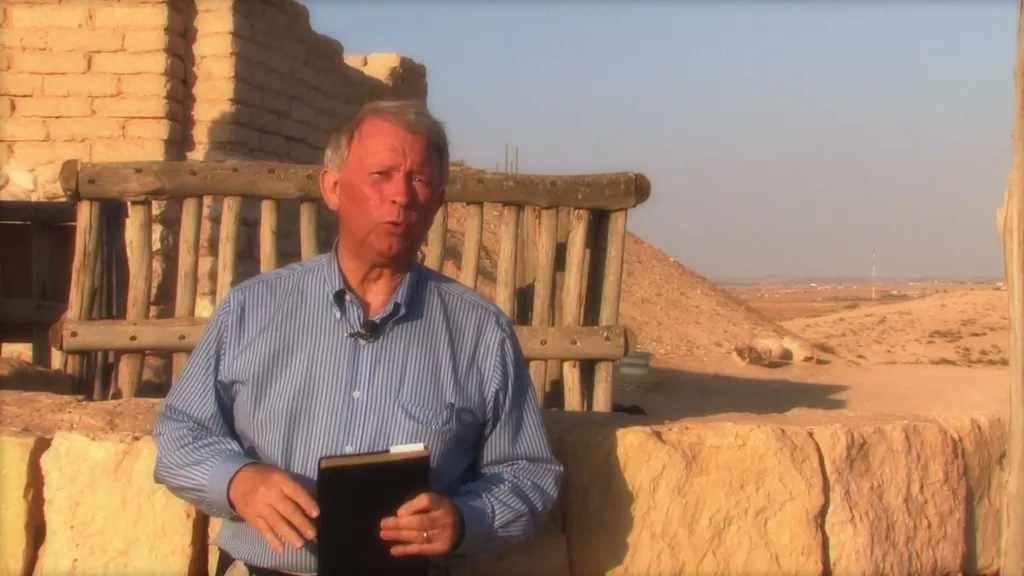
The setting is Beer'sheva (Beer'sheba) in southern Israel, part of the land given by Yahweh to Abraham and his physical descendants. Abraham and Abimelech have a conflict at Beer'sheva, but are able to settle their differences and make a covenant.
The well that I am standing in front of is at the ancient site of Beersheba, the home of Abraham, Isaac and Jacob.
Though the period of Abraham is much earlier than the current city in which I am standing, and consequently the well that you see behind me may not be the same well that Abraham built or even that of Isaac later,
nonetheless it serves as the object of the story about Abraham and Abimelech.
The text of Genesis speaks of a meeting between the two in which they made a covenant of mutual peace.
After this, Abraham approached Abimelech because some of the latter's servants had seized the well that Abraham had dug.
Or the latter one, possibly even that Isaac dug, if it's in fact his well.
Something such as water, so necessary to the existence in this arid land, could not be trifled with.
In order to confirm Abraham's claim to the well, he took seven sheep apart from his flock for Abimelech.
Listen to the words of scripture in Genesis 21, 29 and following.
Then Abimelech asked Abraham, "What is the meaning of these seven ewe lambs which you have set by themselves?"
And he said, "You will take these seven ewe lambs from my hand, that they may be my witness that I have dug this well."
Therefore he called that place Be'er Sheva, because the two of them swore an oath there.
Though this confirmation of ownership is important in understanding the story, the most important is what follows.
It indicates his desire to stay in what we call Be'er Sheva, a word meaning either the well of seven or the well of the oath, depending on what Hebrew root one understands to be behind the word.
Both seem to make sense in the passage.
Abraham then planted a tamarisk tree and called on the name of Yahweh the eternal God.
Note that Abraham was willing to pay for a small well in a land that was given to him already by God.
He maintained peace with his neighbor, even suffering a loss.
When we know we are in God's will, we can prosper in the midst of adversity.
1Yahweh visited Sarah as he had said, and Yahweh did to Sarah as he had spoken. 2Sarah conceived, and bore Abraham a son in his old age, at the set time of which God had spoken to him. 3Abraham called his son who was born to him, whom Sarah bore to him, Isaac. 4Abraham circumcised his son, Isaac, when he was eight days old, as God had commanded him. 5Abraham was one hundred years old when his son, Isaac, was born to him. 6Sarah said, “God has made me laugh. Everyone who hears will laugh with me.” 7She said, “Who would have said to Abraham that Sarah would nurse children? For I have borne him a son in his old age.”
8The child grew and was weaned. Abraham made a great feast on the day that Isaac was weaned. 9Sarah saw the son of Hagar the Egyptian, whom she had borne to Abraham, mocking. 10Therefore she said to Abraham, “Cast out this servant and her son! For the son of this servant will not be heir with my son, Isaac.”
11The thing was very grievous in Abraham’s sight on account of his son. 12God said to Abraham, “Don’t let it be grievous in your sight because of the boy, and because of your servant. In all that Sarah says to you, listen to her voice. For your offspring will be named through Isaac. 13I will also make a nation of the son of the servant, because he is your child.” 14Abraham rose up early in the morning, and took bread and a container of water, and gave it to Hagar, putting it on her shoulder; and gave her the child, and sent her away. She departed, and wandered in the wilderness of Beersheba. 15The water in the container was spent, and she put the child under one of the shrubs. 16She went and sat down opposite him, a good way off, about a bow shot away. For she said, “Don’t let me see the death of the child.” She sat opposite him, and lifted up her voice, and wept. 17God heard the voice of the boy.
The angel of God called to Hagar out of the sky, and said to her, “What troubles you, Hagar? Don’t be afraid. For God has heard the voice of the boy where he is. 18Get up, lift up the boy, and hold him with your hand. For I will make him a great nation.”
19God opened her eyes, and she saw a well of water. She went, filled the container with water, and gave the boy a drink.
20God was with the boy, and he grew. He lived in the wilderness, and as he grew up, he became an archer. 21He lived in the wilderness of Paran. His mother got a wife for him out of the land of Egypt.
22At that time, Abimelech and Phicol the captain of his army spoke to Abraham, saying, “God is with you in all that you do. 23Now, therefore, swear to me here by God that you will not deal falsely with me, nor with my son, nor with my son’s son. But according to the kindness that I have done to you, you shall do to me, and to the land in which you have lived as a foreigner.”
24Abraham said, “I will swear.” 25Abraham complained to Abimelech because of a water well, which Abimelech’s servants had violently taken away. 26Abimelech said, “I don’t know who has done this thing. You didn’t tell me, and I didn’t hear of it until today.”
27Abraham took sheep and cattle, and gave them to Abimelech. Those two made a covenant. 28Abraham set seven ewe lambs of the flock by themselves. 29Abimelech said to Abraham, “What do these seven ewe lambs, which you have set by themselves, mean?”
30He said, “You shall take these seven ewe lambs from my hand, that it may be a witness to me, that I have dug this well.” 31Therefore he called that place Beersheba, because they both swore an oath there. 32So they made a covenant at Beersheba. Abimelech rose up with Phicol, the captain of his army, and they returned into the land of the Philistines. 33Abraham planted a tamarisk tree in Beersheba, and there he called on the name of Yahweh, the Everlasting God. 34Abraham lived as a foreigner in the land of the Philistines many days.