Acts 9 (WEB)
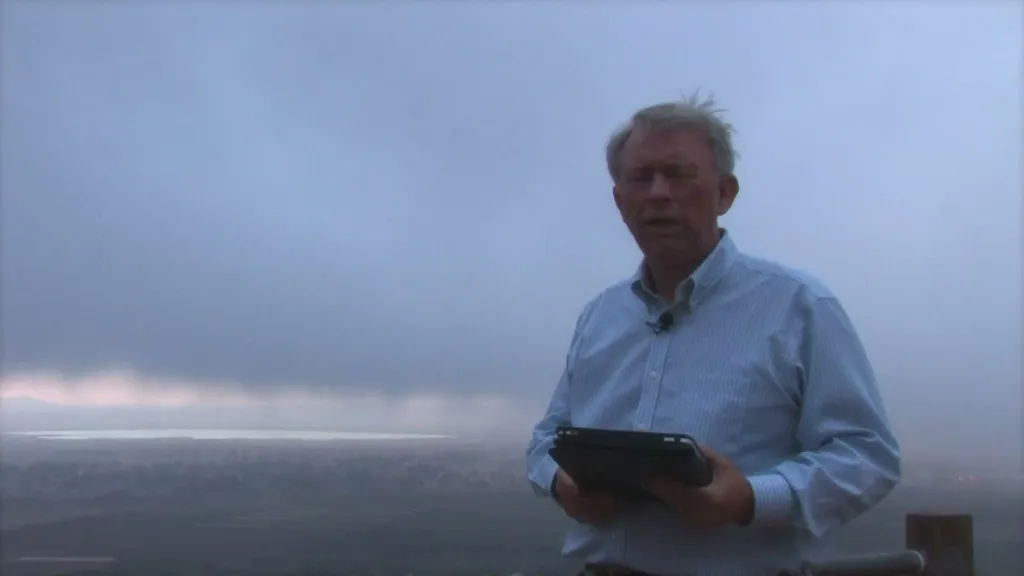
Behind me on this windy day is the country of Syria, with the city of Damascus situated behind my right shoulder to the left several miles away. The Damascus Road that Paul traveled is to the right and goes on the other side of the mountain. I explain in the video my reading of the texts of Acts 9 and 22, that Paul actually became a believer in the Messiah when in Damascus and was baptized there, contrary to the common view that he became a Christian on the Damascus Road.
I'm standing here on a mountain overlooking the land of Syria, up in the Golan Heights, and behind me, just a few hundred meters away, is in fact the road to Damascus,
where Saul, who was persecuting the church, went up to Damascus for the purpose of continuing to be an aggressor against God's purposes.
Now he did this because he was a faithful Jew, a zealot of the Pharisee tradition, someone who believed that people of the way, those who followed Jesus,
were actually a danger to the Jewish faith.
And so as he was traveling on this road, somewhere behind me up to Damascus, less than an hour from where I stand, Jesus appeared out of nowhere to him.
And let's look at the words that the text says.
As he journeyed, he came near Damascus, and suddenly a light shone around him from heaven.
Then he fell to the ground and heard a voice saying to him, "Saul, Saul, why are you persecuting me?"
Then he said, "Who are you, sir?"
Then the Lord said, "I am Jesus, whom you are persecuting.
It is hard for you to kick against the goads."
So he, trembling and astonished, said, "Lord, what do you want me to do?"
Then the Lord said, "Arise and go into the city, and you will be told what you must do."
And the men who journeyed with him stood speechless, hearing a voice but seeing no one.
Then Saul arose from the ground, and when his eyes were opened, he saw no one.
But they led him by the hand and brought him into Damascus, and he was three days without sight, and neither ate nor drank.
This passage is also given again by Saul, then named Paul, in Acts chapter 22.
And when we put these two passages together, we come to some interesting conclusions, at least I do.
And that is that on the road to Damascus, you do not have Saul becoming what we think of as a Christian.
He has not yet become a follower of the way.
Instead, here is a man who has been a zealot in the strongest traditions, someone who is a very intelligent, religious, articulate, and committed Jewish thinker, who believed that Christianity, as it was,
was an affront to the Jewish faith.
And he believed this to such a point that he actually was going around and having Christians arrested, and even some put to death.
And he was desirous to do this even more, not only in Jerusalem, but go to Damascus and continue his work.
But on the way he confronted the living Christ, the resurrected one that he was persecuting.
And Jesus identified himself with Saul, to Saul, as someone that is being persecuted because of Saul's work.
Now, I don't think the text indicates to us that Saul had a radical transformation in his thinking at that point.
I think he is astounded, bewildered, confused, and he goes to Damascus with so many thoughts in his head, he isn't sure what to do.
He has three days without sight.
He's not eating.
He's not drinking.
He's thinking about his whole life as a dedicated zealous Jew, and more recently as a persecutor of Christians.
And now what does he do?
Who is the resurrected Christ who has appeared to him?
We find out in Acts chapter 22 that Ananias, to whom he had been sent, comes to him and says, "Saul, why are you waiting?
Arise and be baptized and wash away your sins, calling on the name of the Lord."
It seems to me that at this juncture, what we encounter in Scripture is that Saul, who's had time to think it through, makes an intelligent choice.
He knows now that he has been called by the living Christ to actually be an apostle to the Gentiles.
And this new truth astounds him, it overwhelms him, to the point that we find out later he even goes three years in the Arabian Desert to try to rethink this new faith.
See, I don't think Paul was driven by emotional arguments.
I don't think Paul was moved by just experience.
I think Paul had to rethink his entire Jewish tradition in light of Scripture.
And when he comes out of this time of seclusion for three years, which began, I believe, with this conversion in Damascus, I think at that point he actually begins to put it all together,
and we find the saved Paul going into Arabia.
1But Saul, still breathing threats and slaughter against the disciples of the Lord, went to the high priest 2and asked for letters from him to the synagogues of Damascus, that if he found any who were of the Way, whether men or women, he might bring them bound to Jerusalem. 3As he traveled, he got close to Damascus, and suddenly a light from the sky shone around him. 4He fell on the earth, and heard a voice saying to him, “Saul, Saul, why do you persecute me?”
5He said, “Who are you, Lord?”
The Lord said, “I am Jesus, whom you are persecuting. 6But rise up and enter into the city, then you will be told what you must do.”
7The men who traveled with him stood speechless, hearing the sound, but seeing no one. 8Saul arose from the ground, and when his eyes were opened, he saw no one. They led him by the hand and brought him into Damascus. 9He was without sight for three days, and neither ate nor drank.
10Now there was a certain disciple at Damascus named Ananias. The Lord said to him in a vision, “Ananias!”
He said, “Behold, it’s me, Lord.”
11The Lord said to him, “Arise and go to the street which is called Straight, and inquire in the house of Judah for one named Saul, a man of Tarsus. For behold, he is praying, 12and in a vision he has seen a man named Ananias coming in and laying his hands on him, that he might receive his sight.”
13But Ananias answered, “Lord, I have heard from many about this man, how much evil he did to your saints at Jerusalem. 14Here he has authority from the chief priests to bind all who call on your name.”
15But the Lord said to him, “Go your way, for he is my chosen vessel to bear my name before the nations and kings, and the children of Israel. 16For I will show him how many things he must suffer for my name’s sake.”
17Ananias departed and entered into the house. Laying his hands on him, he said, “Brother Saul, the Lord, who appeared to you on the road by which you came, has sent me that you may receive your sight and be filled with the Holy Spirit.” 18Immediately something like scales fell from his eyes, and he received his sight. He arose and was baptized. 19He took food and was strengthened.
Saul stayed several days with the disciples who were at Damascus. 20Immediately in the synagogues he proclaimed the Christ, that he is the Son of God. 21All who heard him were amazed, and said, “Isn’t this he who in Jerusalem made havoc of those who called on this name? And he had come here intending to bring them bound before the chief priests!”
22But Saul increased more in strength, and confounded the Jews who lived at Damascus, proving that this is the Christ. 23When many days were fulfilled, the Jews conspired together to kill him, 24but their plot became known to Saul. They watched the gates both day and night that they might kill him, 25but his disciples took him by night and let him down through the wall, lowering him in a basket.
26When Saul had come to Jerusalem, he tried to join himself to the disciples; but they were all afraid of him, not believing that he was a disciple. 27But Barnabas took him and brought him to the apostles, and declared to them how he had seen the Lord on the way, and that he had spoken to him, and how at Damascus he had preached boldly in the name of Jesus. 28He was with them entering into Jerusalem, 29preaching boldly in the name of the Lord Jesus. He spoke and disputed against the Hellenists, but they were seeking to kill him. 30When the brothers knew it, they brought him down to Caesarea and sent him off to Tarsus.
31So the assemblies throughout all Judea, Galilee, and Samaria had peace and were built up. They were multiplied, walking in the fear of the Lord and in the comfort of the Holy Spirit.
32As Peter went throughout all those parts, he came down also to the saints who lived at Lydda. 33There he found a certain man named Aeneas, who had been bedridden for eight years because he was paralyzed. 34Peter said to him, “Aeneas, Jesus Christ heals you. Get up and make your bed!” Immediately he arose. 35All who lived at Lydda and in Sharon saw him, and they turned to the Lord.
36Now there was at Joppa a certain disciple named Tabitha, which when translated means Dorcas. This woman was full of good works and acts of mercy which she did. 37In those days, she became sick and died. When they had washed her, they laid her in an upper room. 38As Lydda was near Joppa, the disciples, hearing that Peter was there, sent two men to him, imploring him not to delay in coming to them. 39Peter got up and went with them. When he had come, they brought him into the upper room. All the widows stood by him weeping, and showing the tunics and other garments which Dorcas had made while she was with them. 40Peter sent them all out, and knelt down and prayed. Turning to the body, he said, “Tabitha, get up!” She opened her eyes, and when she saw Peter, she sat up. 41He gave her his hand and raised her up. Calling the saints and widows, he presented her alive. 42This became known throughout all Joppa, and many believed in the Lord. 43He stayed many days in Joppa with a tanner named Simon.