Acts 22 (WEB)
Saul of Tarsus was confronted by the Risen Messiah Jesus on the road to Damascus. He was told to go to Damascus to find out what he should do. After three days, he was told to arise and be baptized, and to wash away his sins by calling on the name of the Lord Jesus that he had been persecuting. Often the conversion is thought to be on the way to Damascus, but this is unlikely.
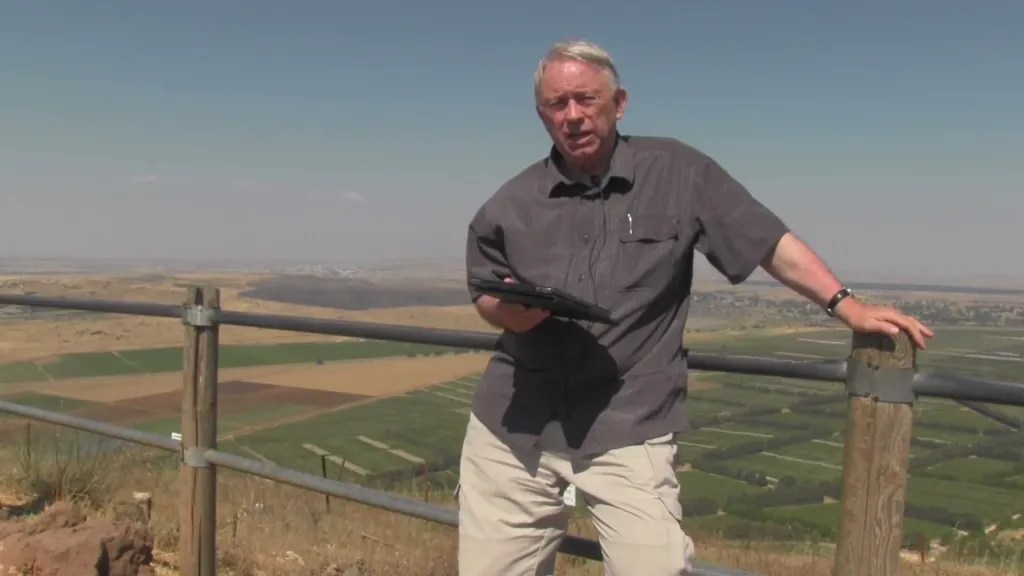
I'm standing here at the bunkers that separated Israel from the Syrians several years ago.
Right below us, there was a battle going on.
And this is called right now The Cloud.
There's a restaurant up here that has that name.
But we're actually at a military bunker overlooking Syria.
It's a good place to talk about something that happened years ago with a man by the name of Saul, who was a persecutor of Christians.
A Jew who had studied under Gamaliel, well respected apparently in the area of the Sanhedrin, because he was involved in the process of Stephen, who was at that time killed for his faith.
But Saul was on a mission.
He was a very intelligent man, but a man with tremendous passion.
And he was jailing those who followed the way, because he believed that they deviated, in fact, from the historic faith of Israel.
And so he was on his way up to a place called Damascus.
And if you look behind me, you can see that in this area here, as we move to Syria, you have actually the Damascus Road over here.
And that's where he was traveling one day.
And something happened special to him.
Chapter 9.
This is recorded in two places.
Chapter 9 and Chapter 22 of the Book of Acts.
And they read a little bit differently, and provide some insight.
Chapter 9 says, "Then Saul, still breathing threats and murder against the disciples of the Lord, went to the high priest and asked letters from him to the synagogues of Damascus."
He wasn't satisfied to just take care of the Christians down in Jerusalem, but also wanted to go up to Syria.
So that if he found any who were of the way, a name for early Christians, whether men or women, he might bring them bound to Jerusalem.
As he journeyed, he came near Damascus, and suddenly a light shone around him from heaven.
Then he fell to the ground and heard a voice saying to him, "Saul, Saul, why are you persecuting me?"
And he said, "Who are you, Lord?"
Then the Lord said, "I am Jesus whom you are persecuting.
It is hard for you to kick against the goads."
A reference to what was put behind oxen to sort of keep them in line.
So he, trembling and astonished, said, "Lord, what do you want me to do?"
Then the Lord said to him, "Arise and go into the city, and you will be told what you must do."
And the men who journeyed with him stood speechless, hearing a voice, but seeing no one.
Then Saul arose from the ground, and when his eyes were opened, he saw no one.
But they led him by the hand and brought him into Damascus, and he was three days without sight, and neither ate nor drank.
Now, this event has been viewed by many people as the conversion of the Apostle Saul, or the man Saul, who became the Apostle Paul later on.
And I really don't think that's what the text teaches us here.
Certainly Saul did become a believer, but I think it was in Damascus, not out here.
And there are several reasons for that.
One is, realize that the word "Lord" does not necessarily refer to what we think of as Yahweh, that is, the God of Israel.
The word "Lord" is also a term of politeness.
It was used in reference to individuals who were authorities, masters.
It meant "sir."
It was a title of respect.
You find the word "Lord" also as a term that would be used of angels.
Oftentimes angels, when they appeared to people, they were addressed in those fashions.
Again, a title of respect.
Sometimes kurios in Greek means Yahweh, equivalent of the Yod-Heh-Wah-Heh in the Hebrew.
Other times it's a polite term in Greek in literature.
So Saul actually goes into Damascus at the command of the Lord here.
But again, he's not sure.
He says, "Who are you?
Sir.
I mean, who are you?"
It's like an angel appearing to you out of nowhere, saying, who am I addressing?
And the one who addresses him says, I am Jesus whom you're addressing.
Well, it's agreed.
Now he has some information about who is the person that stopped him on the road to Damascus.
But this is not a statement of gospel.
There's no gospel here.
Jesus doesn't give him information on what Saul needs to do to be a believer.
All he does is say, listen, you need to go into Damascus and you'll be told what you need to do to be a believer.
So Jesus puts off the gospel here to a human, not to himself.
When he gets into Damascus, we find that he encounters Ananias.
"Now there was a certain disciple of Damascus named Ananias, and to him the Lord said in a vision, Ananias, and he said, here I am, Lord.
So the Lord said to him, arise and go to the street called Straight, and inquire at the house of Judas for one called Saul of Tarsus, for he is praying.
In a vision he has seen a man named Ananias coming in and putting his hand on him so that he might receive his sight.
Then Ananias said, Lord, I've heard from many about this man.
He's done a lot of harm to your saints in Jerusalem.
And he has authority from the chief priest to bind all who call on your name.
But the Lord said, go, for he is a chosen vessel of mine to bear my name before Gentiles, kings, and the children of Israel.
For I will show him how many things he must suffer for my name's sake.
And Ananias went his way and entered the house, and laying his hand on him, said, Brother Saul" — by the way, "brother" here doesn't mean believer Saul, they're fellow Jews.
Brother was a term used for fellow Jews at that time.
"The Lord Jesus, who appeared to you as you came, has sent me that you might receive your sight and be filled with the Holy Spirit.
Immediately there fell from his eyes something like scales, and he received his sight at once" — listen — "and he arose and was baptized."
Now, that's not enough information, because actually Acts 22 fills in some spots that this does not give.
So if you move over to Acts chapter 22, you discover that the same event occurs.
He is giving testimony at this point in Caesarea.
And he goes through the fact of "who are you, Lord," and hearing the voice and going to Damascus, "you'll be told what to do."
And then he goes on and we fill in the place that Ananias comes back to him, and notice what Ananias says.
"The God of our fathers has chosen you, that you should know his will, and see the just one, and hear the voice of his mouth, for you will be his witness to all men of what you have seen and heard.
And now, why are you waiting?"
Now, pay attention, because people miss this in the Greek.
The Greek has two verbs and two participles here, and they relate to each other.
One participle to each verb.
He says, why are you waiting?
Now, arise!
And be baptized.
Those go together.
Next, the command, wash away your sins by calling on the name of the Lord.
Those go together.
It's true that baptism and his forgiveness do have a relationship here, but they're not a cause and effect relationship.
At the baptism, where he is baptized, which is a very Jewish practice, he then calls on the name of this Lord that now has appeared to him.
He spent three days sitting there in blindness waiting for Ananias.
Can you imagine what is going through this Pharisee trained rabbi's mind for three days?
What is going on?
I've just been persecuting these people, and now I find out the one I'm persecuting is the one who approaches me on the road to Damascus.
And so he's putting it all together.
He has to rethink his whole worldview.
Paul's an intellectual.
He has to rethink his whole relationship to Christianity and Judaism and Christ and the Old Testament and the prophets.
He has to rethink all of this.
And now Ananias comes to him and says, listen, you need to go be baptized.
And you need to call on the name of the Lord and have your sins taken away, which in fact Saul does do.
And we find that at this point, he begins to start preaching immediately.
He doesn't need any more training.
He's had all the training he needed.
He just needed a new message.
And so now he receives it.
Not too long after this point, he actually goes into three years of private seminary time, with a one-on-one with a teacher.
I think that's what occurs.
I think for three years he gets his message together by revelation, but this is after his being a believer.
And again, I think we have pretty good evidence here in this text that in fact Paul's conversion is not where people think about it, but in fact is in Damascus with Ananias and a proclamation of gospel that's different from what he encountered on the road to Damascus.
Now you can look here behind us then, and you can see that this open area — as you look, you can see that you have Syria here and you have Israel — and Paul, at one time as Saul, was walking up this area on his way to persecute Christians,
never knowing what was in store for him from the Lord.
1“Brothers and fathers, listen to the defense which I now make to you.”
2When they heard that he spoke to them in the Hebrew language, they were even more quiet.
He said, 3“I am indeed a Jew, born in Tarsus of Cilicia, but brought up in this city at the feet of Gamaliel, instructed according to the strict tradition of the law of our fathers, being zealous for God, even as you all are today. 4I persecuted this Way to the death, binding and delivering into prisons both men and women, 5as also the high priest and all the council of the elders testify, from whom also I received letters to the brothers, and traveled to Damascus to bring them also who were there to Jerusalem in bonds to be punished.
6“As I made my journey and came close to Damascus, about noon suddenly a great light shone around me from the sky. 7I fell to the ground and heard a voice saying to me, ‘Saul, Saul, why are you persecuting me?’ 8I answered, ‘Who are you, Lord?’ He said to me, ‘I am Jesus of Nazareth, whom you persecute.’
9“Those who were with me indeed saw the light and were afraid, but they didn’t understand the voice of him who spoke to me. 10I said, ‘What shall I do, Lord?’ The Lord said to me, ‘Arise, and go into Damascus. There you will be told about all things which are appointed for you to do.’ 11When I couldn’t see for the glory of that light, being led by the hand of those who were with me, I came into Damascus.
12“One Ananias, a devout man according to the law, well reported of by all the Jews who lived in Damascus, 13came to me, and standing by me said to me, ‘Brother Saul, receive your sight!’ In that very hour I looked up at him. 14He said, ‘The God of our fathers has appointed you to know his will, and to see the Righteous One, and to hear a voice from his mouth. 15For you will be a witness for him to all men of what you have seen and heard. 16Now why do you wait? Arise, be baptized, and wash away your sins, calling on the name of the Lord.’
17“When I had returned to Jerusalem and while I prayed in the temple, I fell into a trance 18and saw him saying to me, ‘Hurry and get out of Jerusalem quickly, because they will not receive testimony concerning me from you.’ 19I said, ‘Lord, they themselves know that I imprisoned and beat in every synagogue those who believed in you. 20When the blood of Stephen, your witness, was shed, I also was standing by, consenting to his death, and guarding the cloaks of those who killed him.’
21“He said to me, ‘Depart, for I will send you out far from here to the Gentiles.’ ”
22They listened to him until he said that; then they lifted up their voice and said, “Rid the earth of this fellow, for he isn’t fit to live!”
23As they cried out, threw off their cloaks, and threw dust into the air, 24the commanding officer commanded him to be brought into the barracks, ordering him to be examined by scourging, that he might know for what crime they shouted against him like that. 25When they had tied him up with straps, Paul asked the centurion who stood by, “Is it lawful for you to scourge a man who is a Roman, and not found guilty?”
26When the centurion heard it, he went to the commanding officer and told him, “Watch what you are about to do, for this man is a Roman!”
27The commanding officer came and asked him, “Tell me, are you a Roman?”
He said, “Yes.”
28The commanding officer answered, “I bought my citizenship for a great price.”
Paul said, “But I was born a Roman.”
29Immediately those who were about to examine him departed from him, and the commanding officer also was afraid when he realized that he was a Roman, because he had bound him. 30But on the next day, desiring to know the truth about why he was accused by the Jews, he freed him from the bonds and commanded the chief priests and all the council to come together, and brought Paul down and set him before them.