2 Chronicles 24 (WEB)
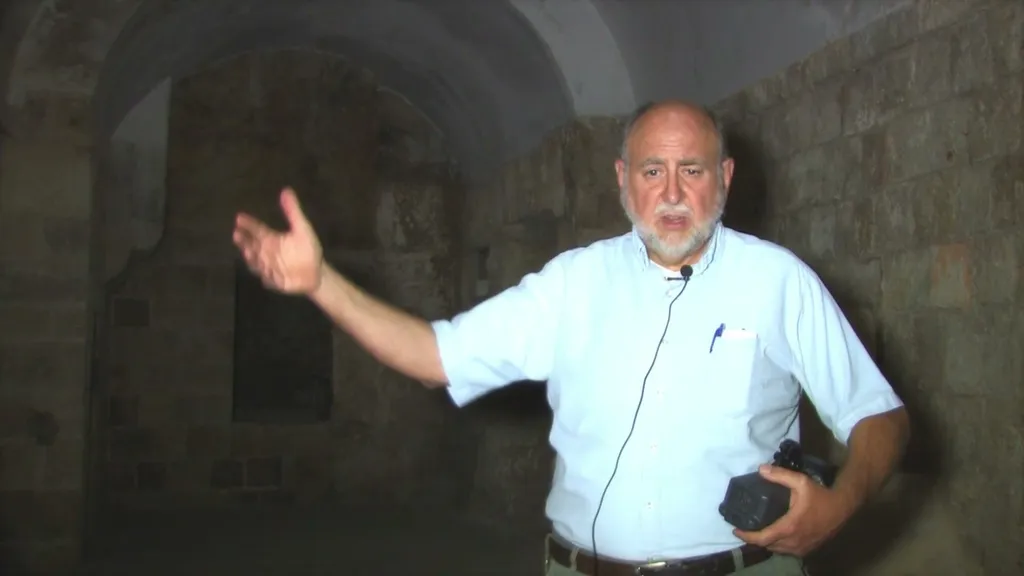
Tom Powers, who was working at the time at the Dominican School and Monastery leads our tour group of important tombs. The tombs at Ecolé Biblique are 8th - 7th century B.C. tombs in which either wealthy or royal persons were buried. The monastery and school of Ecolé Biblique is found in east Jerusalem, a few blocks from the Damascus Gate and next to the Garden Tomb.
Okay, I want to welcome you to the tombs of the École Biblique here in Jerusalem.
The tombs are unique for at least three reasons.
One is their age, which is from the first temple period — we're talking about the time of the kings of Judah, so it's the 8th to 7th centuries BC.
They're unique because of the extent to which they survived, intact.
We have very few tombs that survive to the degree.
We have some similar tombs in Jerusalem at a place called Ketef Hinnom, opposite Mount Zion.
We have a large necropolis opposite the City of David in the village of Silwan, tombs of the same style.
They're unique because of the size.
We have six chambers here that survived intact.
We have another complex that did not survive quite as well.
And they're important because of the elements of decoration.
They're very fancy tombs that belong to a wealthy family, an important family of that period.
One chamber did not survive, but what's interesting is that the doorway goes right into the Garden Tomb compound.
I've never found it on the other side.
I think it must be covered up with foliage or construction or something.
But it's been blocked for many years — but as you can see, the door frame is original.
Here's another curiosity.
Some of you may know, if you've studied the Dead Sea Scrolls, the name John Strugnell.
He was the chief scroll editor for many, many years.
And a few years ago he died, and his family arranged to have his remains brought here, because he spent much of his time in Jerusalem at the École Biblique, even though he was not a member of this community.
So his cremated remains are in this little urn here.
We're standing in the central chamber of this complex.
If you'll notice, the entire room is carved out of solid rock, including the entire ceiling.
The only thing that did not survive was this one corner right here.
It's reconstructed from masonry.
Everything else was cut out by human hands with iron tools to make this amazing complex.
There were six chambers here.
One, two, three, four.
Four of them survived completely intact.
This one over here, half survived.
This one behind you, where we entered, did not survive.
The entrance to the tomb was back here, behind you.
That was the original entrance from the outside, from the slope of the hill.
I mentioned that this is a very large complex, and there are features here that are, I will say, extra fancy in tomb architecture.
For one thing, you have these nicely carved door frames.
All the door frames are recessed like this.
You have panels.
You see, this is a panel that's been cut down just a fraction of an inch, maybe simulating wooden paneling, inlaid wood in a palace, in a villa.
So you have one here, you have one here, you have one up high, and then you have a double cornice.
You see, you have a double cornice all the way around the roofline.
Those are things you don't see just anywhere.
So this would be a wealthy family, a dynasty.
This would be a family tomb.
People were buried in family tombs.
Some have even suggested these could have been royal tombs.
One person who speculates about this is Amos Kloner.
He's one of the experts on tombs of this period in this country.
He thinks these could have been the tombs of the latter kings of Judah.
So, I want to show you the inside of one tomb chamber.
This one survived most nicely.
Okay, here we are in one of the tomb chambers.
What you have here is three burial benches.
One, two, three.
Each of them has this little ridge, a parapet wall around the edge.
Each of them has a nice carved headrest.
These again are fancy features.
You don't find them in every tomb of this period.
So what's happening in a burial, just like in later periods: a body is anointed with oil and spices.
It's wrapped in a shroud, and it's laid on the bench.
That's the first burial, the primary burial.
Now the body decays, of course, and they're left with bones, and the family comes and gathers the bones of their loved ones.
In this period, what's done with the bones is, just like the Bible says, someone is gathered unto their fathers.
And they sleep with their fathers in this repository right down here under the bench.
Okay, this is the place where bones are deposited in the first temple period.
Everybody together in the pit.
Now, we know that in a later period, by the time of Jesus, there's something very different.
People have a different type of burial niche.
It's a long finger-like niche, but the big difference is the bones are gathered and placed in a small chest, a box called an ossuary.
And by the time of Jesus, you have in the theology the idea of resurrection — the bodily resurrection of the dead.
So this is the way bones are handled in the first temple period.
You would come here to your family tomb and gather the bones of your relatives and deposit them very lovingly in this repository under the bench.
Let me explain that the bones you're looking at are this phenomenon I mentioned, of the reuse of the tombs in the Byzantine period.
These tombs were heavily reused in the 5th, 6th, 7th century, when there was a huge monastery here.
In fact, a lady has come and done some work on the bones, a physical anthropologist named Susan Sheridan out of Notre Dame University in America.
You can find her work online if you do a Google search for Byzantine St. Stephen's.
It's there.
So she decided actually that there was a children's hospital here.
She found an unusual proportion of children's skeletal remains.
And she also discovered things that would not surprise us about a monastery, one of which is that the monks wore out their knees and their ankles by a lot of prayer and genuflecting, things like that.
So she's done some very interesting work on the bones.
So I've brought you here to a tomb chamber that is special in itself, for several reasons.
It has the same benches on the sides here with the headrest, but also carries special architectural features that we saw in the central chamber.
You have these recessed panels, the recessed door frame, the cornice all along the top, and it's special because it leads back into yet another chamber behind me,
which is very different, and it has a different style even of burial niches.
I've brought you here into the back chamber of this complex.
In fact, from this back corner right here, diagonally through the rock, it's two meters to the Garden Tomb chamber.
That's how close all this was.
It's all part of the same ancient cemetery.
And the engineering really is exquisite.
They knew exactly how close they could come going this way.
The rock overhead at the top of these chambers, it's less than a meter thick to the surface of the bedrock.
So it was very precise layout and engineering.
Look around you at these burial places right here.
Now, what they were was a rock-hewn sarcophagus.
It was a sarcophagus that was part of the bedrock and carved out sort of like a bathtub.
So the walls were this high all the way around.
Same over there.
And from this ledge to the outer lip would have been bridged by stone panels.
It was covered.
And this was a burial place for somebody very important.
And it was a one-time burial, as we understand it.
This was the matriarch, the patriarch, maybe the king, if Amos Kloner is correct, that these were royal tombs.
And their remains were not disturbed.
It would have been a one-time burial.
When you go in a few minutes over to the Garden Tomb, you will see something very similar to this, and it will become clear to you that they actually are from the same period,
which is the first temple period, the eighth, seventh centuries BC.
And in this room, the same features, this cornice around the roofline — so the same architectural features follow you from the central chamber through this antechamber back here.
1Joash was seven years old when he began to reign, and he reigned forty years in Jerusalem. His mother’s name was Zibiah, of Beersheba. 2Joash did that which was right in Yahweh’s eyes all the days of Jehoiada the priest. 3Jehoiada took for him two wives, and he became the father of sons and daughters.
4After this, Joash intended to restore Yahweh’s house. 5He gathered together the priests and the Levites, and said to them, “Go out to the cities of Judah, and gather money to repair the house of your God from all Israel from year to year. See that you expedite this matter.” However the Levites didn’t do it right away. 6The king called for Jehoiada the chief, and said to him, “Why haven’t you required of the Levites to bring in the tax of Moses the servant of Yahweh, and of the assembly of Israel, out of Judah and out of Jerusalem, for the Tent of the Testimony?” 7For the sons of Athaliah, that wicked woman, had broken up God’s house; and they also gave all the dedicated things of Yahweh’s house to the Baals.
8So the king commanded, and they made a chest, and set it outside at the gate of Yahweh’s house. 9They made a proclamation through Judah and Jerusalem, to bring in for Yahweh the tax that Moses the servant of God laid on Israel in the wilderness. 10All the princes and all the people rejoiced, and brought in, and cast into the chest, until they had filled it. 11Whenever the chest was brought to the king’s officers by the hand of the Levites, and when they saw that there was much money, the king’s scribe and the chief priest’s officer came and emptied the chest, and took it, and carried it to its place again. Thus they did day by day, and gathered money in abundance. 12The king and Jehoiada gave it to those who did the work of the service of Yahweh’s house. They hired masons and carpenters to restore Yahweh’s house, and also those who worked iron and bronze to repair Yahweh’s house. 13So the workmen worked, and the work of repairing went forward in their hands. They set up God’s house as it was designed, and strengthened it. 14When they had finished, they brought the rest of the money before the king and Jehoiada, from which were made vessels for Yahweh’s house, even vessels with which to minister and to offer, including spoons and vessels of gold and silver. They offered burnt offerings in Yahweh’s house continually all the days of Jehoiada.
15But Jehoiada grew old and was full of days, and he died. He was one hundred thirty years old when he died. 16They buried him in David’s city among the kings, because he had done good in Israel, and toward God and his house.
17Now after the death of Jehoiada, the princes of Judah came and bowed down to the king. Then the king listened to them. 18They abandoned the house of Yahweh, the God of their fathers, and served the Asherah poles and the idols, so wrath came on Judah and Jerusalem for this their guiltiness. 19Yet he sent prophets to them to bring them again to Yahweh, and they testified against them; but they would not listen.
20The Spirit of God came on Zechariah the son of Jehoiada the priest; and he stood above the people, and said to them, “God says, ‘Why do you disobey Yahweh’s commandments, so that you can’t prosper? Because you have forsaken Yahweh, he has also forsaken you.’”
21They conspired against him, and stoned him with stones at the commandment of the king in the court of Yahweh’s house. 22Thus Joash the king didn’t remember the kindness which Jehoiada his father had done to him, but killed his son. When he died, he said, “May Yahweh look at it, and repay it.”
23At the end of the year, the army of the Syrians came up against him. They came to Judah and Jerusalem, and destroyed all the princes of the people from among the people, and sent all their plunder to the king of Damascus. 24For the army of the Syrians came with a small company of men; and Yahweh delivered a very great army into their hand, because they had forsaken Yahweh, the God of their fathers. So they executed judgment on Joash.
25When they had departed from him (for they left him seriously wounded), his own servants conspired against him for the blood of the sons of Jehoiada the priest, and killed him on his bed, and he died. They buried him in David’s city, but they didn’t bury him in the tombs of the kings. 26These are those who conspired against him: Zabad the son of Shimeath the Ammonitess and Jehozabad the son of Shimrith the Moabitess. 27Now concerning his sons, the greatness of the burdens laid on him, and the rebuilding of God’s house, behold, they are written in the commentary of the book of the kings. Amaziah his son reigned in his place.