1 Kings 18 (WEB)
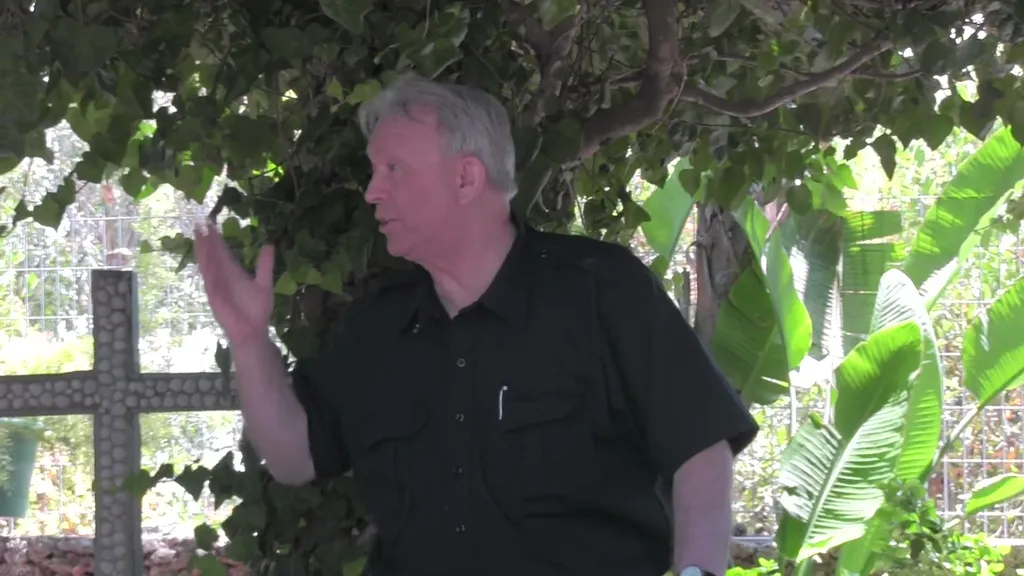
I am with my tour group on the top of Mt. Carmel, where Elijah challenged the 700 prophets of Ba'al to a contest as to who was truly God. This is one of the most interesting and theologically significant passages of the Old Testament.
What we're talking about today here on a place called Mount Carmel, the garden of the divinity, Carmel, is the story of Elijah.
And Elijah is a very interesting prophet of Israel.
And you're familiar with Ahab and Jezebel and the struggles with Elijah and the prophets.
And Elijah said, I'm the last guy standing, not knowing that God had actually preserved the prophets of God.
And sometimes we just don't know why things are because God is in charge.
But Elijah, the word means Yahweh is my God.
Eli, my God.
Yah, Yahweh.
Like hallelujah is give praise to Yahweh.
And Eli means my God, and then is Yah.
Now that's important.
His name is important here because we find a contest between the prophets of Baal, the Canaanite deity, and obviously the consort of Baal, whose name is Asherah, his goddess consort.
There are 700 in excess prophets against one.
That seems unfair, doesn't it?
700 to 1.
But Elijah said, I'm the last one around, so what have we got to work with?
So he told Ahab to meet here on Carmel and to have a contest and see whose God is in fact truly God.
And I can't take the time to read this whole passage, but we need to set the stage.
The Canaanite religion and the worship of nature religion, the idea that through involvement in various kinds of sexual activity that the gods then would produce fertilization to the land and the rain.
And so one of the curses that God gave to Israel when they came out, Deuteronomy chapter 31, is that if you will do what is right and follow my laws, then I will bless you.
I will bring prosperity to you.
Your crops will be wonderful.
There will be rain upon the land.
Everything will be great.
On the other hand, if you choose to be disobedient to me, then I will close up the windows of heaven to you and your crops will not do well.
And you'll be cursed because of that.
Well, we find out that Israel had turned its back on Yahweh, and so now they're going to be participants and people of the covenant who have been disobedient.
Now, they were not members of the covenant.
They had forgotten their covenant.
Have you ever thought about we sometimes as Christians have forgotten our covenant with God?
It's not as though he kicks us out of the kingdom, so to speak.
He just starts giving us a good spanking.
And so that's what's happening here.
And so the people had turned back and started false religion.
And so Yahweh sends a prophet, Elijah, and there's a contest here to find out who's truly God.
God had closed up the windows of heaven.
Remember, Elijah prayed and it had not, it didn't rain for three and a half years, right?
Well, we're going to find after this contest, God brings rain.
And we find out the reason why he does.
In chapter 18, we find out that, verse 22, I alone am left a prophet of Yahweh, but Baal's prophets are 450 men.
He says, so here's what we're going to do.
We're going to build two altars up here somewhere.
We don't know exactly where it was, but two altars.
And the prophets of Baal get a first shot.
How nice can he be?
You get first opportunity.
You pray, if Baal brings fire and consumes the sacrifice, then he's truly God.
On the other hand, if Yahweh is true God and he consumes the sacrifice, then he's true God.
And so Elijah allows them their opportunity, and so the prophets of Baal, they are involved in preparing the bull for sacrifice.
Verse 26, so they took the bull which was given them and they prepared it and called on the name of Baal from morning even till noon.
So they were going out here five or six hours calling on Baal.
You ever think your prayers are not answered?
Look at these guys.
They're out here yelling and screaming at the top of their lungs and Baal's not paying any attention to them, because there's still no fire on that altar.
Wow.
Oh, Baal, hear us.
No voice.
Notice the emphasis.
No voice.
No one answered.
Then they leaped about the altar which they had made.
Maybe he's not paying attention because we're too still.
We're going to start going in the spirit here and jumping around the altar, leaping and jumping around and saying, maybe we'll get the attention of Baal.
Nothing.
So it was at noon that Elijah mocked them and said, cry aloud for he is a god.
Either he is meditating — hmm — or he is busy.
Actually the Hebrew word here is fairly graphic, and we'll not translate it for you graphically, but it's translated in the Living paraphrase — not a translation — they translated, he's in the restroom.
Or he's on a journey, or perhaps he is sleeping and must be awakened.
Now, the concept of God that's being portrayed of Baal here by Elijah, Eliyahu, is consistent with a finite deity with all the limitations of humanity.
Restroom, resting, sleeping.
But the Bible says that Yahweh does neither sleep nor slumber.
He's always available.
He's on a journey.
Yahweh's always here.
He's always with you.
He does not have these human limitations that Baal does.
He's mocking them.
So they cried aloud.
This got their dander up, they would say.
So they cried aloud and cut themselves.
If the leaping won't do it, let's try the blood.
Leaping, cut themselves with knives and lances until the blood gushed out.
And when midday was passed, they prophesied until the time of the offering of the evening sacrifice.
But there was no voice.
No one answered.
No one paid attention.
See the emphasis again and again?
Let me tell you, it's silent out here except for these screaming prophets.
Now that's important to get the setting.
You see the setting?
These people are tired, yelling, screaming, doing everything imaginable to get a God who doesn't exist to hear them.
Now you've got to see the contrast.
Then Elijah said to all the people, Come here to me.
So all the people came near to him and he repaired the altar of Yahweh.
See the words?
The altar of Yahweh was in disrepair because people had abandoned their worship.
See?
They hadn't been doing their duty to their covenant responsibilities.
He said, so he repaired the altar of Yahweh that was broken down.
Then Elijah took 12 stones.
Anybody have an idea why 12?
Oh, 12 tribes.
The focus here in this passage that you might miss is what we call covenant renewal.
Because the people had come out of Egypt with covenant, commitment.
Exodus chapter 20, based on chapter 19, 20, 21 through 25, the covenant that they had committed to, and now they had violated it.
And now punishment had come, disobedience and punishment, cursing had come.
So Elijah took 12 stones according to the number of the tribes of the sons of Jacob, to whom the word of Yahweh had come, saying, Israel shall be your name.
Then with the stones he built an altar in the name of Yahweh, and he made a trench around the altar large enough to hold two seahs of seed.
See the problem?
Elijah gave the prophets of Baal full sway.
No water needed, no trench.
Make it as easy as possible.
Maybe a spark of the stone will even create a fire for you, you know?
But now he's making sure that no one doubts what happens.
He says, I'm going to make sure that nobody can claim that this happened by accident.
Somebody had their Bic lighter, you know?
So it says he made this trench, and then he put the wood in order on the bull in pieces.
See how it's very, very carefully laid out.
See how they're careful?
And he laid it on the wood and filled four water pots with water and poured it on the burnt sacrifice and on the wood.
No chance of fire starting accidentally here.
Then he said, do it a second time.
Well, let's do it a third time.
No accidents.
This guy has a lot of faith.
You know why?
Because it's not going to be an accident if that fire starts up.
It's going to have to be God.
Sometimes we have to put God…
Not in a bad sense, but put God to the test.
Because how do we pray?
We pray in light of what God has revealed.
It's okay to pray when God says, that's the way I work.
And so God came to the aid.
So the water ran all around the altar and filled the trench.
And it came to pass at the time of the evening sacrifice that Elijah, the prophet, came near and said, Yahweh, God of Abraham, Isaac, and…
And notice, it doesn't say Jacob.
Abraham, Isaac, and Israel.
Let it be known this day that you are God in Israel, and I am your servant.
And that I have done all these things at your word.
If we follow the word of God, we've got assurance.
I've had people say every promise in the book is mine, every chapter.
That's a wrong song because you can't take other people's promises.
That's called stealing.
You can only take those promises that are yours.
And not every promise is to every person.
But he knew the promise to Israel of obedience.
Hear me, O Yahweh, hear me, that this people may know that you are Yahweh God and that you have turned their hearts back to you again.
We have renewal of covenant.
Then the fire of Yahweh fell and consumed the burnt sacrifice.
And it's sort of like Yahweh says, you know what?
Just as you made it extremely difficult for there to be considered an accident, that a fire starts.
I'm going to go abundantly over also.
Notice what he does.
He consumed the burnt sacrifice and the wood and the stones and the dust, and he licked up the water that was in the trench.
No mistaking that this is God.
Now when all the people saw it, they fell on their face and they said, Yahweh, he is God.
Yahweh, he is God.
And Eliyahu said to them, Seize the prophets of Baal.
Do not let one of them escape and take them right down here to the brook where I'm standing.
You'll see it from on top.
And put them to death.
And they did.
And after that, Elijah, he sends one of his servants, right, to look over the Mediterranean, right over here.
That's the only sea you can see from here, and he went to look over the sea, and what did he see?
He saw a cloud the size of a man's hand, what's about 10 miles away?
Where's my guides?
About 10 miles?
I think that's right, 10 or 11 miles?
Something like that.
How big — how big is a cloud that's the size of a man's hand as you're looking at it from 10 miles away?
Big, big cloud.
Because now God, because the people's hearts have been turned back to God, he then brings back the blessings of the covenant.
And the rain comes back.
And that's the story of 1 Kings 18.
1After many days, Yahweh’s word came to Elijah, in the third year, saying, “Go, show yourself to Ahab; and I will send rain on the earth.”
2Elijah went to show himself to Ahab. The famine was severe in Samaria. 3Ahab called Obadiah, who was over the household. (Now Obadiah feared Yahweh greatly; 4for when Jezebel cut off Yahweh’s prophets, Obadiah took one hundred prophets, and hid them fifty to a cave, and fed them with bread and water.) 5Ahab said to Obadiah, “Go through the land, to all the springs of water, and to all the brooks. Perhaps we may find grass and save the horses and mules alive, that we not lose all the animals.”
6So they divided the land between them to pass throughout it. Ahab went one way by himself, and Obadiah went another way by himself. 7As Obadiah was on the way, behold, Elijah met him. He recognized him, and fell on his face, and said, “Is it you, my lord Elijah?”
8He answered him, “It is I. Go, tell your lord, ‘Behold, Elijah is here!’”
9He said, “How have I sinned, that you would deliver your servant into the hand of Ahab, to kill me? 10As Yahweh your God lives, there is no nation or kingdom where my lord has not sent to seek you. When they said, ‘He is not here,’ he took an oath of the kingdom and nation that they didn’t find you. 11Now you say, ‘Go, tell your lord, “Behold, Elijah is here.”’ 12It will happen, as soon as I leave you, that Yahweh’s Spirit will carry you I don’t know where; and so when I come and tell Ahab, and he can’t find you, he will kill me. But I, your servant, have feared Yahweh from my youth. 13Wasn’t it told my lord what I did when Jezebel killed Yahweh’s prophets, how I hid one hundred men of Yahweh’s prophets with fifty to a cave, and fed them with bread and water? 14Now you say, ‘Go, tell your lord, “Behold, Elijah is here”.’ He will kill me.”
15Elijah said, “As Yahweh of Armies lives, before whom I stand, I will surely show myself to him today.” 16So Obadiah went to meet Ahab, and told him; and Ahab went to meet Elijah.
17When Ahab saw Elijah, Ahab said to him, “Is that you, you troubler of Israel?”
18He answered, “I have not troubled Israel, but you and your father’s house, in that you have forsaken Yahweh’s commandments and you have followed the Baals. 19Now therefore send, and gather to me all Israel to Mount Carmel, and four hundred fifty of the prophets of Baal, and four hundred of the prophets of the Asherah, who eat at Jezebel’s table.”
20So Ahab sent to all the children of Israel, and gathered the prophets together to Mount Carmel. 21Elijah came near to all the people, and said, “How long will you waver between the two sides? If Yahweh is God, follow him; but if Baal, then follow him.”
The people didn’t say a word.
22Then Elijah said to the people, “I, even I only, am left as a prophet of Yahweh; but Baal’s prophets are four hundred fifty men. 23Let them therefore give us two bulls; and let them choose one bull for themselves, and cut it in pieces, and lay it on the wood, and put no fire under; and I will dress the other bull, and lay it on the wood, and put no fire under it. 24You call on the name of your god, and I will call on Yahweh’s name. The God who answers by fire, let him be God.”
All the people answered, “What you say is good.”
25Elijah said to the prophets of Baal, “Choose one bull for yourselves, and dress it first, for you are many; and call on the name of your god, but put no fire under it.”
26They took the bull which was given them, and they dressed it, and called on the name of Baal from morning even until noon, saying, “Baal, hear us!” But there was no voice, and nobody answered. They leaped about the altar which was made.
27At noon, Elijah mocked them, and said, “Cry aloud, for he is a god. Either he is deep in thought, or he has gone somewhere, or he is on a journey, or perhaps he sleeps and must be awakened.”
28They cried aloud, and cut themselves in their way with knives and lances until the blood gushed out on them. 29When midday was past, they prophesied until the time of the evening offering; but there was no voice, no answer, and nobody paid attention.
30Elijah said to all the people, “Come near to me!”; and all the people came near to him. He repaired Yahweh’s altar that had been thrown down. 31Elijah took twelve stones, according to the number of the tribes of the sons of Jacob, to whom Yahweh’s word came, saying, “Israel shall be your name.” 32With the stones he built an altar in Yahweh’s name. He made a trench around the altar large enough to contain two seahs of seed. 33He put the wood in order, and cut the bull in pieces and laid it on the wood. He said, “Fill four jars with water, and pour it on the burnt offering and on the wood.” 34He said, “Do it a second time;” and they did it the second time. He said, “Do it a third time;” and they did it the third time. 35The water ran around the altar; and he also filled the trench with water.
36At the time of the evening offering, Elijah the prophet came near and said, “Yahweh, the God of Abraham, of Isaac, and of Israel, let it be known today that you are God in Israel and that I am your servant, and that I have done all these things at your word. 37Hear me, Yahweh, hear me, that this people may know that you, Yahweh, are God, and that you have turned their heart back again.”
38Then Yahweh’s fire fell and consumed the burnt offering, the wood, the stones, and the dust; and it licked up the water that was in the trench. 39When all the people saw it, they fell on their faces. They said, “Yahweh, he is God! Yahweh, he is God!”
40Elijah said to them, “Seize the prophets of Baal! Don’t let one of them escape!”
They seized them; and Elijah brought them down to the brook Kishon, and killed them there.
41Elijah said to Ahab, “Get up, eat and drink; for there is the sound of abundance of rain.”
42So Ahab went up to eat and to drink. Elijah went up to the top of Carmel; and he bowed himself down on the earth, and put his face between his knees. 43He said to his servant, “Go up now and look toward the sea.”
He went up and looked, then said, “There is nothing.”
He said, “Go again” seven times.
44On the seventh time, he said, “Behold, a small cloud, like a man’s hand, is rising out of the sea.”
He said, “Go up, tell Ahab, ‘Get ready and go down, so that the rain doesn’t stop you.’”
45In a little while, the sky grew black with clouds and wind, and there was a great rain. Ahab rode, and went to Jezreel. 46Yahweh’s hand was on Elijah; and he tucked his cloak into his belt and ran before Ahab to the entrance of Jezreel.