1 Corinthians 12 (WEB)
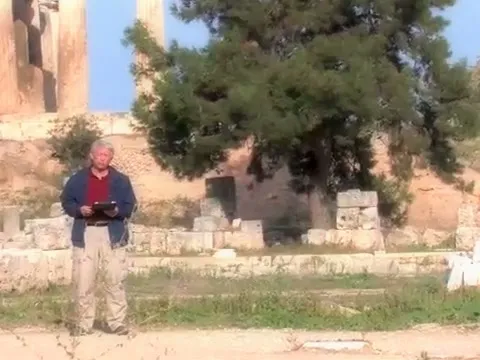
Many non-Jewish Corinthians brought many of their pagan beliefs and practices into the church at Corinth. Paul, 1 Cor 12:1-3, challenges their adherence to the religious practices in the religion of Apollo and Dionysius, distinguishing the "spirituals" (pneumatika) in 12:1-3 from gifts of the Spirit (charismata) in 12:4ff.
I'm standing in front of the Temple of Apollo in the ancient site of Corinth.
Here at Corinth there were a lot of problems in the church.
Problems regarding wisdom of the world versus the wisdom of God, rivalry between parties within the church, difficulties with food offered to idols.
Probably no issue received more attention in the book of 1 Corinthians than what is discussed in 1 Corinthians 12-14 regarding spirituals and gifts of the Spirit.
Paul in chapter 12 says, Now concerning spirituals, brothers, I don't want you to be ignorant.
You know that you were Gentiles, carried away to these dumb idols, these voiceless idols, however you were led.
Therefore I make known to you that no one, speaking by the Spirit of God, calls Jesus accursed.
And no one can say that Jesus is the Lord, except by the Holy Spirit.
These first three verses of 1 Corinthians chapter 12 set the stage for the remaining three chapters.
For in these we find that Paul distinguishes between some of the phenomena that these Corinthian believers were involved in, over against the legitimate gifts of the Spirit, the charismata discussed in verses 4 following in chapter 12.
The Temple of Apollo is a natural setting because there were two major religious ideologies at that time, or viewpoints, that emphasize the issue of speaking in tongues and prophecy and revelation.
The first was the religion of Apollo, as evidenced by his temple, and also by the fact that just a few miles from here in the mountains you find the oracle at Delphi,
who had a prophet and who gave revelation regarding prophetic utterance.
So these Corinthians, they brought into the Christian church their former pagan ideas.
And it became necessary for the Apostle Paul to somehow distinguish between the pagan views of the Spirit and the biblical views of the Spirit from God.
And so he says, you wrote to me.
Regarding spirituals, pneumatikon, you wrote to me about these spiritual things, and he said, I don't want you to be ignorant about them, because in fact the Spirit operates in certain ways and not other ways.
And by understanding these, we can know what is a work of the Spirit and what is not a work of the Spirit.
And so in these three chapters the religion of Apollo works prominent, because these people were familiar with revelation and prophecy from the religion of Apollo, as you see his temple behind me.
But also there was another religion called the religion of Dionysianism, the god of wine, Bacchus in Latin, who came from the Middle East all the way through Turkey into Greece,
at least in the legends.
And Dionysianism was also given to excess of emotion and spiritual experiences, to the point that it was viewed in Dionysianism that when you were controlled by the god, you could not control yourself.
You were involved in all sorts of ecstatic utterance that was not understandable to anyone else.
It was not a language of this world, so to speak, and so the god speaking through you…
With this kind of background, these Corinthians, they brought into the Christian church a totally foreign idea to what we see in the Jewish understanding of this, and the view that we see in the book of Acts.
Because we find out in the book of Acts that they were speaking real languages, and not merely this ecstatic utterance that we find here at Corinth.
We find that the work of the Spirit, even as Paul enunciates later in chapter 14, was not beyond the individual's control.
They were not just simply so controlled by the Spirit that they could not do anything.
Rather, the spirits of the prophets, as Paul says in 14 of 1 Corinthians, he says, is subject to the prophets.
And so we have a situation where the biblical text is clarified by understanding of the pagan religions that existed here at Corinth.
1Now concerning spiritual things, brothers, I don’t want you to be ignorant. 2You know that when you were heathen, you were led away to those mute idols, however you might be led. 3Therefore I make known to you that no man speaking by God’s Spirit says, “Jesus is accursed.” No one can say, “Jesus is Lord,” but by the Holy Spirit.
4Now there are various kinds of gifts, but the same Spirit. 5There are various kinds of service, and the same Lord. 6There are various kinds of workings, but the same God who works all things in all. 7But to each one is given the manifestation of the Spirit for the profit of all. 8For to one is given through the Spirit the word of wisdom, and to another the word of knowledge according to the same Spirit, 9to another faith by the same Spirit, and to another gifts of healings by the same Spirit, 10and to another workings of miracles, and to another prophecy, and to another discerning of spirits, to another different kinds of languages, and to another the interpretation of languages. 11But the one and the same Spirit produces all of these, distributing to each one separately as he desires.
12For as the body is one and has many members, and all the members of the body, being many, are one body; so also is Christ. 13For in one Spirit we were all baptized into one body, whether Jews or Greeks, whether bond or free; and were all given to drink into one Spirit.
14For the body is not one member, but many. 15If the foot would say, “Because I’m not the hand, I’m not part of the body,” it is not therefore not part of the body. 16If the ear would say, “Because I’m not the eye, I’m not part of the body,” it’s not therefore not part of the body. 17If the whole body were an eye, where would the hearing be? If the whole were hearing, where would the smelling be? 18But now God has set the members, each one of them, in the body, just as he desired. 19If they were all one member, where would the body be? 20But now they are many members, but one body. 21The eye can’t tell the hand, “I have no need for you,” or again the head to the feet, “I have no need for you.” 22No, much rather, those members of the body which seem to be weaker are necessary. 23Those parts of the body which we think to be less honorable, on those we bestow more abundant honor; and our unpresentable parts have more abundant modesty, 24while our presentable parts have no such need. But God composed the body together, giving more abundant honor to the inferior part, 25that there should be no division in the body, but that the members should have the same care for one another. 26When one member suffers, all the members suffer with it. When one member is honored, all the members rejoice with it.
27Now you are the body of Christ, and members individually. 28God has set some in the assembly: first apostles, second prophets, third teachers, then miracle workers, then gifts of healings, helps, governments, and various kinds of languages. 29Are all apostles? Are all prophets? Are all teachers? Are all miracle workers? 30Do all have gifts of healings? Do all speak with various languages? Do all interpret? 31But earnestly desire the best gifts. Moreover, I show a most excellent way to you.