Romans 4 (WEB)
Be Patient. Wait. God is Faithful.
Abraham Before His Tent at Night
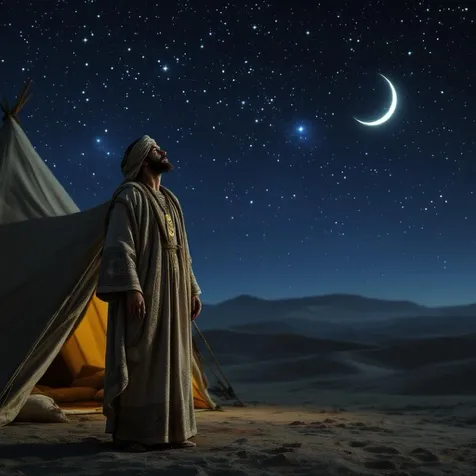
Paul tells us in chapter four that even during Old Testament times, faith was God’s measuring stick. The earlier verses in the chapter tell us this clearly “3 For what does the Scripture say? “Abraham believed God, and it was accounted to him for righteousness.”4 Now to him who works, the reward is not counted as grace, but as something owed. 5 But to him who doesn’t work, but believes in him who justifies the ungodly, his faith is accounted for righteousness.”
There it is, right out in the open. It was Abraham’s belief that counted, and was credited (deemed) to Abraham as righteousness. This statement is further explained in verse 20, listed above. It fully reveals how that faith was expressed. Abraham didn’t give a profession of faith or walk down an aisle and repent (although those might be valid). Abraham looked at God’s promise to him, and he chose to remain steadfast, not wavering in unbelief. He grew in his faith and belief that God would do what He said He would do. And, Abraham acted on it. He left a place not knowing exactly where he was going or how he would get there. The only thing that he knew was that God would be there when he got there.
Reader, do you have that kind of faith? If you do, it is very pleasing to God. The person who would remain faithful must believe that God is who He says that He is, and that He’ll do what He says He will do. It can be challenging at times because we seldom see God fulfill those promises within a timeframe that meets our expectations. The fact of the matter is that, although Abraham believed the promise, at times he was trying to “help God out”. That’s what the whole Ismael fiasco was about. As Abram waited for God to perform what He had promised, he gave in to the temptation to outthink God and to figure “maybe God meant for me to do this through my wife Sarai’s handmaid”. Wow! That sure hasn’t turned out well. Read the Word and understand God’s promises. He made those promises, and He will deliver on those promises, but it may take some time. Be patient. Wait. God is faithful.
1What then will we say that Abraham, our forefather, has found according to the flesh? 2For if Abraham was justified by works, he has something to boast about, but not toward God. 3For what does the Scripture say? “Abraham believed God, and it was accounted to him for righteousness.” 4Now to him who works, the reward is not counted as grace, but as something owed. 5But to him who doesn’t work, but believes in him who justifies the ungodly, his faith is accounted for righteousness. 6Even as David also pronounces blessing on the man to whom God counts righteousness apart from works:
7“Blessed are they whose iniquities are forgiven,
whose sins are covered.
8Blessed is the man whom the Lord will by no means charge with sin.”
9Is this blessing then pronounced only on the circumcised, or on the uncircumcised also? For we say that faith was accounted to Abraham for righteousness. 10How then was it counted? When he was in circumcision, or in uncircumcision? Not in circumcision, but in uncircumcision. 11He received the sign of circumcision, a seal of the righteousness of the faith which he had while he was in uncircumcision, that he might be the father of all those who believe, though they might be in uncircumcision, that righteousness might also be accounted to them. 12He is the father of circumcision to those who not only are of the circumcision, but who also walk in the steps of that faith of our father Abraham, which he had in uncircumcision.
13For the promise to Abraham and to his offspring that he would be heir of the world wasn’t through the law, but through the righteousness of faith. 14For if those who are of the law are heirs, faith is made void, and the promise is made of no effect. 15For the law produces wrath; for where there is no law, neither is there disobedience.
16For this cause it is of faith, that it may be according to grace, to the end that the promise may be sure to all the offspring, not to that only which is of the law, but to that also which is of the faith of Abraham, who is the father of us all. 17As it is written, “I have made you a father of many nations.” This is in the presence of him whom he believed: God, who gives life to the dead, and calls the things that are not, as though they were. 18Against hope, Abraham in hope believed, to the end that he might become a father of many nations, according to that which had been spoken, “So will your offspring be.” 19Without being weakened in faith, he didn’t consider his own body, already having been worn out, (he being about a hundred years old), and the deadness of Sarah’s womb. 20Yet, looking to the promise of God, he didn’t waver through unbelief, but grew strong through faith, giving glory to God, 21and being fully assured that what he had promised, he was also able to perform. 22Therefore it also was “credited to him for righteousness.” 23Now it was not written that it was accounted to him for his sake alone, 24but for our sake also, to whom it will be accounted, who believe in him who raised Jesus our Lord from the dead, 25who was delivered up for our trespasses, and was raised for our justification.