Luke 20 (WEB)
A False Dichotomy
Coin Bearing Caesar's Image
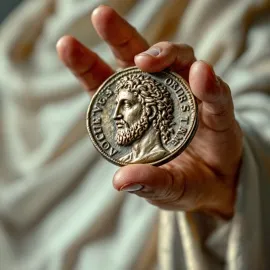
These verses prompt considerable introspection and consternation within the Christian community. Especially in the United States, where we as citizens have freedoms that the rest of the world community of Christians doesn’t enjoy. It causes us to wonder, “How much should we be involved in politics?” Some Christians, like most of the Amish, think that it means we shouldn’t even vote. I believe that is errant thinking. I think that each of us, as believers, will have to answer for the votes we cast and for those we ignored to cast. The Bible is filled with calls to action, both within the Church and in the communities in which we live. We should support policies that reflect biblical values. I even think that every believer should pray and ask God whether they should be involved in political leadership. When I was a young man, being fluent in Spanish in Texas, I was encouraged by many people to “run for governor” or get involved in local politics, as I could appeal to a broader audience. I neither felt inclined nor led to do such a thing. I just wanted to build a business, share the gospel, and serve others. So, political leadership isn’t for every Christian, but I sure believe it is for some.
A country that is respectful of God’s ways is a country with law, order, justice, mercy, and concern for our fellow citizens. Godly citizens should manifest the Fruit of the Spirit in how they speak and how they behave. Being involved doesn’t mean “forcing our religion” on others, as some political adversaries might state. Instead, it is heeding the call of the Prophet Micah, who tells us what the will of God is for mankind: to love justice, to love mercy, and to walk humbly with our God (Micah 6:8). We are to vote in conformance with that. This includes voting for the sanctity of life, supporting godly law enforcement over chaos, sentencing that matches the crime, and prioritizing the rights of the individual over the government’s rights, because each person is made in the image of God.
The Pharisees were once again trying to catch Jesus off guard. They were presenting him with a false dilemma (also known as a false dichotomy). That means an “either/or” kind of argument. The Christian walk regarding government presents no false dichotomy. It is not a zero-sum game. Jesus is telling us to be involved in the things of God and in the things of government. We need to keep them in the proper perspective. Being involved in things of government means different things to different believers in various places. In North Korea, China, or Yemen, it might mean just trying to stay alive as you go through each day, trusting God and doing whatever work He has for you to do. In the United States, it might mean engaging in public debate and dialogue as did Charlie Kirk, who was assassinated last week. Charlie lovingly presented the things of God, giving his opponents an opportunity to speak. We are always to present the truths of God, but to do so in love (Ephesians 4:15). So, I think Jesus is calling for balance in the life of a believer. Be involved in the political system in which you find yourself as much as you are called to do, but always remember that the things that matter most are the things of God. They are eternal. Worldly government is not. They will fall. The Kingdom of God will go on forever. Love Him with all of your heart, soul, and strength. And love your neighbor as yourself. Let your engagement with any government reflect those core truths.
1On one of those days, as he was teaching the people in the temple and preaching the Good News, the priests and scribes came to him with the elders. 2They asked him, “Tell us: by what authority do you do these things? Or who is giving you this authority?”
3He answered them, “I also will ask you one question. Tell me: 4the baptism of John, was it from heaven, or from men?”
5They reasoned with themselves, saying, “If we say, ‘From heaven,’ he will say, ‘Why didn’t you believe him?’ 6But if we say, ‘From men,’ all the people will stone us, for they are persuaded that John was a prophet.” 7They answered that they didn’t know where it was from.
8Jesus said to them, “Neither will I tell you by what authority I do these things.”
9He began to tell the people this parable: “A man planted a vineyard and rented it out to some farmers, and went into another country for a long time. 10At the proper season, he sent a servant to the farmers to collect his share of the fruit of the vineyard. But the farmers beat him and sent him away empty. 11He sent yet another servant, and they also beat him and treated him shamefully, and sent him away empty. 12He sent yet a third, and they also wounded him and threw him out. 13The lord of the vineyard said, ‘What shall I do? I will send my beloved son. It may be that seeing him, they will respect him.’
14“But when the farmers saw him, they reasoned among themselves, saying, ‘This is the heir. Come, let’s kill him, that the inheritance may be ours.’ 15Then they threw him out of the vineyard and killed him. What therefore will the lord of the vineyard do to them? 16He will come and destroy these farmers, and will give the vineyard to others.”
When they heard that, they said, “May that never be!”
17But he looked at them and said, “Then what is this that is written,
‘The stone which the builders rejected
was made the chief cornerstone’?
18Everyone who falls on that stone will be broken to pieces,
but it will crush whomever it falls on to dust.”
19The chief priests and the scribes sought to lay hands on him that very hour, but they feared the people—for they knew he had spoken this parable against them. 20They watched him and sent out spies, who pretended to be righteous, that they might trap him in something he said, so as to deliver him up to the power and authority of the governor. 21They asked him, “Teacher, we know that you say and teach what is right, and aren’t partial to anyone, but truly teach the way of God. 22Is it lawful for us to pay taxes to Caesar, or not?”
23But he perceived their craftiness, and said to them, “Why do you test me? 24Show me a denarius. Whose image and inscription are on it?”
They answered, “Caesar’s.”
25He said to them, “Then give to Caesar the things that are Caesar’s, and to God the things that are God’s.”
26They weren’t able to trap him in his words before the people. They marveled at his answer and were silent. 27Some of the Sadducees came to him, those who deny that there is a resurrection. 28They asked him, “Teacher, Moses wrote to us that if a man’s brother dies having a wife, and he is childless, his brother should take the wife and raise up children for his brother. 29There were therefore seven brothers. The first took a wife, and died childless. 30The second took her as wife, and he died childless. 31The third took her, and likewise the seven all left no children, and died. 32Afterward the woman also died. 33Therefore in the resurrection whose wife of them will she be? For the seven had her as a wife.”
34Jesus said to them, “The children of this age marry and are given in marriage. 35But those who are considered worthy to attain to that age and the resurrection from the dead neither marry nor are given in marriage. 36For they can’t die any more, for they are like the angels and are children of God, being children of the resurrection. 37But that the dead are raised, even Moses showed at the bush, when he called the Lord ‘The God of Abraham, the God of Isaac, and the God of Jacob.’ 38Now he is not the God of the dead, but of the living, for all are alive to him.”
39Some of the scribes answered, “Teacher, you speak well.” 40They didn’t dare to ask him any more questions.
41He said to them, “Why do they say that the Christ is David’s son? 42David himself says in the book of Psalms,
‘The Lord said to my Lord,
“Sit at my right hand,
43until I make your enemies the footstool of your feet.”’
44“David therefore calls him Lord, so how is he his son?”
45In the hearing of all the people, he said to his disciples, 46“Beware of those scribes who like to walk in long robes, and love greetings in the marketplaces, the best seats in the synagogues, and the best places at feasts; 47who devour widows’ houses, and for a pretense make long prayers. These will receive greater condemnation.”