Luke 13 (WEB)
Producing Good Fruit
Fruitful Tree in the Vineyard
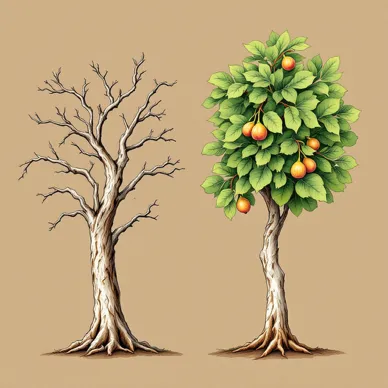
Evangelical Christians tend to be reluctant to discuss good works. We understand that works can easily creep into the reality of God’s salvation by grace alone. Too much focus on good works can often lead believers to think that they have somehow contributed to their own salvation. You were saved by grace, and you continue to be saved by grace. HOWEVER, a believer must not exclude the reality that faith without action (works) is dead on arrival. James, the brother of Jesus, explains this extensively in the Book of James. Paul himself explains in Ephesians chapter two that we are indeed saved by grace, but we were saved FOR works (Ephesians 2:10). Reader, you can’t exclude your duty to do good works from God’s total and complete provision of being saved by grace. Through faith you will be saved, but you will not progress past being born again.
I have a close friend who had several children who were born with birth defects. He and his wife had some dysfunction in their genes that caused several of their children to be born without fully developed skeletal systems. It was absolutely heartbreaking when these children were born. He is a physician, and he told me that when these precious little babies were born, he held them for 15-30 minutes until they died. The couple named them, loved them for a few brief moments, and then buried them. They were precious little boys and girls who made it to birth but didn’t progress beyond that. That’s sort of a strange picture of what it would be like to be born again and never produce any fruit in your life.
The parable gives a good solution to the fruit production problem. “Dig around its roots and fertilize it.” That’s precisely what you and I need to do. We need to ask God to break up the hard soil around our hearts and allow Him to pour on the fertilizer. Fertilizer, sunshine, and water are often the solution to a plant that won’t produce. The same is true in our lives. Let God break up bad habits and sin patterns in your life. Take a deep daily dive into God’s word (like reading these devotionals). Let the Living Water, Jesus, pour Himself over the roots of your heart and be fruitful. Ask the Holy Spirit for direction on what He would have you to do today, and DO IT!
1Now there were some present at the same time who told him about the Galileans whose blood Pilate had mixed with their sacrifices. 2Jesus answered them, “Do you think that these Galileans were worse sinners than all the other Galileans, because they suffered such things? 3I tell you, no, but unless you repent, you will all perish in the same way. 4Or those eighteen on whom the tower in Siloam fell and killed them—do you think that they were worse offenders than all the men who dwell in Jerusalem? 5I tell you, no, but, unless you repent, you will all perish in the same way.”
6He spoke this parable. “A certain man had a fig tree planted in his vineyard, and he came seeking fruit on it and found none. 7He said to the vine dresser, ‘Behold, these three years I have come looking for fruit on this fig tree, and found none. Cut it down! Why does it waste the soil?’ 8He answered, ‘Lord, leave it alone this year also, until I dig around it and fertilize it. 9If it bears fruit, fine; but if not, after that, you can cut it down.’”
10He was teaching in one of the synagogues on the Sabbath day. 11Behold, there was a woman who had a spirit of infirmity eighteen years. She was bent over and could in no way straighten herself up. 12When Jesus saw her, he called her and said to her, “Woman, you are freed from your infirmity.” 13He laid his hands on her, and immediately she stood up straight and glorified God.
14The ruler of the synagogue, being indignant because Jesus had healed on the Sabbath, said to the multitude, “There are six days in which men ought to work. Therefore come on those days and be healed, and not on the Sabbath day!”
15Therefore the Lord answered him, “You hypocrites! Doesn’t each one of you free his ox or his donkey from the stall on the Sabbath and lead him away to water? 16Ought not this woman, being a daughter of Abraham whom Satan had bound eighteen long years, be freed from this bondage on the Sabbath day?”
17As he said these things, all his adversaries were disappointed; and all the multitude rejoiced for all the glorious things that were done by him.
18He said, “What is God’s Kingdom like? To what shall I compare it? 19It is like a grain of mustard seed which a man took and put in his own garden. It grew and became a large tree, and the birds of the sky live in its branches.”
20Again he said, “To what shall I compare God’s Kingdom? 21It is like yeast, which a woman took and hid in three measures of flour, until it was all leavened.”
22He went on his way through cities and villages, teaching, and traveling on to Jerusalem. 23One said to him, “Lord, are they few who are saved?”
He said to them, 24“Strive to enter in by the narrow door, for many, I tell you, will seek to enter in and will not be able. 25When once the master of the house has risen up and has shut the door, and you begin to stand outside and to knock at the door, saying, ‘Lord, Lord, open to us!’ then he will answer and tell you, ‘I don’t know you or where you come from.’ 26Then you will begin to say, ‘We ate and drank in your presence, and you taught in our streets.’ 27He will say, ‘I tell you, I don’t know where you come from. Depart from me, all you workers of iniquity.’ 28There will be weeping and gnashing of teeth when you see Abraham, Isaac, Jacob, and all the prophets in God’s Kingdom, and yourselves being thrown outside. 29They will come from the east, west, north, and south, and will sit down in God’s Kingdom. 30Behold, there are some who are last who will be first, and there are some who are first who will be last.”
31On that same day, some Pharisees came, saying to him, “Get out of here and go away, for Herod wants to kill you.”
32He said to them, “Go and tell that fox, ‘Behold, I cast out demons and perform cures today and tomorrow, and the third day I complete my mission. 33Nevertheless I must go on my way today and tomorrow and the next day, for it can’t be that a prophet would perish outside of Jerusalem.’
34“Jerusalem, Jerusalem, you who kills the prophets and stones those who are sent to her! How often I wanted to gather your children together, like a hen gathers her own brood under her wings, and you refused! 35Behold, your house is left to you desolate. I tell you, you will not see me until you say, ‘Blessed is he who comes in the name of the Lord!’”