Esther 4 (WEB)
For Such a Time as This
Esther Before the King's Throne
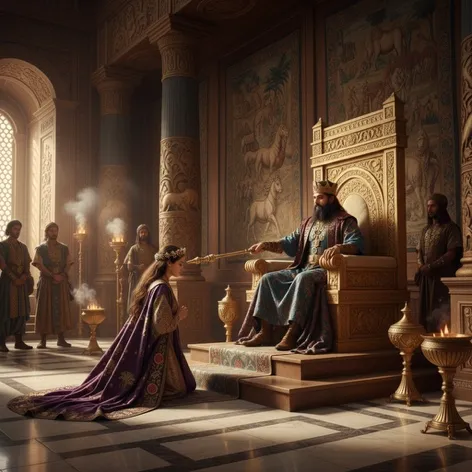
Purim is one of the most celebrated holidays among the Jewish people. In Israel today, tens of thousands of children act out the parts in the story. There are plays in the schools, synagogues, and even in the streets of Jerusalem. Anyone who visits Israel at that time of year can see kids running around dressed up like the heroes in the story. What transpired is an anomaly in Jewish history, because it celebrates a time in ancient Babylon when good triumphed over evil, when Jews were out of options for survival, but God showed up and arranged not only salvation for the Jews, but payback for the wrongdoers far more effective than any human could orchestrate. God in His sovereignty brought salvation to the Jewish people on that day. The good guy won. The evil guy was vanquished. And Hadassah (renamed Esther by the Persians) was the true spiritual heroine of the day, not because of her power of persuasion, but because she chose to be a willing participant in God’s plan without regard for the cost or her own personal safety. By being a willing participant in God’s plan, she became the deliverer of God’s people. She was willingly used as God’s vessel. The story line is not complicated.
Many Jews remained in Babylon after the captivity, and in time the Jewish population became enmeshed in the Babylonian hierarchy. The King had a tiff with his insolent queen and banished her. He then made a search for a suitable replacement. A beautiful young Jewish woman, Hadassah, was being raised by her uncle Mordecai, and when the King sent word out that the search was on for the queen’s replacement, the wise uncle arranged for his niece to enter the beauty contest. Now, Mordecai had some contact with the king’s court, and had exposed a plot to assassinate the king, but it went unnoticed at the time. As the selection process progressed, Hadassah (known as Esther) surpassed the others and became the king’s consort. Meanwhile, Haman, a wicked man who was a member of the king’s court, was eaten up with jealousy because, as he made his way up through the king’s ranks, an edict was given that all should bow and pay homage to him. Mordecai, being a Jew, refused to bow to anyone other than God, and Haman began to hatch a plan to have Mordecai hanged, and his people destroyed.
One should read the entire Book of Esther to get the whole back story, but as one reads, the pressure builds up. The entire Jewish population is on the eve of extinction in Babylon. They had no political, economic, or military means to hinder their destruction. But God, in His sovereignty, had given Esther access and influence to the king. This wasn’t something she had earned or deserved. It was a gift from God. Esther could have played it safe and I am sure that playing it safe must have crossed her mind. But uncle Mordecai would have nothing of it. He understood the promises and purposes of God. He knew that God was working His purposes out and that what God desired would happen with or without Esther’s cooperation. What God had orchestrated was a situation in which Esther could participate in God’s plan and be part of the blessing, or refuse to do so, and pay eternal consequences. In verse 14 cited above, Mordecai reminded her that God was going to do what He was going to do, but he challenged Esther with the thought, “For if you keep silent at this time, relief and deliverance will rise for the Jews from another place, but you and your father's house will perish. And who knows whether you have not come to the kingdom for such a time as this?”
In verse 16, we see that Esther makes the right decision. She chooses to participate in the blessing. And she decides to do so, come what may. She replies, “Then I will go to the king, though it is against the law, and if I perish, I perish.” The king remembers the deeds of Mordecai, desires to save Esther and her people, and Haman ends up getting hanged on the very gallows he had prepared for Mordecai. God’s purposes prevailed. Reader, this type of decision may come to you in your lifetime because, perhaps you, too, have come to where you are “for such a time as this.” It is God who has put resources into your hands that are at your disposal. Whether we acknowledge it or not, ALL of our time, talents, and treasure have been given to us by His design and by His grace. When opportunities come your way to step into harness with God and to be His earthly instrument in what He is accomplishing, choose to say, “I will do what God calls me to do, even if it costs me my life.”
1Now when Mordecai found out all that was done, Mordecai tore his clothes and put on sackcloth with ashes, and went out into the middle of the city, and wailed loudly and bitterly. 2He came even before the king’s gate, for no one is allowed inside the king’s gate clothed with sackcloth. 3In every province, wherever the king’s commandment and his decree came, there was great mourning among the Jews, and fasting, and weeping, and wailing; and many lay in sackcloth and ashes.
4Esther’s maidens and her eunuchs came and told her this, and the queen was exceedingly grieved. She sent clothing to Mordecai, to replace his sackcloth, but he didn’t receive it. 5Then Esther called for Hathach, one of the king’s eunuchs, whom he had appointed to attend her, and commanded him to go to Mordecai, to find out what this was, and why it was. 6So Hathach went out to Mordecai, to the city square which was before the king’s gate. 7Mordecai told him of all that had happened to him, and the exact sum of the money that Haman had promised to pay to the king’s treasuries for the destruction of the Jews. 8He also gave him the copy of the writing of the decree that was given out in Susa to destroy them, to show it to Esther, and to declare it to her, and to urge her to go in to the king to make supplication to him, and to make request before him for her people.
9Hathach came and told Esther the words of Mordecai. 10Then Esther spoke to Hathach, and gave him a message to Mordecai: 11“All the king’s servants and the people of the king’s provinces know that whoever, whether man or woman, comes to the king into the inner court without being called, there is one law for him, that he be put to death, except those to whom the king might hold out the golden scepter, that he may live. I have not been called to come in to the king these thirty days.”
12They told Esther’s words to Mordecai. 13Then Mordecai asked them to return this answer to Esther: “Don’t think to yourself that you will escape in the king’s house any more than all the Jews. 14For if you remain silent now, then relief and deliverance will come to the Jews from another place, but you and your father’s house will perish. Who knows if you haven’t come to the kingdom for such a time as this?”
15Then Esther asked them to answer Mordecai, 16“Go, gather together all the Jews who are present in Susa, and fast for me, and neither eat nor drink three days, night or day. I and my maidens will also fast the same way. Then I will go in to the king, which is against the law; and if I perish, I perish.” 17So Mordecai went his way, and did according to all that Esther had commanded him.