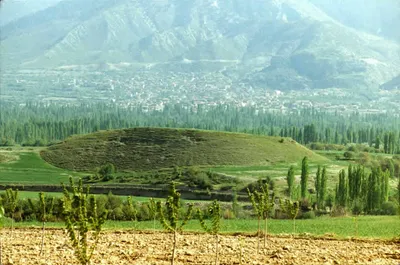
Colosse was just under 12 miles from Laodicea, in the Lycus Valley, just south of the Lycus River. Throughout its history, Colosse was known for its “colossinus” wool fabric, which was a distinctive red. The material trade apparently attracted Jews to the city as well.
The church in Colosse was founded by Epaphras, who was from the city, and Timothy (Col 1:7,8), but may have been visited by Paul at some point. It was also the home of Philemon, the recipient of a letter from Paul, and his runaway slave Onesimus. Christianity thrived in the successive centuries. A church dedicated to St. Michael was built near the city as early as 450, and a bishop from the city attended the Council of Chalcedon in A.D. 451.
Because of Saracen and Sassanian raids in the 700’s, the city was abandoned when its residents moved to nearby Chonai, which was easier to defend.
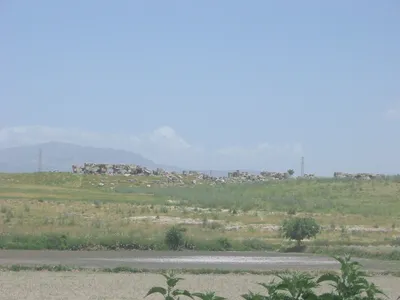
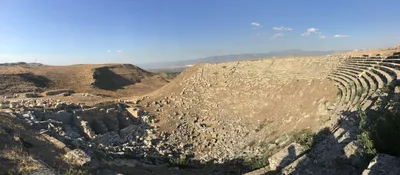
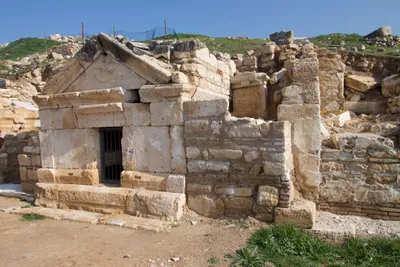
As of 2010, Colosse had not been excavated, but surveys of the area have identified the remains of a defensive wall, a necropolis and a theater.
Bibliography.ASB 1935, “Archaeological Sites: Colosse”; Baez-Camargo, Gonzalo, Archaeological Commentary on the Bible (New York: Doubleday & Co., 1984), 256; Unger, Merrill F., Archaeology and the New Testament (Grand Rapids: Zondervan, 1962), 264-66. Yamauchi, Edwin, The Archaeology of New Testament Cities, (Grand Rapids: Baker, 1980) 155-161.
Cities of the Lycus Valley
Site Study
| Hershel Wayne House | Lycus Valley
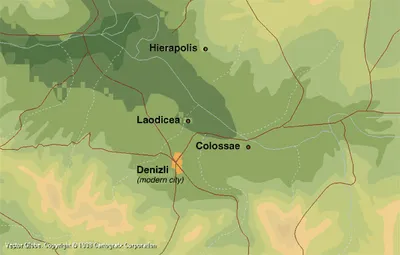
Hierapolis, Laodicea, and Colossae are biblical cities spoken of by the apostle Paul.
Hierapolis (modern Pamukkale) did not have an apostle's letter written to it, but in the second century, it became an important city. The apostle Philip was martyred there, and a disciple of the apostle John, Papias, lived there.
One of the apostle Paul's letters was addressed to the church at Colosse due to the influence of some incipient gnostic beliefs, and the man Philemon appears to have been a member of that church. The apostle John addressed one of his letters in the Revelation to the church at Laodicea, speaking of their lukewarm condition.
Hierapolis (Pamukkale) and Caesarea Philippi (Panias, Banias) in Israel both have what was considered an entrance to Hades, though the entrance in Turkey boasted the fumes of Hades. Hierapolis was where the apostle (not evangelist) Philip was martyred and where Papias was bishop in the second century. The poison emitting from the site in Hierapolis would kill someone going into it and the priests would demonstrate this by putting in animal sacrifices, yet they did enter very briefly, and held their breath, I would presume. Colosse (it is finally being excavated) is near Laodicea and Hierapolis, though the latter is on the other side of Lycus Valley and Laodicea on the same side and much nearer to Colosse. The back area of Colosse has cold running waters in the streams, which also overflow on the ground near the city of Colosse. The rusted pipes of Laodicea demonstrate the hot pipes of the city and illustrate the statement that John uses, that Laodicea has neither the refreshing cold waters of Colosse nor the warm healing waters of the hot springs at Hierapolis.
Map showing the Biblical Sites of Hierapolis, Laodicea, and Colossae
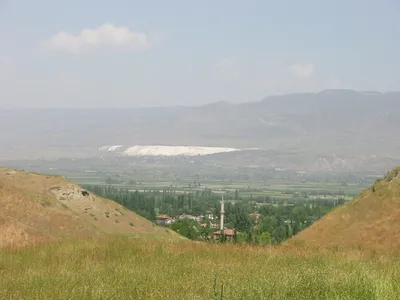
View of Hierapolis across Lycus Valley from Laodicea
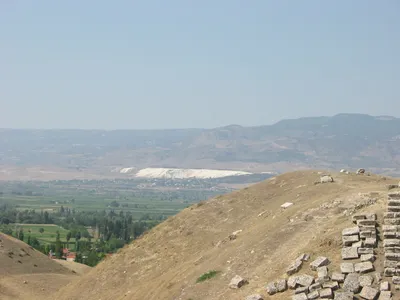
Hierapolis (Pammukale) Viewed across Lycus Valley from Laodicea
1Paul, an apostle of Christ Jesus through the will of God, and Timothy our brother, 2to the saints and faithful brothers in Christ at Colossae: Grace to you and peace from God our Father and the Lord Jesus Christ.
3We give thanks to God the Father of our Lord Jesus Christ, praying always for you, 4having heard of your faith in Christ Jesus and of the love which you have toward all the saints, 5because of the hope which is laid up for you in the heavens, of which you heard before in the word of the truth of the Good News 6which has come to you, even as it is in all the world and is bearing fruit and growing, as it does in you also, since the day you heard and knew the grace of God in truth, 7even as you learned from Epaphras our beloved fellow servant, who is a faithful servant of Christ on your behalf, 8who also declared to us your love in the Spirit.
9For this cause, we also, since the day we heard this, don’t cease praying and making requests for you, that you may be filled with the knowledge of his will in all spiritual wisdom and understanding, 10that you may walk worthily of the Lord, to please him in all respects, bearing fruit in every good work and increasing in the knowledge of God, 11strengthened with all power, according to the might of his glory, for all endurance and perseverance with joy, 12giving thanks to the Father, who made us fit to be partakers of the inheritance of the saints in light, 13who delivered us out of the power of darkness, and translated us into the Kingdom of the Son of his love, 14in whom we have our redemption, the forgiveness of our sins.
15He is the image of the invisible God, the firstborn of all creation. 16For by him all things were created in the heavens and on the earth, visible things and invisible things, whether thrones or dominions or principalities or powers. All things have been created through him and for him. 17He is before all things, and in him all things are held together. 18He is the head of the body, the assembly, who is the beginning, the firstborn from the dead, that in all things he might have the preeminence. 19For all the fullness was pleased to dwell in him, 20and through him to reconcile all things to himself by him, whether things on the earth or things in the heavens, having made peace through the blood of his cross.
21You, being in past times alienated and enemies in your mind in your evil deeds, 22yet now he has reconciled in the body of his flesh through death, to present you holy and without defect and blameless before him, 23if it is so that you continue in the faith, grounded and steadfast, and not moved away from the hope of the Good News which you heard, which was proclaimed in all creation under heaven, of which I, Paul, was made a servant.
24Now I rejoice in my sufferings for your sake, and fill up on my part that which is lacking of the afflictions of Christ in my flesh for his body’s sake, which is the assembly, 25of which I was made a servant according to the stewardship of God which was given me toward you to fulfill the word of God, 26the mystery which has been hidden for ages and generations. But now it has been revealed to his saints, 27to whom God was pleased to make known what are the riches of the glory of this mystery among the Gentiles, which is Christ in you, the hope of glory. 28We proclaim him, admonishing every man and teaching every man in all wisdom, that we may present every man perfect in Christ Jesus; 29for which I also labor, striving according to his working, which works in me mightily.